





Theme 1: Transforming the culture
2023/24 was another challenging year for the Northern Health and Social Care Trust with significant pressures on all services. The Trust again needed incredible resilience and resourcefulness from staff – and throughout continued to provide compassionate and person-centred care. The challenges of the past number of years have shown that through the tremendous collective team spirit of all staff, they continue to show they are the Trust’s greatest asset!
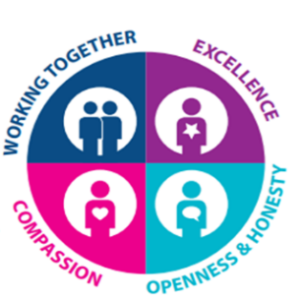
A key component to achieving the Trust’s vision of providing compassionate care with our community, in our community is a commitment to the HSC shared values. These values, practices and behaviours are at the heart of Trust culture and how the Trust does things is as important as what it does. The Trust’s values and behaviours are the golden thread embedded within people management, development, policies and practices.
The Trust #teamNORTH Corporate Objectives are:
- Build Northern partnerships and integrated care
- Continue to improve outcomes and experience
- Deliver value by optimising resources
- Nurture our people, enable our talent and build our teams
- Improve population health and address health and social care inequalities
The Trust’s vision, values and corporate objectives are three core pillars of the Team North culture. The Trust defines culture as simply ‘the way we do things around here’ and it needs constant cultivation and leadership across all levels of the organisation.
Therefore, the Trust is committed to:
- Building an open, just and learning culture
- Nurturing an environment where staff health and wellbeing is protected, and diversity is embraced
- Recognising and valuing staff for their contributions, and enabling them to experience Team North as ‘more than a workplace’
- Enhancing leadership capability at all levels, developing stronger teams and the next generation of Team North leaders
- Developing the skills and confidence to ensure the workforce is digitally literate
- Ensuring that staff understand the Trust’s vision, and feel informed, engaged and listened to, and work in safe and flexible teams that meet the needs of the population
- Putting plans in place to attract the best talent to join Team North
Open, Just and Learning Culture
During 2023/24, the continued to embed Team North’s Open, Just and Learning Culture (OJLC).
- September 2023: Leadership Conference & Chair’s Awards
- October 2023: NURTURE Programme focus group
- November 2023: Resource Hub build, Senior Leaders forum, OJLC workshop
- December 2023: NURTURE Programme communications and engagement
- January 2024: NURTURE Programme pilot, launch of Resource Hub
 OJLC underpinned the 2023 Leadership Conference, where over 200 delegates, both clinical and non-clinical, attended. The keynote speakers focussed on the hallmarks of psychologically safe teams, and what we can expect to see, hear and feel in teams where there is an OJLC.
OJLC was also the theme of Senior Leaders’ Forum (SLF) and a Shared Team North Leadership Pathways Event (December 2023).
The 60 leaders across all levels of the organisation, who participated in one of the Trust’s three Team North Leadership Pathways programmes, also attended a joint workshop where they were introduced to the concepts of an OJLC, and challenged to think about how this can be brought to life within their own teams and leadership styles.
In January 2024, the Trust launched ‘Team North Welcome’ as a new approach to Corporate Induction. All new staff now attend the ‘NURTURE’ programme, which introduces them to the concept of an OJLC, and sets out the reciprocal expectations for all of Team North through seven sessions:
- Welcome to Team North
- Understanding Our Values
- ‘Respect’ EDI Training
- Teams in Team North
- Understanding Human Factors and QI
- Raising Concerns in the Workplace
- Experiences Matter
The OD team has also worked alongside colleagues in Governance to include an OJLC element to the proforma used at Leadership Safety Huddles, and a resource hub has also been developed with information and guidance on Team North’s OJLC.
Personal and public involvement (including patient and service user experience)
Involving service users, carers and communities
The Northern Health and Social Care Trust believes that service users and carers have unique expertise, which should be used to influence and redesign services. Understanding what matters most to service users, carers and local communities helps to provide services that are accessible and responsive to all. Through strong leadership, the Trust continues to embed Personal and Public Involvement (PPI) and Patient and Client Experience (PCE) into its work and do all it can to make sure that our services improve as a result of the feedback received. The Trust’s Involvement Plan sets out its vision, commitment and integrated approach to PCE, PPI and Co-production activities.
Working in partnership with people and communities results in better decisions about service changes. The Trust’s Engagement Advisory Board is an advisory body that supports the Trust to engage in a way that meets the needs and interests of all communities. Members include service users and carers, who have demonstrated links with local communities. The Engagement Advisory Board has supported the Trust to think about how it provides quality services and to prepare for the introduction of Encompass in the Trust in November 2024.
The Trust’s Involvement Network is made up of over 300 service users, carers and representative organisations who work in partnership with the Trust to shape and design services. During the year, members have received 90 involvement opportunities and 423 members have taken part in more than 42 engagement events.
Over the last year, service users and carers have helped to shape and develop a number of service improvements – 154 projects have led to service improvements, an increase of 72% from the previous year. The Trust’s Involvement Annual Report includes many examples of how service users and carers have worked with the Trust to drive change and improvement.
Care Opinion is a two-way feedback mechanism that provides the opportunity for open, honest conversations with service users and is the foundation to build and develop trusting relationships. Across the Trust, Care Opinion has become more widely recognised as supporting evidence for quality improvement initiatives, and ward or department story reports inform Leadership Safety Huddles.
Over the last year, the Trust has received 743 stories, which is an increase of 48% from the previous year. Patient experience has been a key element of the regular reviews of the Trust’s new model for acute maternity services. The feedback has helped to refine processes, and inform planned developments and service improvements.
Health and social care faces many challenges and the Trust must fully engage service users, carers and the public in improving services. The Trust will continue to develop the methods used to engage and make sure they are both flexible and robust, with patient experience at the centre.
Quality Improvement
The Quality Improvement Network is a trust-wide network of colleagues trained in Quality Improvement skills with the aim of using Quality Improvement methods to tackle small, medium-sized and system wide challenges together.
The Network is our way of providing increased scale and reach, enhancing knowledge exchange, supporting innovation and creating meaningful relationships. The Network has a cooperative infrastructure across the organisation to support us to continually improve services for the people we serve.
Skills to improve
- 8,881 staff have completed level 1 Quality Improvement training
- 42 staff trained in Quality Improvement Fundamentals
- 92 staff graduated from Safety Quality North cohorts 5 and 6
- 30 Senior Leaders trained in Leading Quality Improvement
- 105 registered for Quality Coach pilot programme
- 388 staff attended the Quality Improvement Masterclass Series
- Trust Quality Improvement Capability Framework developed to support staff build confidence, knowledge and skills to improve
Quality Management and Improvement projects
- 188 improvement projects aimed at improving services and outcomes supported through QI clinics and QI mentoring
- 5 Trust projects took part in year 2 of the HSCQI Timely Access to Safe Care
- 2 Trust projects took part in HSCQI Delivering Value programme
- 1 Trust project took part in HSCQI Opioid Improvement Collaborative
- 5 high level projects identified for improvement in the Trust’s Safety and Quality Improvement Plan
Culture and Learning
- 186 staff trained in Understanding Human Factors and Quality Improvement as part of the NUTURE programme
- 59 staff trained in Introduction to Human Factors
- 5 poster presentations showcased at the International Forum for Quality and Safety in Healthcare
Innovation
- 12 projects supported via My Journey with 10,430 podcast listens and 3,727 video views
- Northern Trust led the regional Q Exchange project in leveraging capacity for improvement with the HSCNI workforce
Celebration and Recognition
- 329 nominations for staff to recognise excellence as part of the Greatix initiative
- 92 staff achievements and success recognised as part of Safety Quality North graduation celebrations
- Staff took part in World Quality Day to recognise the efforts and contributions from staff and service users
Complaints and compliments
The Trust values all feedback received from patients and service users, including complaints, compliments and suggestions. The Trust is committed to listening to and learning from all of its patients and service users, so that the Trust can continually improve the quality of services, particularly when the care provided may not have been of the standard that would be expected.
Facts/Figures:
- 854 formal complaints received (an increase from 840 in 2022/23)
- 100% of complaints acknowledged within 2 days
- 59% of complaints were responded to within 20 working days
- 5,827 compliments were received through the Chief Executive’s office (compared to
3,404 in 2022/23) - The two main categories of compliments that were received relate to professional
behaviour/attitudes of staff and quality of treatment and care
The top 5 categories of complaints related to:
- Quality of Treatment & Care
- Staff Attitude/Behaviour
- Communication/Information
- Waiting list, Delay/Cancellation for Outpatient appointments
- Clinical Diagnosis
Learning from complaints
The Trust continues to review complaints in an open and transparent way and considers complaints to be an important source of learning. Discussing and sharing the outcome of complaint investigations is one of the ways it improves the experience for people using Trust services and ensures that staff take the learning on board. Learning is shared and discussed in various forums, including Quarterly Complaints Review meetings with Operational Directors, Quadruple E Steering Group, which forms part of the Trust’s Integrated Governance and Assurance Framework, and which feeds into the Risk & Assurance Group, and at monthly Divisional Governance meetings.
To ensure staff are aware of their responsibilities in respect of complaints, the Complaints Team provides training via e-learning and offers face-to-face training when required. Within 2023/24, a total of 654 staff completed Level 1 Complaints & Service User Experience Training. Level 2 Complaint Reviewer Training is offered to specific service groups of 10 or more via Microsoft Teams. Within 2023/24, a total of 199 staff completed Level 2 Reviewer Training.
NI Public Service Ombudsman (NIPSO) cases
In instances where people are not satisfied with the outcome of an investigation into their complaint, there is an opportunity for them to approach the NIPSO Office directly. The Advice, Support Service and Initial Screening Team (ASSIST) is the public’s first point of contact with the office.
Where the ASSIST team conclude that they cannot resolve the complaint, the case is forwarded to the Ombudsman’s Investigations Team. In 2023/24, there were 23 requests for information from the NIPSO Office:
- 7 cases were not accepted for investigation
- 3 cases went to alternative resolution
- 13 are on-going
Incidents
An incident is described as ‘any event or circumstance(s) that could have, or did lead to, harm, loss or damage to people, property, environment or reputation, or a breach of security or confidentiality’.
The aim of the incident reporting system is to encourage an open reporting and learning culture within departments, divisions and Trust-wide, acknowledging that lessons learned need to be shared to improve safety, and apply best practice in managing risks.
The Trust uses DATIXWeb, an electronic risk management system. This web-based system facilitates the reporting of incidents in a timely manner; information regarding incidents is more accessible via dashboard reporting; and incident details are held in one single place. This supports timelier reporting, more efficient analysis and learning for the organisation, and facilitates the ownership and management of risk. Data and information on incidents also contributes to the identification and establishment of quality improvement projects within the Trust.
In terms of the wider Risk Management agenda, a number of other modules are available within the DATIXWeb system in the Trust; these are Risk Registers, Safety Alerts, Complaints, Serious Adverse Incidents (within the Incident module), Coroner’s and Claims. This holistic risk management system for the Trust supports more timely learning and identification of themes and supports decision-making.
A total of 26,295 incidents were reported in 2023/24, which is an increase of nearly 12% from the previous year. This increase is reflective of the ongoing training and awareness that has taken place around incident reporting and the continued use of Trigger Lists for incident reporting. Trigger Lists outline the types of incidents the Trust would expect to be reported should they occur.
Total number of incidents and top 5 reported incident types
Financial Year 2023/24:
- Total incidents – 26,295
- Slip/trip/fall – 7,031
- Violence/aggression – 4,573
- Medication – 1,859
- Absconded – 864
- Self-Harm – 719
Serious adverse incidents
A Serious Adverse Incident (SAI) is ‘an event which may have caused unexpected serious harm or death’. During the period 2023/24, a total of 86 SAIs were identified and notified to the Strategic Planning and Performance Group (SPPG). In the previous financial year, 113 SAIs were notified, representing a 24% decrease in SAIs notified.
The table below outlines the number of SAIs involving death for the period 2023/24 at the time of reporting:
| Division | Total SAIs notified to the SPPG involving death |
| Mental Health and Learning Disability Services (MHLDCW) | 32 |
| Children and Young People (CYP) | 3 |
| Medicine and Emergency Medicine (MEM) | 2 |
| Paediatrics, Women’s and Corporate Support Services | 1 |
| Total | 38 |
One of the criteria for determining if an incident is a SAI, is ‘Suspected suicide of a service user who has a mental illness or disorder and is known to/referred to mental health or learning disability services in the 12 months prior to the incident’. Sadly, the significant number of suicide related deaths means the number of SAI notifications from Mental Health and Learning Disability, involving a death, are higher than other Divisions.
Learning from Serious Adverse Incidents
Each SAI report is presented at a Safety Panel, chaired by an Executive Director, which considers the quality and robustness of the review and examines the recommendations to ensure the learning from the SAI is reflected in the outcomes and disseminated internally to staff and/or shared regionally. The Learning for Improvement Group (which is a sub-group, reporting to the Safety and Care Quality Steering Group, within the Trust’s overarching Assurance Framework) provides oversight of those recommendations and ensures that learning has been shared appropriately and trends identified.
Learning can be indicated for sharing regionally, which can be achieved through the issuing of an immediate alert, a learning letter, a reminder of best practice letter or through the regional newsletter ‘Learning Matters’ which can be accessed via Learning Matters Newsletters | HSC Public Health Agency (hscni.net)
Leadership safety huddles
There are numerous informal and formal opportunities for senior leaders to engage with frontline staff and services to demonstrate that their contribution to safe service delivery is valued, and to strengthen collaboration between leaders and frontline staff. Leadership Safety Huddles is one of the formal opportunities for senior leaders to talk to and listen to frontline staff about issues and concerns relating to service user safety, and encourage participation in quality and safety improvement at all levels of the Trust.
During 2023/24, a total of 40 Leadership Safety Huddles were held, which is an increase from the 35 held during the previous year.


