




Compliments and complaints annual report 2024/2025
1 April 2024 – 31 March 2025
About the Northern Health and Social Care Trust
Due to the implementation of encompass in November 2024, and ongoing validation of data, it has not been possible to acknowledge the full extent of activity for the 2024/25 year, therefore most of the data below is up to 7 November 2024 only.
- 48,083* inpatients, inclusive of elective inpatients
- 315,137* acute outpatients across all specialties
- 153,958** attendances at Emergency Department and Minor Injury Units
- 23,099* day case patients across all specialties
- 2,006* births
- 879 children looked after by Trust
- 555 children on child protection register
- 4,860 domiciliary care packages for older people provided in the community
*Data reflects activity for the period 1 April 2024 – 7 November 2024
**Attendances at Emergency Departments and Minor Injury Units is based on data from 1 April 2024 – 31 March 2025, however the data from November 2024 to March 2025 continues to be validated, due to the implementation of the new encompass system
Facts and Figures
1 April 2024 to 31 March 2025
Data in brackets denotes previous financial year activity.
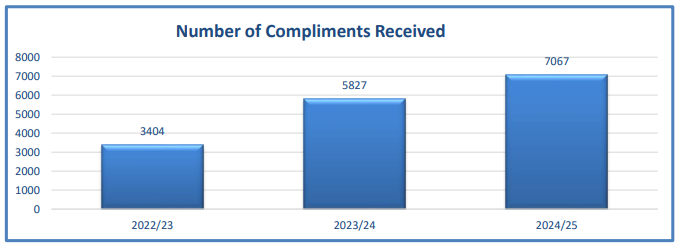
- 7067 Compliments (5827)*
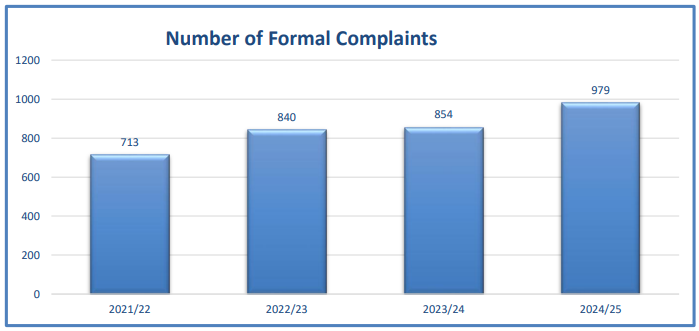
- 979 Complaints (854)*
- 120 Reopened
- 54% Compliance (59%)*
- 20 Complaints escalated to SAI (3)*
- 100% Of complaints acknowledged within 2 working days
- 12 Independent Sector Provider Complaints (ISP-These are processed as formal complaints)
- 3 Children Order Cases
- 41 Ombudsman Cases ongoing
Number of Complaints by Financial Year
What people complained about
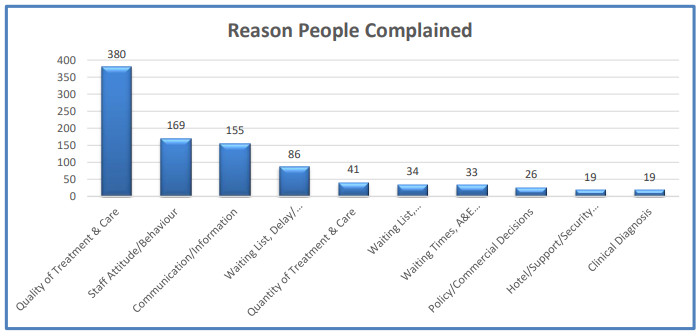
The chart below shows the number of complaints by subject in 2024/2025. The top 3 reasons why people complained were Quality of Treatment & Care, Staff Attitude/Behaviour and Communication/Information.
67% of complaints were recevied by email, 32% in writing 1% via telephone.
Complaints received by division
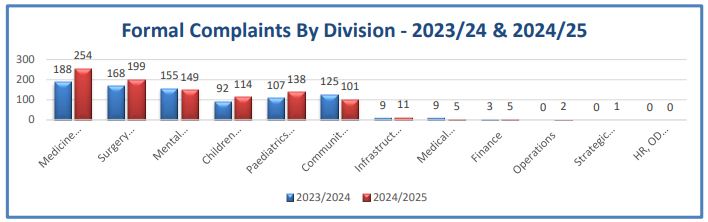
The services provided by the NHSCT are organised into 12 Divisions. The graph below shows the distribution of complaints across these Divisions over the past year 2 years.
Response Times
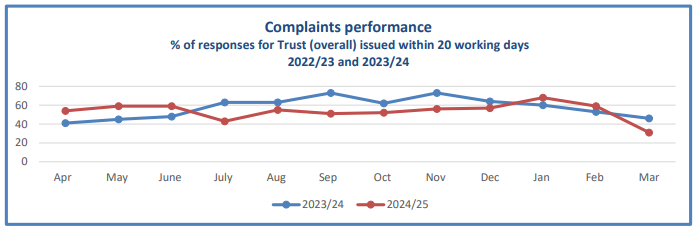
The HSC Complaints Procedure outlines that complaints should be acknowledged within 2 working days and that complaints should be responded to within 20 working days, if at all possible.
Various factors can impact on the time taken to review a complaint, such as information may be awaited from other agencies or due to the complexity of the complaint review.
During 2024/2025, 54% of complaints were responded to within 20 working days which is a decrease of 5% from the previous year. 100% of complaints were acknowledged within 2 working days.
Average length of time complaints open
Of the 979 complaints received the average length of time the complaints were open was 29 days
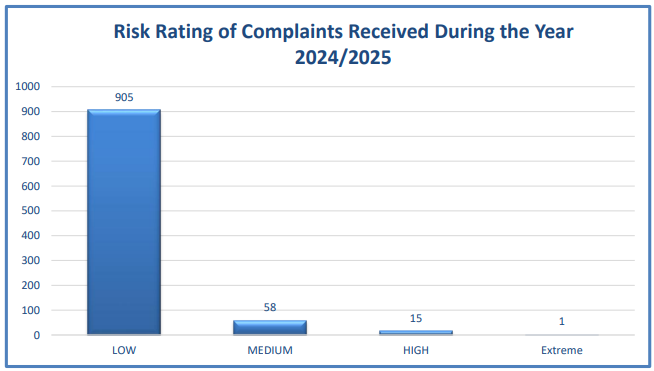
Risk rating of complaints received
Independent sector providers
There were 12 formal complaints raised with the Trust during the year that related to Independent Sector providers/establishments.
Children Order complaints
Complaints by, or on behalf of children about services provided to them under Part IV of the Children (NI) Order 1995, are dealt with under a separate procedure – the Children Order Representations & Complaints Procedure.
During the year, there were 3 complaints dealt with under this procedure. The timescale for responding to Children Order complaints is 28 days.
Learning from complaints – Lessons learnt/Improvement from complaints
The Trust welcomes complaints so that we can learn lessons and improve our services. An action plan may be completed, where appropriate, allowing us to use this information to feedback to patients and staff on the changes and improvements made. Complaints are discussed with the staff concerned and often the issues are brought to staff meetings for discussion as to how services can be improved.
You told us: The Service User has spent extended periods of time in admission to Holywell Hospital and his mother is concerned about the level of care provided. When in the Intensive Care Unit, he improves but after being transferred to the Tobernaveen unit, his condition deteriorates as he has altercations with other patients. She would like him to be in safer conditions with better communication from his family.
We did: The Team have offered reassurances that robust risk assessments are completed for all patients, and enhanced patient observations are provided for those who require a higher level of therapeutic care. Staff complete general observations on all patients to try to ascertain if a patient’s presentation has changed so that staff can de-escalate any potential situations, such as violence and aggression. Training in relation to de-escalation techniques is routinely monitored by Senior Management and they ensure that all staff complete this mandatory training. This training addresses how staff should therapeutically respond to such situations relating to violence and aggression, alongside the physical interventions that are taught
You told us: The complainant attended her twenty-six-week antenatal appointment and is disappointed with the attitude of the Midwife who made her feel a burden. The Midwife could not find her on the Encompass system.
We did: The Midwife has reflected on her attitude and lack of empathy and offered apologies for the anxiety and distress she caused as it was not her intention. A different Midwife has been allocated to the complainant and the complainant is happy with this.
You told us: The Service User was transferred to the Mid Ulster Hospital after a fall. During his attendance he was diagnosed with probable Alzheimer’s. This is the reason he was placed in a Dementia unit and his family are unhappy with this placement. They feel he is coherent and sound of mind. They would like him moved.
We did: During his admission the Consultant Geriatrician referred the Service User to the Memory Service for assessment and at that time made a diagnosis of ‘probable dementia’, based on his medical and social history, observed behaviors and presentation. The Social Work staff in the Mid Ulster Hospital confirmed that they had a discussion with his family in relation to his level of confusion, however, a diagnosis of Dementia was not discussed
Compliments received
Services across the Trust receive many compliments in the form of Thank You letters, emails, cards and verbal feedback. During 2024/2025 over 7067 compliments were received across service areas this is a 21% increase in compliments. Compliments are always appreciated as they allow Service Users/Patients’ positive experience to be shared with our staff, they also identify areas of good working practice that can be shared with other service areas. Below are some examples of compliments received during 2024/2025.
- A relative of a Service User got in touch after an appointment with the Dementia Physio and OT Services, and would like to pass on their gratitude for the care received.
- The Service User wanted to say thank you to all the staff who looked after her at the Gynae Ward, Causeway Hospital Coleraine. From the day she arrived to departure, she was treated with respect, dignity and a very positive attitude. The staff were all friendly and nothing was too much trouble. She wanted thank the Doctors, Surgeons and Theatre staff. The Service User is now well on the road to recovery.
- Relative’s father attended phlebotomy clinic. He stated that the Nurse was friendly, polite and professional when taking her father’s blood. She stated that the nurse made her father’s experience very positive.
Additional Information
There were 36 formal enquiries and 554 other enquiries received during 2024/2025 with most being received from MLAs, MPs or local Councillors. A number of these were received from Service Users, carers or other third parties.
During the year, 4,644 staff were trained, 4,425 completed – E Learning Complaints Training Level 1 and 219 Complaint Reviewer Training Level 2. Complaints Training was also included in a number of other courses delivered during the year including Corporate Induction and Managers’ Induction.
If complainants are dissatisfied:
Sometimes people are not always happy with the outcome of the investigation into their complaint. The Trust encourages people to let us know if they are unhappy, and we will consider other options to attempt to resolve their concerns. The Trust routinely offers to meet complainants, as this allows the opportunity for more detailed discussions, on a face-to-face basis.
Ombudsman
Sometimes people are not always happy with the outcome of the investigation into their complaint. For those who remain dissatisfied, they may approach the NIPSO Office directly. The Advice, Support Service and Initial Screening Team (ASSIST) is the public’s first point of contact with the office. Where the ASSIST team decide that they cannot resolve the complaint, the case is forwarded to the Ombudsman’s Investigations Team.
In 2024/2025, there were 27 requests for information from the NIPSO Office:
- 4 cases were not accepted for investigation,
- 3 cases went to alternative resolution
- 20 are on-going within this year.
- 21 further cases are ongoing from previous and current years


