
This scheme was drawn up in accordance with Section 75 and Schedule 9 of the Northern Ireland Act 1998. Approved by the Equality Commission for Northern Ireland in July 2011 and revised in August 2023 to take account of changes in organisational structure and demographic profile
This plan can be made available in minority ethnic languages, on request, to meet the needs of those not fluent in English.
How to contact us
Equality Unit
- Northern Health and Social Care Trust, 8E Coleraine Road, Ballymoney, BT53 6BP
Please contact us with your requirements:
- Telephone: 028 2766 1377
- Mobile: 078 2566 7154 (for texting)
- Email: equality.unit@northerntrust.hscni.net
Foreword
Section 75 of the Northern Ireland Act 1998 (the Act) requires public authorities, in carrying out their functions relating to Northern Ireland, to have due regard to the need to promote equality of opportunity and regard to the desirability of promoting good relations across a range of categories outlined in the Act (see 1.1).
In our Equality Scheme we set out how the Northern Health and Social Care Trust (the Trust) proposes to fulfil the Section 75 statutory duties.
In developing the Scheme, the Trust fully adopted the model Scheme devised by the Equality Commission of Northern Ireland – the purpose and intent of which is to set out best practice. The Trust customised the Scheme to outline its functions, the staff that it employs and the profile of the population to whom it provides health and social care.
We will commit the necessary resources in terms of people, time and money and take the necessary steps to make sure that the Section 75 statutory duties are complied with and that the Equality Scheme is implemented effectively, and on time.
We commit to having effective internal arrangements in place for ensuring our effective compliance with the Section 75 statutory duties and for monitoring and reviewing our progress.
We will develop and deliver a programme of communication and training with the aim of ensuring that all our staff and board members are made fully aware of our Equality Scheme and understand the commitments and obligations within it. We will develop a programme of awareness raising for our consultees on the Section 75 statutory duties and our commitments in our Equality Scheme.
We, the Chair and Chief Executive of the Trust are fully committed to effectively fulfilling our Section 75 statutory duties across all our functions (including service provision, employment and procurement) through the effective implementation of our Equality Scheme. Strong leadership is necessary to ensure that the Section 75 duties are integrated into core business activities and put into effect and visible practice.
We realise the important role that the community and voluntary sector and the general public have to play to ensure the Section 75 statutory duties are effectively implemented. Our Equality Scheme demonstrates how determined we are to ensure there are opportunities, for people affected by our work, to positively influence how we carry out our functions in line with our Section 75 statutory duties. It also offers the means whereby persons directly affected by what they consider to be a failure, on our part, to comply with our Equality Scheme, can make complaints.
On behalf of the Trust and our staff we are pleased to support and endorse this Equality Scheme which has been drawn up in accordance with Section 75 and Schedule 9 of the Northern Ireland Act 1998 and Equality Commission guidelines.
The Trust is also mindful of the Human Rights Act, which was enacted in October 2000, and will seek to ensure that this Scheme is compatible with the European Convention on Human Rights.
Signed by:
Jennifer Welsh, Chief Executive
Anne O’Reilly, Chair
Contents
Chapter 1
- Introduction
- Section 75 of the Northern Ireland Act 1998
- How we propose to fulfil the Section 75 duties in relation to the relevant functions of Northern Health and Social Care Trust
- Who we are and what we do
Chapter 2
- Our arrangements for assessing our compliance with the Section 75 Duties
- Responsibilities and reporting
Chapter 3
Chapter 4
- Our arrangements for assessing, monitoring and publishing the impact of policies
- Our arrangements for assessing the likely impact adopted or proposed to be adopted on the promotion of equality of opportunity of policies
- Screening
- Equality impact assessment
- Our arrangements for publishing the results of the assessments of the likely impact of policies we have adopted or propose to adopt on the promotion of equality of opportunity
- What we publish
- How we publish the information
- Where we publish the information
- Our arrangements for monitoring any adverse impact of policies we have adopted on equality of opportunity
- Our arrangements for publishing the results of our monitoring
Chapter 5
- Staff training
- Commitment to staff training
- Training objectives
- Awareness raising and training arrangements
- Monitoring and evaluation
Chapter 6
- Our arrangements for ensuring and assessing public access to information and services we provide
- Access to information
- Access to services
- Assessing public access to information and services
Chapter 7
Chapter 8
Chapter 9
Chapter 10
Appendices
- Organisational chart
- Example groups relevant to the Section 75 categories for Northern Ireland purposes
- List of consultees
- Timetable for measures proposed
- Glossary of terms
Chapter 1: Introduction
Section 75 of the Northern Ireland Act 1998
1.1 Section 75 of the Northern Ireland Act 1998 (the Act) requires the Trust to comply with two statutory duties:
Section 75 (1)
In carrying out our functions relating to Northern Ireland we are required to have due regard to the need to promote equality of opportunity between
- persons of different religious belief, political opinion, racial group, age, marital status or sexual orientation
- men and women generally
- persons with a disability and persons without
- persons with dependants and persons without.
Section 75 (2)
In addition, without prejudice to the obligations above, in carrying out our functions in relation to Northern Ireland we are required to have regard to the desirability of promoting good relations between persons of different religious belief, political opinion or racial group. It is not a case of good relations or equality of opportunity – they are intrinsically linked, interdependent and complimentary to one another. This combination of equality and good relations apply to policy formulation, resource allocations, service provision, employment, procurement and all dealings with service users, families, carers and Trust staff.
The promotion of equality of opportunity entails more than the elimination of discrimination. It requires proactive measures to be taken to facilitate the promotion of equality of opportunity between the categories identified in Section 75 (1). The equality duty should not deter a public authority from taking action to address disadvantage among particular sections of society – in deed such action may be an appropriate response to addressing inequalities. There is no conflict between the S75 statutory duties and other affirmation action measures or positive action measures which a public authority may undertake under anti-discrimination laws.
“Functions” include the “powers and duties” of a public authority (see Section 98 (1) of the Northern Ireland Act 1998.). This includes our employment, service provision and procurement functions. The ECNI Short Guide to Section 75 of the Northern Ireland Act 1998 and Budgets June 2015, states that function also extends to budget processes. S75 does not prevent difficult decisions being taken, nor does it stop decisions which will affect one group more than another. It enables financial decisions which are informed by evidence of the impact they are likely to have, where mitigation and alternative policies have been considered and which are transparent and accountable.
Please see below under “Who we are and what we do” for a detailed explanation of our functions.
How we propose to fulfil the Section 75 duties in relation to the relevant functions of the Trust
1.2. Schedule 9 4. (1) of the Act requires the Trust, as a designated public authority, to set out in an Equality Scheme how it proposes to fulfil the duties imposed by Section 75 in relation to its relevant functions. This Equality Scheme is intended to fulfil that statutory requirement. It is both a statement of our arrangements for fulfilling the Section 75 statutory duties and our plan for their implementation.
1.3. The Northern Health and Social Care Trust is committed to the discharge of its Section 75 obligations in all parts of our organisation and we will commit the necessary available resources in terms of people, time and money to ensure that the Section 75 statutory duties are complied with and that our Equality Scheme can be implemented effectively.
Who we are and what we do
The Northern Health and Social Care Trust (the Trust) was established on 1 April 2007 under the Northern Health and Social Services (Establishment) Order (Northern Ireland) 2006.
The Headquarters of the Trust are located at Bretten Hall, Antrim Area Hospital, 45 Bush Road, Co Antrim, BT41 2PX.
Map of NI showing the Northern Health and Social Care Trust
Section 98 (1) of the Northern Ireland Act 1998.
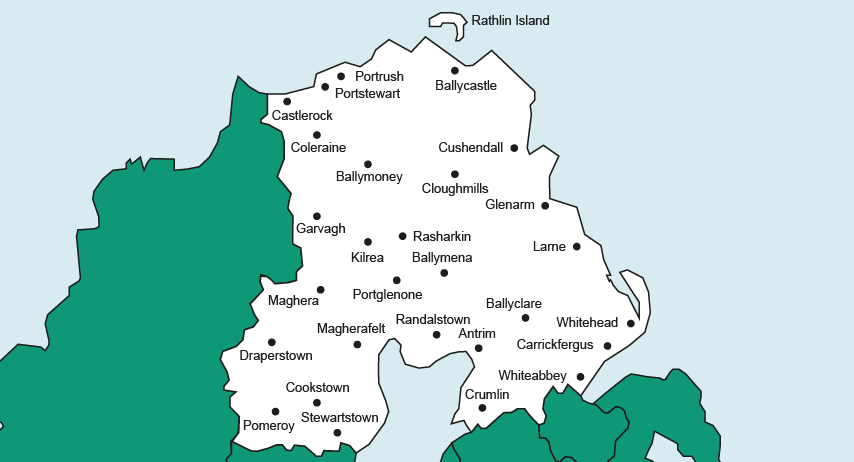
The Health and Personal Social Services (Northern Ireland) Order 1991 Article 10(1) defines the nature and function of the Trust as a major employer and provider of health and social care services.
The Trust covers four local council areas – Antrim and Newtownabbey, Causeway Coast and Glens, Mid and East Antrim and Mid Ulster. The population profile indicates that the Trust has the largest older population and the largest child population, when compared to other health and social care trusts in Northern Ireland.
The Trust provides a range of health and social care services to a population of approximately 479,000 people across a geographical area of 1,733 square miles (2,773 square km) making it the largest geographical trust in Northern Ireland. The Trust employs approximately 12,000 staff across a full range of medical, health and social care disciplines.
The Trust provides a wide range of hospital, community and primary care services. Working in collaboration with GPs and other agencies, staff deliver locally based services in Trust premises, in people’s own homes and in the community. The Trust purchases some services including domiciliary care, residential and nursing care from independent and community /voluntary agencies.
The Trust provides a range of health and social care services, the majority of which are provided in peoples’ own homes. We also provide community based health and social care services including day centres, health centres and residential care, from approximately 150 locations.
We provide acute services from Antrim Area Hospital and Causeway Hospital in Coleraine. Services are also provided from the Braid Valley, Dalriada, Moyle, Mid-Ulster, Whiteabbey and Robinson hospitals.
Holywell Hospital, a psychiatric hospital based in Antrim, is the base for a wide range of mental health and addiction services.
Delivering safe and effective services which are accessible and responsive to the needs of patients, clients and carers is central to the Trust’s role.
The Trust acknowledges its responsibilities when buying services from other providers. The Trust will ensure that the obligations under Section 75 of the Northern Ireland Act 1998 will be reflected in contractual arrangements made with those providers.
The Trust also has the power to exercise statutory functions which embrace all the activities undertaken by the Trust including the recruitment/employment of its staff, financial arrangements, contracted-out services and staff training, maintenance of its property and the delivery and development of services, including the purchase of equipment and facilities needed to do this.
The Trust carries out its business in the following ways:-
- undertake assessments of needs
- developing strategies to address those needs
- setting and monitoring quality and performance standards
- carrying out reviews of service areas
- resource allocation and financial management
- setting service agreements with purchasers of care
- human resource management in relation to its staff, and
- corporate and clinical governance, i.e. ensuring safe practices.
The Trust has an annual budget of £809m. Funding is secured from a range of commissioners, the main commissioner being the Strategic Planning and Performance Group (SPPG), an integral part of the Department of Health.
How we do our business
The Trust Board is the governing body of the organisation. It has six key objectives for which it is accountable to the Department of Health, Social Services and Public Safety.
The Board:
- sets the strategic direction of the Trust;
- monitors performance against objectives;
- ensures effective financial stewardship;
- ensures that high standards of corporate governance and personal behaviour are maintained;
- appoints, appraises and remunerates Senior Executives; and
- ensures that there is effective dialogue on its plans and performance between the Trust and the local community.
The Trust Board also oversees the role and function of its Quality Assurance Framework. The Trust Board holds public meetings, normally on the fourth Thursday of each month. These are held at various locations throughout the Trust area to encourage public attendance. Details of meetings are placed on the Trust website.
The main decision making bodies in the Trust are the Trust Board, Executive Team and Senior Management Team. The Trust has a Chief Executive and a Chair. The Chief Executive is the accountable officer for the Trust. The Chair works very closely with the Chief Executive and is responsible for the operation of the Trust Board.
Chapter 2: Our arrangements for assessing our compliance with the Section 75 duties (Schedule 9 4. (2) (a))
- Some of our arrangements for assessing our compliance with the Section 75 statutory duties are outlined in other relevant parts of this Equality Scheme.
The Trust has also committed to, and completed, an Equality Action Plan. This action plan seeks to promote equality of opportunity and good relations through measures which are based on the context of the Trust’s functions. The action measures will be linked to the development of the Trust’s corporate planning cycle, thus ensuring strategic mainstreaming. The action based plan is complementary to the implementation and fulfilment of the Section 75 equality duties and will further enhance the screening and EQIA processes. The Trust is committed to reviewing its action based plan. The plan was informed by a comprehensive analysis of inequalities and identification of key themes as detailed in the Audit of Inequalities. This audit enabled the Trust to identify functional areas where there was potentially scope for further or better discharge of the Section 75 equality duties and therefore informed key strategic actions.
The Trust monitors success in its Action Based Plan via its Section 75 Annual Progress Report which is submitted to the Equality Commission on the 31 August each year.
In addition we have the following arrangements in place for assessing our compliance:
Responsibilities and reporting
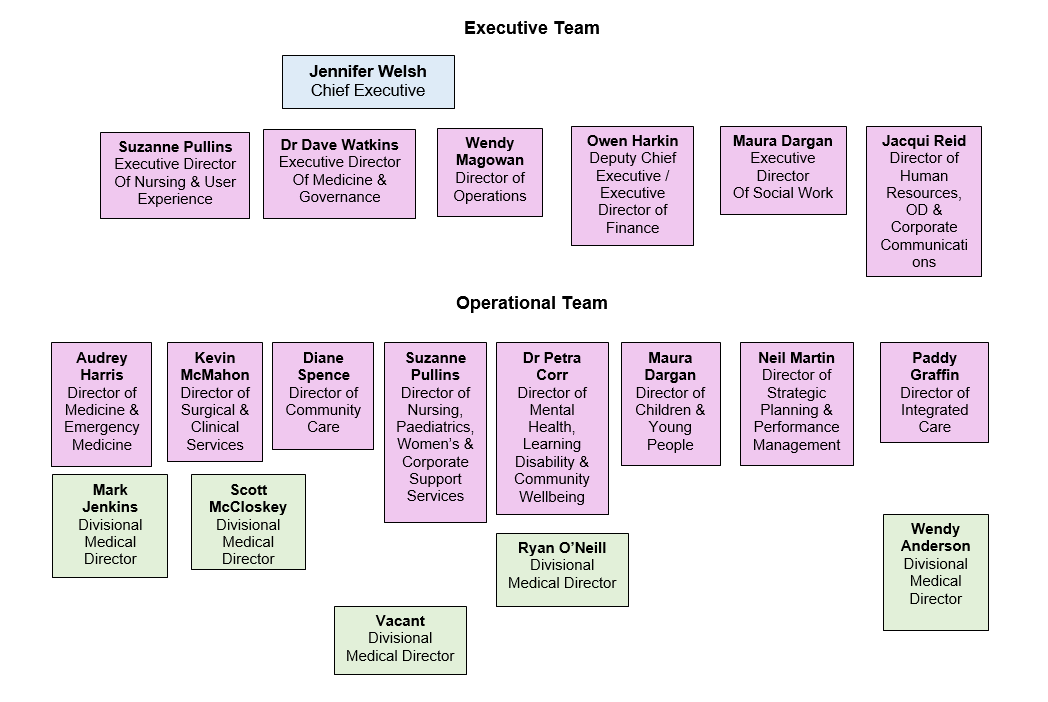
The management arrangements put in place to enable the Trust to carry out its statutory responsibilities and to conduct its business are illustrated in Appendix 1.
Management Structure
(a) Trust Board
The Trust Board forms the statutory body responsible for all the activities of the organisation and is responsible for the overall policies of the Trust.It functions as a corporate decision-making body. The Trust Board comprises a Non-Executive Chair and four Non-Executive Directors appointed by the Department of Health, Social Services and Public Safety (DHSSPS) Appointments Unit, and five Executive Directors who include the Chief Executive.
Executive and Non-Executive Members are full and equal members and their role as managers of the Board of Directors will be to consider the key strategic and managerial issues facing the Trust in carrying out its statutory and other functions.
(b) Chief Executive
The Chief Executive is responsible for the overall performance of the executive functions of the Trust. The Chief Executive is the Accountable Officer of the Trust and shall be responsible for ensuring the discharge of obligations under Financial Directions and in line with the requirements of the Accountable Officer memorandum for Trust Chief Executives.
(c) Non-Executive Members
The Non-Executive Members shall not seek to exercise any individual executive powers on behalf of the Trust. They may however, exercise collective authority when acting as members of or when chairing a committee of the Trust which has delegated powers.
(d) Chair
The Chair of the Board has certain delegated executive powers and is responsible for the operation of the Board and for chairing all Board meetings when present. The Chair works closely with the Chief Executive to ensure that key and appropriate issues are discussed by the Trust Board in a timely manner with all the necessary information and advice being made available to the Board to inform the debate and ultimate resolutions.
The Trust’s vision is ‘to provide compassionate care with our community in our community’. In delivery, planning and reforming services, all staff are guided by the Health and Social Care Values for All – Working Together, Excellence, Openness and Honesty, and Compassion.
The Trust’s principal corporate objectives give a structured, consistent and concentrated focus to its efforts.
- Objective 1 – Build Northern partnerships and integrate care
- Objective 2 – Continue to improve outcomes and experience
- Objective 3 – Deliver value by optimising resources
- Objective 4 – Nurture our people, enable our talent and build our teams
- Objective 5 – Improve population health and address health and social care inequalities
(e) Executive Team
The Executive Team, chaired by the Chief Executive, brings together senior executives including the Executive Directors to the Trust Board. It is responsible for the implementation of Trust’s strategies and policies and for key operational matters. It also plans and develops services for the Trust and formulates service delivery recommendations to the Trust Board within national and local policy guidelines. The Executive Team monitors the quality of service and the Trust’s performance in relation to established business plans and ensures that the Trust’s decision making reflects the needs and opinions of the consumer.
(f) Individual Division
The Trust manages its staff and delivers its services through a Division, each of which is headed up by a Director. These Divisions are as follows:-
- Finance
- Strategic Planning, Performance and ICT
- Human Resources, Organisational Development and Corporate Communications
- Paediatrics, Women’s Services and Corporate Support
- Children and Young People
- Mental Health, Learning Disability and Community Wellbeing
- Community Care
- Medicine and Emergency Medicine
- Surgical and Clinical Services
- Infrastructure
Whilst the Trust believes the services it provides are of a high quality, it is not complacent about the need to keep them continually under review to ensure they remain appropriate to the needs of people. The quality of care is monitored regularly within the Trust and the Trust is also accountable through its contracts with purchasers for ensuring that specific service standards are met. Section 75 of the Northern Ireland Act will become an integral part of the manner in which the Trust carries out its functions.
Accountability Structure
(a) Department of Health and Social Services and Public Safety
The Trust is accountable to the Department and through it to the Northern Ireland Assembly. The Department has a statutory duty to secure the provision of health and personal social services for the population of Northern Ireland and, in so doing, uses statutory powers to delegate functions to Health and Personal Social Services (HPSS) bodies including the Northern Health and Social Care Trust. The Department is responsible for directing the Trust and other HPSS bodies in ensuring national and regional policies are implemented and for the effective stewardship of HPSS resources.
(b) Strategic Planning and Performance Group (SPPG)
The Strategic Planning and Performance Group plans and oversees the delivery of health and social care services for the population of Northern Ireland.
The Group is part of the Department of Health and is accountable to the Minister for Health. It is responsible for planning, improving and overseeing the delivery of effective, high quality, safe health and social care services within available resources.
(c) Trusts
Within health and social care there are 6 integrated health and social care trusts (including the Northern Ireland Ambulance Trust) providing health and social care services to the Northern Ireland public. Services are provided locally and on a regional basis.
External Relationships
In order to ensure local people and the people who use the Trust’s services have a stronger voice to influence the shape and range of services available, the Trust will be building on the links it has already established with the Strategic Planning and Performance Group, Borough and District Councils, the Patient and Client Council, other Government agencies, independent sector providers, voluntary and community groups representing all categories of persons specified in Section 75 of the NI Act 1998, GPs, Trade Union and professional organisations and individuals.
2.2. We are committed to the fulfilment of our Section 75 obligations in all parts of our work.
2.3. Responsibility for the effective implementation of our Equality Scheme lies with the Chair and Chief Executive of the Trust. The Director of Strategic Planning Performance and ICT is accountable to the Trust Board for the development, implementation, maintenance and review of the Equality Scheme in accordance with Section 75 and Schedule 9 of the Northern Ireland Act 1998, including any good practice or guidance that has been or may be issued by the Equality Commission.
2.4. If you have any questions or comments regarding our Equality Scheme, please contact in the first instance, Kelly McBride, at the address given below and we will respond to you as soon as possible:
Kelly McBride, Head of Equality
- Route Complex, 8e Coleraine Road, Ballymoney, Co Antrim, BT53 6BP
- Telephone: 028 2766 1377
- Mobile: 078 2566 7154
- E-mail: equality.unit@northerntrust.hscni.net
2.5. Objectives and targets relating to the statutory duties will be integrated into our strategic and operational business plans (see Appendix 4).
2.6. Employees’ job descriptions and performance plans reflect their contributions to the discharge of the Section 75 statutory duties and implementation of the Equality Scheme, where relevant. The personal performance plans are subject to appraisal in the annual performance review.
2.7. The Trust prepares an annual report on the progress it has made on implementing the arrangements set out in this Equality Scheme to discharge our Section 75 statutory duties (Section 75 annual progress report).
The Section 75 annual progress report will be sent to the Equality Commission by 31 August each year and will follow any guidance on annual reporting issued by the Equality Commission.
Progress on the delivery of Section 75 statutory duties will also be included in our (organisational) annual report.
2.8. The latest Section 75 annual progress report is available on our website, or by contacting:
Kelly McBride, Head of Equality
- Route Complex, 8e Coleraine Road, Ballymoney, Co Antrim, BT53 6BP
- Telephone: 028 2766 1377
- Mobile: 078 2566 7154
- E-mail: equality.unit@northerntrust.hscni.net
2.9. The Trust liaises closely with the Equality Commission to ensure that progress on the implementation of our Equality Scheme is maintained.
2.10. Regular reports will be provided to Senior Management and Trust Board on implementation of Section 75 duties.
2.11. The Trust has developed an action plan to promote equality of opportunity and good relations. This action plan is available on our website at http://www.northerntrust.hscni.net
2.12. The action measures that will make up our action plan will be relevant to our functions. They will be developed and prioritised on the basis of an audit of inequalities. The audit of inequalities will gather and analyse information across the Section 75 categories (see 1.1) to identify the inequalities that exist for our service users and those affected by our policies (see 4.1). The audit of inequalities will be a living document and will be revised and extended on an ongoing basis.
2.13. Action measures will be specific, measurable, linked to achievable outcomes, realistic and time bound. Action measures will include performance indicators and timescales for their achievement.
2.14. We will develop any action plans for a period of between one and five years in order to align them with our corporate and business planning cycles. Implementation of the action measures will be incorporated into our business planning process.
2.15. We will seek input from our stakeholders and consult on our action plan before we send it to the Equality Commission and thereafter when reviewing the plan as per 2.16 below.
2.16. We will monitor our progress on the delivery of our action measures annually and update the action plan as necessary to ensure that it remains effective and relevant to our functions and work.
- Equality Action Plans Audit of Inequalities
- See Appendix 4 ‘Timetable for measures proposed’ and section 2.11 of this Equality Scheme.
- See section 1.1 of this Equality Scheme for a list of these categories.
- See section 4.1 of this Equality Scheme for a definition of policies.
2.17. The Trust will inform the Commission of any changes or amendments to our action plan and will also include this information in our Section 75 annual progress report to the Commission. Our Section 75 annual progress report will incorporate information on progress we have made in implementing our action plans/action measures.
2.18. Once finalised, our action plan will be available on the Trust’s Intranet and Staffnet.
If you require it in an alternative format please contact
Equality Unit
- Route Complex, 8e Coleraine Road, Ballymoney, Co. Antrim, BT53 6BP
- Telephone: 028 2766 1377
- Mobile: 078 2566 7154
- E-mail: equality.unit@northerntrust.hscni.net
Chapter 3: Our arrangements for consulting
3.1. We recognise the importance of consultation in all aspects of the implementation of our statutory equality duties. We will consult on our Equality Scheme, action measures, equality impact assessments and other matters relevant to the Section 75 statutory duties.
3.2. We are committed to carrying out consultation in accordance with the following principles (as contained in the Equality Commission’s guidance ‘Section 75 of the Northern Ireland Act 1998 – A Guide for Public Authorities (April 2010)’):
3.2.1. All consultations will seek the views of those directly affected by the matter/policy, the Equality Commission, representative groups of Section 75 categories, other public authorities, voluntary and community groups, our staff and their trades unions and professional bodies and such other groups who have a legitimate interest in the matter, whether or not they have a direct economic or personal interest.
Initially all consultees (see Appendix 3), as a matter of course, will be notified (by email or post) of the matter/policy being consulted upon to ensure they are aware of all consultations. Thereafter, to ensure the most effective use of our and our consultees’ resources, we will take a targeted approach to consultation for those consultees that may have a particular interest in the matter/policy being consulted upon and to whom the matter/policy is of particular relevance. This may include for example regional or local consultations, sectoral or thematic consultation etc.
3.2.2. Consultation with all stakeholders will begin as early as possible. We will engage with affected individuals and representative groups to identify how best to consult or engage with them. We will ask our consultees what their preferred consultation methods are and will give consideration to these. Methods of consultation could include:
- Face-to-face meetings
- Focus groups
- Written documents with the opportunity to comment in writing
- Questionnaires
- Information/notification by email with an opportunity to opt in/opt out of the consultation
- Internet discussions or
- Telephone consultations.
- Online
This list is not exhaustive and we may develop other additional methods of consultation more appropriate to key stakeholders and the matter being consulted upon.
3.2.3. We will consider the accessibility and format of every method of consultation we use in order to remove barriers to the consultation process. Specific consideration will be given as to how best to communicate with children and young people, people with disabilities (in particular people with learning disabilities and sensory disabilities) ethnic communities, and others e.g. older persons – this may be facilitated through the use of advocates and specifically trained facilitators and by making information accessible and providing improved visual signage. We take account of existing and developing good practice, including the Equality Commission’s guidance Let’s Talk Let’s Listen – Guidance for public authorities on consulting and involving children and young people (2008).
Information will be made available, on request, in alternative formats (see Chapter 6), in a timely manner, usually within a timely fashion usually within 20 working days. If this cannot be facilitated the Trust will inform consultees of the reasons for this and provide a new estimated response time scale.
Alternative formats may include Easy Read, Braille, audio formats (CD, mp3 or DAISY), large print or minority languages to meet the needs of those for whom English is not their first language.
3.2.4. Specific training is provided to those facilitating consultations to ensure that they have the necessary skills to communicate effectively with consultees.
3.2.5. To ensure effective consultation with consultees (see Appendix 3) on Section 75 matters, we will develop a programme of awareness raising on the Section 75 statutory duties and the commitments in our Equality Scheme, in line with our Involvement Plan. The development of an additional resources, will further enhance participation and engagement.
3.2.6. The consultation period lasts for a minimum of twelve weeks to allow adequate time for groups to consult amongst themselves as part of the process of forming a view. However, in exceptional circumstances when this timescale is not feasible (for example implementing EU Directives or UK wide legislation, meeting Health and Safety requirements, addressing urgent public health matters or complying with Court judgements), we may shorten timescales to eight weeks or less before the policy is implemented. We may continue consultation thereafter and will review the policy as part of our monitoring commitments. (Please see below at 4.27 to 4.31 for details on monitoring)
Where, under these exceptional circumstances, we must implement a policy immediately, as it is beyond our authority’s control, we may consult after implementation of the policy, in order to ensure that any impacts of the policy are considered.
3.2.7. If a consultation exercise is to take place over a period when consultees are less able to respond, for example, over the summer or Christmas break, or if the policy under consideration is particularly complex, we will give consideration to the feasibility of allowing a longer period for the consultation.
3.2.8. We are conscious of the fact that affected individuals and representative groups may have different needs. We will take appropriate measures to ensure full participation in any meetings that are held. We will consider for example the time of day, the appropriateness of the venue, in particular whether it can be accessed by those with disabilities, how the meeting is to be conducted, the use of appropriate language, whether a signer and/or interpreter is necessary, and whether the provision of childcare and support for other carers is required.
3.2.9. We make all relevant information available to consultees in appropriate formats to ensure meaningful consultation. This includes detailed information on the policy proposal being consulted upon and any relevant quantitative and qualitative data.
3.2.10. In making any decision with respect to a policy adopted or proposed to be adopted, we take into account any assessment and consultation carried out in relation to the policy.
3.2.11. We provide feedback to consultees in a timely manner. A feedback report is prepared which includes summary information on the policy consulted upon, a summary of consultees’ comments and a summary of our consideration of and response to consultees’ input. The feedback is provided in formats suitable to consultees. (Please see also 6.3)
3.3. A list of our consultees is included in this Equality Scheme at Appendix 3. It can also be obtained from our website (www.northerntrust.hscni.net) or by contacting Kelly McBride.
3.4. Our consultation list is not exhaustive and is reviewed on an annual basis to ensure it remains relevant to our functions and policies.
We welcome enquiries from any person/s or organisations wishing to be added to the list of consultees. Please contact Kelly McBride to provide your contact details and have your areas of interest noted or have your name/details removed or amended. Please also inform us at this stage if you would like information sent to you in a particular format or language.
Chapter 4: Our arrangements for assessing, monitoring and publishing the impact of policies
Our arrangements for assessing the likely impact of policies adopted or proposed to be adopted on the promotion of equality of opportunity (Schedule 9 4. (2) (b))
4.1. In the context of Section 75, ‘policy’ is very broadly defined and it covers all the ways in which we carry out or propose to carry out our functions in relation to Northern Ireland. In respect of this Equality Scheme, the term policy is used for any (proposed/amended/existing) strategy, policy initiative or practice and/or decision, whether written or unwritten and irrespective of the label given to it, eg, ‘draft’, ‘pilot’, ‘high level’ or ‘sectoral’.
4.2. In making any decision with respect to a policy adopted or proposed to be adopted, we take into account any assessment and consultation carried out in relation to the policy, as required by Schedule 9 9. (2) of the Northern Ireland Act 1998.
4.3. The Trust uses the tools of screening and equality impact assessment to assess the likely impact of a policy on the promotion of equality of opportunity and good relations. In carrying out these assessments we will relate them to the intended outcomes of the policy in question and will also follow Equality Commission guidance:
- the guidance on screening, including the screening template, as detailed in the Commission’s guidance ‘Section 75 of the Northern Ireland Act 1998 – A Guide for Public Authorities (April 2010)’ and
- on undertaking an equality impact assessment as detailed in the Commission’s guidance ‘Practical guidance on equality impact assessment (February 2005)’.
Screening
4.4. The purpose of screening is to identify those policies that are likely to have an impact on equality of opportunity and/or good relations.
4.5. Screening is completed at the earliest opportunity in the policy development/review process. Policies which we propose to adopt will be subject to screening prior to implementation. For more detailed strategies or policies that are to be put in place through a series of stages, we will screen at various stages during implementation.
4.6. The lead role in the screening of a policy is taken by the policy decision maker who has the authority to make changes to that policy. However, screening will also involve other relevant team members, for example, equality specialists, those who implement the policy and staff members from other relevant work areas. Where possible we will include key stakeholders in the screening process.
4.7. The following questions are applied to all our policies as part of the screening process:
- What is the likely impact on equality of opportunity for those affected by this policy, for each of the Section 75 equality categories? (minor/major/none)
- Are there opportunities to better promote equality of opportunity for people within the Section 75 equality categories?
- To what extent is the policy likely to impact on good relations between people of a different religious belief, political opinion or racial group? (minor/major/none)
- Are there opportunities to better promote good relations between people of a different religious belief, political opinion or racial group?
4.8. In order to answer the screening questions, we gather all relevant information and data, both qualitative and quantitative. In taking this evidence into account we consider the different needs, experiences and priorities for each of the Section 75 equality categories. Any screening decision will be informed by this evidence
4.9. Completion of screening, taking into account our consideration of the answers to all four screening questions set out in 4.7 above, will lead to one of the following four outcomes:
- The policy has been ‘screened in’ for equality impact assessment
- The policy has been ‘screened out’ with mitigation or an alternative policy proposed to be adopted
- Mitigation – Where an assessment (screening in this case) reveals that a particular policy has an adverse impact on equality of opportunity and / or good relations, a public authority must consider ways of delivering the policy outcomes which have a less adverse effect on the relevant Section 75 categories.
- The policy has been ‘screened out’ without mitigation or an alternative policy proposed to be adopted.
- The policy will be subjected to ongoing screening. (For more detailed strategies or policies that are to be put in place through a series of stages, screening should be considered at various times during implementation).
4.10. If our screening concludes that the likely impact of a policy is ‘minor’ in respect of one, or more, of the equality of opportunity and/or good relations categories, we may on occasion decide to proceed with an equality impact assessment, depending on the policy. If an EQIA is not to be conducted we will nonetheless consider measures that might mitigate the policy impact as well as alternative policies that might better achieve the promotion of equality of opportunity and/or good relations.
Where we mitigate we will outline in our screening template the reasons to support this decision together with the proposed changes, amendments or alternative policy.
This screening decision will be ‘signed off’ by the appropriate policy lead within the Trust.
4.11. If our screening concludes that the likely impact of a policy is ‘major’ in respect of one, or more, of the equality of opportunity and/or good relations categories, we will normally subject the policy to an equality impact assessment. This screening decision will be ‘signed off’ by the appropriate policy lead within the Trust.
4.12. If our screening concludes that the likely impact of a policy is ‘none’, in respect of all of the equality of opportunity and/or good relations categories, we may decide to screen the policy out. If a policy is ‘screened out’ as having no relevance to equality of opportunity or good relations, we will give details of the reasons for the decision taken. This screening decision will be ‘signed off’ by the appropriate policy lead within the Trust.
4.13. As soon as possible following the completion of the screening process, the screening template, signed off and approved by the senior manager responsible for the policy, will be made available on our website at http://www.northerntrust.hscni.net and on request from Kelly McBride.
4.14. If a consultee, including the Equality Commission, raises a concern about a screening decision based on supporting evidence, we will review the screening decision.
4.15. Our screening reports are published quarterly [see below at 4.20 – 4.22 and 4.23 for details].
Equality impact assessment
4.16. An equality impact assessment (EQIA) is a thorough and systematic analysis of a policy, whether that policy is formal or informal, and irrespective of the scope of that policy. The primary function of an EQIA is to determine the extent of any impact of a policy upon the Section 75 categories and to determine if the impact is an adverse one. It is also an opportunity to demonstrate the likely positive outcomes of a policy and to seek ways to more effectively promote equality of opportunity and good relations.
4.17. Once a policy is screened and screening has identified that an equality impact assessment is necessary, we will carry out the EQIA in accordance with Equality Commission guidance. The equality impact assessment will be carried out as part of the policy development process, before the policy is implemented.
4.18. Any equality impact assessment will be subject to consultation at the appropriate stage(s). (For details see above Chapter 3 “Our Arrangements for Consulting”).
Our arrangements for publishing the results of the assessments of the likely impact of policies we have adopted or propose to adopt on the promotion of equality of opportunity
(Schedule 9 4. (2) (d); Schedule 9 9. (1))
4.19. We make publicly available the results of our assessments (screening and EQIA) of the likely impact of our policies on the promotion of equality of opportunity and good relations.
What we publish
4.20. Screening reports
These are published quarterly. Screening reports detail:
- All policies screened by the Trust over the three month period
- A statement of the aim(s) of the policy/policies to which the assessment relates
- Consideration given to measures which might mitigate any adverse impact
- Consideration given to alternative policies which might better achieve the promotion of equality of opportunity;
- Screening decisions, i.e:
- whether the policy has been ‘screened in’ for equality impact assessment.
- whether the policy has been ‘screened out’ with mitigation or an alternative policy proposed to be adopted.
- whether the policy has been ‘screened out’ without mitigation or an alternative policy proposed to be adopted.
- Where applicable, a timetable for conducting equality impact assessments
- A link to the completed screening template(s) on our website
4.21. Screening templates
For details on the availability of our screening templates please refer to 4.13.
4.22. Equality impact assessments
EQIA reports are published once the impact assessment has been completed. These reports include:
- A statement of the aim of the policy assessed
- Information and data collected
- Details of the assessment of impact(s)
- Consideration given to measures which might mitigate any adverse impact
- Consideration given to alternative policies which might better achieve the promotion of equality of opportunity
- Consultation responses
- The decision taken
- Future monitoring plans.
How we publish the information
4.23. All information we publish is accessible and can be made available in alternative formats on request. Please see 6.3 below.
Where we publish the information
4.24. The results of our assessments (screening reports and completed templates, the results of equality impact assessments) are available on our website and by contacting Kelly McBride.
4.25. In addition to the above, screening reports (electronic link or hard copy on request if more suitable for recipients) which include all policies screened over a 3 month period are also sent directly to all consultees on a quarterly basis.
4.26. We will inform the general public about the availability of this material through communications such as press releases where appropriate.
Our arrangements for monitoring any adverse impact of policies we have adopted on equality of opportunity
(Schedule 9 4. (2) (c))
4.27. Monitoring can assist us to deliver better public services and continuous improvements. Monitoring Section 75 information involves the processing of sensitive personal data (data relating to the racial or ethnic origin of individuals, sexual orientation, political opinion, religious belief, etc). In order to carry out monitoring in a confidential and effective manner, the Trust follows guidance from the Office of the Information Commissioner and the Equality Commission.
4.28. We monitor any adverse impact on the promotion of equality of opportunity of policies we have adopted. We are also committed to monitoring more broadly to identify opportunities to better promote equality of opportunity and good relations in line with Equality Commission guidance.
4.29. The systems we have established to monitor the impact of policies and identify opportunities to better promote equality of opportunity and good relations are:
- The collection, collation and analysis of existing relevant primary quantitative and qualitative data across all nine equality categories on an ongoing basis
- The collection, collation and analysis of existing relevant secondary sources of quantitative and qualitative data across all nine equality categories on an ongoing basis
- An audit of existing information systems within one year of approval of this Equality Scheme, to identify the extent of current monitoring and take action to address any gaps in order to have the necessary information on which to base decisions
- Undertaking or commissioning new data if necessary.
4.30. If over a two year period monitoring and evaluation show that a policy results in greater adverse impact than predicted, or if opportunities arise which would allow for greater equality of opportunity to be promoted, we will ensure that the policy is revised to achieve better outcomes for relevant equality groups.
4.31. We review our EQIA monitoring information on an annual basis. Other monitoring information is reviewed on an annual basis for example complaints monitoring, maintenance of a compendium of research literature on an annual basis.
Our arrangements for publishing the results of our monitoring
(Schedule 9 4. (2) (d))
4.32. Schedule 9 4. (2) (d) requires us to publish the results of the monitoring of adverse impacts of policies we have adopted. However, we are committed to monitoring more broadly and the results of our policy monitoring are published as follows:
4.33. EQIA monitoring information is published as part of our Section 75 annual progress report [see 2.7]
4.34. Monitoring information is also published and made available on the Trust’s website.
4.35 All information published is accessible and can be made available in alternative formats on request. Please see below at 6.3 for details.
- See Chapter 6 of our Equality Scheme for further information on alternative formats of information we provide.
- Please see Appendix 3 for a list of our consultees.
- Please see 4.27 to 4.31 for details on monitoring.
- Mitigation – Where an assessment (screening in this case) reveals that a particular policy has an adverse impact on equality of opportunity and / or good relations, a public authority must consider ways of delivering the policy outcomes which have a less adverse effect on the relevant Section 75 categories.
Chapter 5: Staff training
(Schedule 9 4.(2) (e))
Commitment to staff training
5.1 We recognise that awareness raising and training play a crucial role in the effective implementation of our Section 75 duties.
5.2 Our Chair and Chief Executive wishes to positively communicate the commitment of the Trust to the Section 75 statutory duties, both internally and externally.
To this end we have introduced an effective communication and training programme for all staff and will ensure that our commitment to the Section 75 statutory duties is made clear in all relevant publications.
Training objectives
5.3 The Trust has drawn up a detailed training plan for its staff which will aim to achieve the following objectives:
- to raise awareness of the provisions of Section 75 of the Northern Ireland Act 1998, our Equality Scheme commitments and the particular issues likely to affect people across the range of Section 75 categories, to ensure that our staff fully understand their role in implementing the Scheme
- to provide those staff involved in the assessment of policies (screening and EQIA) with the necessary skills and knowledge to do this work effectively
- to provide those staff who deal with complaints in relation to compliance with our Equality Scheme with the necessary skills and knowledge to investigate and monitor complaints effectively
- to provide those staff involved in consultation processes with the necessary skills and knowledge to do this work effectively
- to provide those staff involved in the implementation and monitoring of the effective implementation of the Trust’s Equality Scheme with the necessary skills and knowledge to do this work effectively.
Awareness raising and training arrangements
5.4. The following arrangements are in place to ensure all our staff Trust Board Members and Non-Executive Directors are aware of and understand our equality obligations.
5.5
- We have developed specific guidelines for Trust Board members which highlight the Section 75 equality duties; implications for policy development, budget setting and corporate planning and focus on leadership and top-level commitment.
- We have developed a summary of this Equality Scheme and raise awareness of this via a variety of means e.g. Chief Executive Briefing, E Brief, Team Briefing, and staff net etc.
- Specific guidelines for Regional Strategic Planning and Performance Group members were devised to highlight the important changes introduced for implementing the Section 75 equality duties; implications for policy development and corporate planning; emphasis on achieving outcomes and addressing inequalities; and focus on leadership and top-level commitment.
- Trust Board members and Executive Team receive regular updates on the promotion of equality of opportunity and good relations and a comprehensive overview on compliance and performance through the Section 75 annual progress report
- A summary of this Equality Scheme is available to all staff.
- Staff have access to copies of the full Equality Scheme.
- The Section 75 statutory duties form part of induction training for new staff.
- Focused training is provided for key staff within the Trust who are directly engaged in taking forward the implementation of our Equality Scheme commitments (for example those involved in research and data collection, policy development, service design, conducting equality impact assessments, consultation, monitoring and evaluation).
- Where appropriate, training is provided to ensure staff are aware of the issues experienced by the range of Section 75 groups.
- When appropriate and on an ongoing basis, arrangements are made to ensure staff are kept up to date with Section 75 developments.
- Personal and Public Involvement (PPI) training is provided in order to build capacity amongst those who wish to become involved with Trust decision making and design and delivery of services.
5.5. Training and awareness raising programmes is, where relevant, developed in association with the appropriate Section 75 groups and our staff.
In order to share resources and expertise, the Trust, where possible, works closely with other bodies and agencies in the development and delivery of training.
Monitoring and evaluation
5.6. Our training programme is subject to the following monitoring and evaluation arrangements:
- We evaluate the extent to which all participants in this training programme have acquired the necessary skills and knowledge to achieve each of the above objectives.
- The extent to which training objectives have been met will be reported on as part of the Section 75 annual progress report, which will be sent to the Equality Commission.
- Equality, Good Relations and Human Rights: Making a Difference e-learning and local arrangements for monitoring and reporting on training.
Chapter 6: Our arrangements for ensuring and assessing public access to information and services we provide
(Schedule 9 4. (2) (f))
6.1. The Trust is committed to ensuring that the information we disseminate and the services we provide are fully accessible to all parts of the community in Northern Ireland. We keep our arrangements under review to ensure that this remains the case.
6.2. We are aware that some groups will not have the same access to information as others.
In particular:
- People with sensory, learning, communication and mobility disabilities may require printed information in other formats.
- Members of ethnic minority groups, whose first language is not English, may have difficulties with information provided only in English.
- Children and young people may not be able to fully access or understand information.
Access to information
6.3. To ensure equality of opportunity in accessing information, we provide information in alternative formats on request, usually within 20 working days, where reasonably practicable. If this cannot be facilitated the Trust will advise of the reasons for this and provide a new estimated response time scale.
Alternative formats may include Easy Read, Braille, audio formats (CD, mp3 or DAISY), large print or minority languages to meet the needs of those for whom English is not their first language.
The Trust liaises with representatives of young people and disability and minority ethnic organisations and takes account of existing and developing good practice.
We will respond to requests for information in alternative formats in a timely fashion usually within 20 working days.
6.4. In disseminating information through the media we will seek to advertise in the press where appropriate.
6.5. We will also provide information through our Website, Corporate Plan, E Brief, Magazine and other Trust publications.
Access to services
6.6. The Trust is committed to ensuring that all of our services are fully accessible to everyone in the community across the Section 75 categories. The Trust also adheres to the relevant provisions of current anti-discrimination legislation.
6.7. The Trust provides interpreters to those who are not competent in English and those who require either British or Irish Sign Language interpreters.
Assessing public access to information and services
6.8. We monitor on an ongoing basis across all our functions, in relation to access to information and services, to ensure equality of opportunity and good relations are promoted.
6.9. These include:
- Provision of interpreting/translation services – quarterly reports
- Monitoring of complaints – ongoing and annual
- Reasonable adjustments – ongoing and annual
- Satisfaction Surveys – ongoing and annual
Article 55 Review – every 3 years.
Chapter 7: Timetable for measures we propose in his Equality Scheme
(Schedule 9 4. (3) (b))
7.1. Appendix 4 outlines our timetable for all measures proposed within this Equality Scheme. The measures outlined in this timetable will be incorporated into our business planning processes.
7.2 This timetable is different from and in addition to our commitment to developing action plans/action measures to specifically address inequalities and further promote equality of opportunity and good relations. We have included in our Equality Scheme a commitment to implement and deliver the action plan. Accordingly, this commitment it is listed in the timetable of measures at Appendix 4. For information on these action measures please see above at 2.11 – 2.18.
Chapter 8: Our complaints procedure
(Schedule 9 10.)
8.1. The Trust is responsive to the views of members of the public. We will endeavour to resolve all complaints made to us.
8.2. Schedule 9 paragraph 10 of the Act refers to complaints. A person can make a complaint to a public authority if the complainant believes he or she may have been directly affected by an alleged failure of the authority to comply with its approved Equality Scheme.
If the complaint has not been resolved within a reasonable timescale, the complaint can be brought to the Equality Commission. Contact details are as follows:
Equality Commission
- Equality House, 7-9 Shaftesbury Square, Belfast, BT2 7DP
- Web: www.equalityni.org
- Telephone: 028 90 500 600
- Textphone: 028 90 500 589
- Enquiry Line: 028 90 890 890
- Fax: 028 90 248 687
- Email: information@equalityni.org
8.3. A person wishing to make a complaint that the Trust has failed to comply with its approved Equality Scheme can do so by contacting the Chief Executive by email, telephone or via face to face appointment.
Chief Executive
- Trust Headquarters, Bretten Hall, Antrim Area Hospital, Bush Road, Antrim, BT41 2RL
To enable full access to the complaints procedure, the complaints literature is available in alternative formats.
8.4. We will in the first instance acknowledge receipt of each complaint within two working days.
8.5. The Trust will carry out an internal investigation of the complaint and will respond substantively to the complainant within one (1) month of the date of receiving the letter of complaint. Under certain circumstances, if the complexity of the matter requires a longer period, the period for response to the complainant may be extended to two (2) months. In those circumstances, the complainant will be advised of the extended period within one month of making the complaint.
8.6. During this process the complainant will be kept fully informed of the progress of the investigation into the complaint and of any outcomes.
8.7. In any subsequent investigation by the Equality Commission, the Trust will co-operate fully, providing access in a timely manner to any relevant documentation that the Equality Commission may require.
Similarly, the Trust will co-operate fully with any investigation by the Equality Commission under sub-paragraph 11 (1) (b) of Schedule 9 to the Northern Ireland Act 1998.
8.8. The Trust will make all efforts to implement promptly and in full any recommendations arising out of any Commission investigation.
Chapter 9: Publication of our Equality Scheme
(Schedule 9 4. (3) (c))
9.1. Our Equality Scheme is available free of charge in print form and alternative formats from:
Kelly McBride
- Head of Equality, Route Complex, 8e Coleraine Road, Ballymoney, Co Antrim, BT53 6BP
- Telephone: 028 2766 1377
- Mobile Text: 078 2566 7154
- E-mail: equality.unit@northerntrust.hscni.net
9.2. Our Equality Scheme is also available on our website.
9.3. The following arrangements are in place for the publication in a timely manner of our Equality Scheme to ensure equality of access:
- We make every effort to communicate widely the existence and content of our Equality Scheme. This may include press releases, prominent advertisements in the press, the internet and direct mail shots to groups representing the various categories in Section 75.
- We email a link to our approved Equality Scheme to our consultees on our consultation lists. Other consultees without e-mail will be notified by letter that the Scheme is available on request. The Trust will respond promptly to requests for alternative formats – it is difficult to be prescriptive in terms of exact timescale to have the alternative format produced as the Trust often outsources the transcription into Easyread or Braille or Audio-cassette and translation of materials into ethnic minority languages. The Trust is committed to making the process as expeditious as possible to promote equality of opportunity.
- Our Equality Scheme is available on request in alternative formats such as Easy Read, Braille, large print, audio formats ( CD, mp3, DAISY) and in minority languages to meet the needs of those not fluent in English.
- Specific consideration will be given and advice sought from those with specialist knowledge in this area as to how best the Trust can communicate with children and young people, people with disabilities (in particular people with learning disabilities), minority ethnic communities, and others e.g. older persons – this may be facilitated through the use of specially trained staff and/or advocates.
9.4. For a list of our stakeholders and consultees please see Appendix 3 of the Equality Scheme, visit our website at http://www.northerntrust.hscni.net or contact Kelly McBride.
Chapter 10: Review of our Equality Scheme
(Schedule 9 8. (3))
10.1. As required by Schedule 9 paragraph 8 (3) of the Northern Ireland Act 1998 we will conduct a thorough review of this Equality Scheme. This review will take place either within five years of submission of this Equality Scheme to the Equality Commission or within a shorter timescale to allow alignment with the review of other planning cycles.
The review will evaluate the effectiveness of our Scheme in relation to the implementation of the Section 75 statutory duties relevant to our functions in Northern Ireland.
10.2. In undertaking this review we will follow any guidance issued by the Equality Commission. A report of this review will be made public at http://www.northerntrust.hscni.net and sent to the Equality Commission. The Trust will engage with service users, staff, representative organisations, Trade Union professional bodies to assess satisfaction with our Equality Scheme compliance.
Appendices
Appendix 1: Organisational Chart
Appendix 2: Example groups relevant to the Section 75 categories for Northern Ireland purposes
Religious belief
Example groups: Buddhist; Catholic; Hindu; Jewish; Muslims, people of no religious belief; Protestants; Sikh; other faiths.
For the purposes of Section 75, the term “religious belief” is the same definition as that used in the Fair Employment & Treatment (NI) Order. Therefore, “religious belief” also includes any perceived religious belief (or perceived lack of belief) and, in employment situations only, it also covers any “similar philosophical belief”.
Political opinion
Example groups: Nationalist generally; Unionists generally; members/supporters of other political parties.
*See Section 98 of the Northern Ireland Act 1998, which states: “In this Act…”political opinion” and “religious belief” shall be construed in accordance with Article 2(3) and (4) of the Fair Employment & Treatment (NI) Order 1998.”
Racial group
Example groups: Black people; Chinese; Indians; Pakistanis; people of mixed ethnic background; Polish; Roma; Travellers; White people.
Men and women generally
Example groups: Men (including boys); Trans-gendered people; Transsexual people; women (including girls).
Marital status
Example groups: Civil partners or people in civil partnerships; divorced people; married people; separated people; single people; widowed people.
Age
Example groups: Children and young people; older people.
Persons with a disability
Example groups: Persons with disabilities as defined by the Disability Discrimination Act 1995.
Persons with dependants
Example groups: Persons with personal responsibility for the care of a child; for the care of a person with a disability; or the care of a dependant older person.
Sexual orientation
Example groups: Bisexual people; heterosexual people; gay or lesbian people.
Appendix 3: List of consultees
- This list is not exhaustive and will be revised in light of experience.
- All NI Political Representatives including MLAs and Councillors will be included.
Consultation List
- Abbeyfield Society
- Accord NI
- ACET Northern Ireland
- ACSONI African & Caribbean Support Organisation
- Action Cancer
- Action Deaf Youth
- Action for Children NI
- Action Mental Health
- Action on Elder Abuse
- RNID
- Addiction NI
- ADOPT NI
- Advice NI
- Age NI
- Age Sector Platform
- AHPFNI (Allied Health Professionals NI)
- Al-Anon Family Groups
- Alcoholics Anonymous
- Alliance Party of Northern Ireland
- Alzheimer’s Society NI
- An Droichead
- An Munia Tober
- Antrim & Newtownabbey Borough Council
- ARC (NI)
- Ards & North Down Borough Council
- Ark Housing Association
- Armagh City, Banbridge & Craigavon Borough Council
- Arthritis Care
- Arts Care
- ASCERT
- Asthma UK
- Autism Initiatives NI
- Autism Network NI
- Autism NI
- Aware Defeat Depression
- Barnardos NI
- Beechfield Children’s Respite Unit (Praxis Care)
- Belfast Central Mission
- Belfast City Council
- Belfast Islamic Centre
- Brain Injury Matters
- Britain’s General Union (GMB)
- British Academy of Audiology
- British and Irish Orthoptic Society
- British Association of Dental Nurses
- British Association of Social Workers (NI office)
- British Deaf Association (NI)
- British Dental Association (NI) Branch
- British Dietetic Association
- British Geriatric Society
- British Heart Foundation
- British Medical Association
- British Orthodontic Society
- British Psychological Society NI Office
- British Psychology Society NI Branch
- British Red Cross
- Bryson Charitable Group
- Business in the Community Northern Ireland
- Business Services Organisation
- Bytes Project
- Cancer Focus Northern Ireland
- Carafriend
- Carers NI
- Carers Trust Northern Ireland
- CAUSE
- Causeway Coast and Glens Borough Council
- Headquarters
- Centre for Health & Well Being
- Centre for Independent Living NI
- Centre for Young Men’s Studies
- Chartered Society of Physiotherapy (NI)
- Chest Heart & Stroke Association NI
- Child Accident Prevention Trust (CAPT)
- Childline NI
- Children in Northern Ireland
- Children’s Law Centre NI
- Chinese Chamber of Commerce
- Chinese Welfare Association
- Choice Housing
- Church of Ireland Board of Social Responsibility
- Church of Jesus Christ of Latter Day Saints NI
- Civil Service Pensions Alliance NI
- Clanmil Housing Association
- CLAPA Northern Ireland
- Clic Sargent
- Coiste
- Commisioner for Older People NI
- Commissioner for Children and Young People
- Committee on the Administration of Justice (CAJ)
- Common Purpose
- Common Youth
- Community Development and Health Network
- Community Evaluation (NI)
- Community Foundation NI
- Community NI
- Community Pharmacy NI
- Community Practitioners & Health Visitors Association
- Community Relations Council
- Community Safety Unit – Dept of Justice
- Community Transport Association
- Confederation of British Industry (CBI)
- Conservation Volunteers (NI) – (Head Office: Belfast)
- Contact – for families with disabled children
- Co-Operation Ireland
- Council for Catholic Maintained Schools (Headquarters: Lisburn)
- Council for the Curriculum Examination and Assessment (CCEA)
- CPHVA – Unite The Union
- Crossroads Care NI
- CRUSE Bereavement Care Northern Ireland
- Cystic Fibrosis Trust
- DARD (Department of Agriculture and Rural Development) Equality Branch
- Department for Education – Strategy and Equality Unit
- Department for the Economy
- Department of Communities
- Department of Finance – Strategic Equality Branch
- Department of Health
- Department of Infrastructure
- Department of Justice
- DePaul
- Derry City & Strabane District Council
- Diabetes UK (NI)
- Diocesan Office (Roman Catholic Archdiocese)
- Disability Action
- Disability Sport NI
- Disabled Drivers Association NI
- Down’s Syndrome Association
- DUP
- Early Years Organisation
- Education Authority
- Egyptian Society of NI
- Employers for Child Care
- Employers For Disability
- Epilepsy Action NI
- Equality Coalition (CAJ)
- Equality Commission for Northern Ireland
- Equality EANI
- Extern
- Extra Care
- Family Care Adoption Services
- Family Care Society NI
- Family Mediation Northern Ireland
- Family Planning Association NI
- Fermanagh & Omagh District Council
- Fibromyalgia Support Northern Ireland
- Fire Brigades Union
- Focus The Identity Trust
- Food Standards Agency
- Foras na Gaeilge
- Foster Care Associates
- Fostering Network
- Beaumont Care
- Free Presbyterian Church of Ulster
- Friendship Centre Federation
- Gay and Lesbian Youth Northern Ireland
- Gender and Sexual Orientation Equality & Human Rights Office
- General Consumer Council for NI
- General Medical Council
- Girls Brigade Northern Ireland
- Glencraig Camphill Community NI
- Green Party
- GROW
- Guide Dogs for the Blind Association
- Guild of Healthcare / Hospital Pharmacists
- Guru Nanak Ji Sikh Community
- Habinteg Housing Association [Ulster] Limited
- Habitat for Humanity Northern Ireland
- Haemophilia Society Group
- Harmony Community Trust
- Health & Healthcare Research Unit – QUB
- Health and Social Care Board Headquarters – CEO
- Health Promotion Agency
- Hearing Concern
- Hearing Dogs for the Deaf
- HERE NI
- Home Start UK
- Homeless Support Unit
- Housing Rights Service
- HSC Board
- Huntington’s Disease Associaton NI
- IA Support Group NI
- ICO NI
- ICPD (Institute for Counselling & Personal Development Trust)
- IMTAC
- Include Youth
- Independent Health Care Providers
- Independent Living Centre NI
- Indian Community Centre NI
- Indonesian Association NI
- Inspire
- Institute for Conflict Research
- Institute of Directors (Northern Ireland)
- Institute of Governance, QUB
- Institute of Public Health in Ireland
- Investing for Health team
- Irish Advocacy Network Ltd (NI Office)
- Islamic Centre
- Japan Society of NI
- Jehovah’s Witnesses (Hospital Liaison Committee)
- Jigsaw Northern Ireland
- LaLeche League
- Law Centre
- Law Society NI
- Leonard Cheshire Disability, Domiciliary & Day Care
- Supported Housing
- Life (NI)
- Lifeline
- Lifestart Foundation Ltd NI
- Lighthouse (previously PIPS)
- Link Centre
- Lisburn & Castlereagh City Council
- Livability
- Macmillan Cancer Support
- MACS Supporting Young People
- Mandarin Speakers Association
- Marie Curie Cancer Care
- ME Support NI
- Mediation Northern Ireland
- MENCAP
- Men’s Advisory Project NI
- Mental Health & Learning Disability Team RQIA
- Mental Health Review Tribunal
- Mid & East Antrim Borough Council
- Mid-Ulster District Council
- Mind Yourself
- Mindwise
- Miscarriage Association
- Multiple Sclerosis Society NI
- Muscular Dystrophy Group
- National Autistic Society NI
- National Board for Nursing, Midwifery and Health
- Visiting Northern Ireland
- National Children’s Bureau (NCB) NI
- National Deaf Children’s Society
- National Energy Action NEA
- National Foundation for Educational Research
- National Organisation Circumcision
- National Society for the Prevention of Cruelty to Children (NSPCC)
- NB Housing
- Nevis HealthCare
- New Horizons
- New Life Counselling Service
- Newry & Mourne & Down District Council
- Nexus NI
- NHS Confederation on Learning Disability
- NI Association For Mental Health
- NI Association of CAB
- NI Association of Social Workers
- NI Blood Transfusion Service
- NI Cancer Fund for Children
- NI Cancer Registry
- NI Childminding Association
- NI Children’s Hospice
- NI Committee of Irish Congress of Trade Unions
- NI Council for Integrated Education
- NI Council for the Homeless
- NI Federation of Housing Associations
- NI Fire & Rescue Service
- NI Gay Rights Association
- NI Guardian ad Litem Agency
- NI Home Accident Prevention Council c/o Fermanagh & Omagh District Council Offices
- NI Housing Executive
- NI Human Rights Commission
- NI Inter Faith Forum
- NI Medical and Dental Training Agency
- NI Music Therapy Trust
- NI Newpin
- NI Orthoptic Society (BIOS)
- NI Policing Board
- NI Practice & Education Council for Nursing and
- Midwifery
- NI Public Service Alliance (NIPSA)
- NI Rare Diseases Partnership – Chair:
- NI Sikh Association
- NI Women’s European Platform
- NI Youth Forum
- NIACRO (Northern Ireland Association for the Care and Resettlement of Offenders)
- NICON
- NICRAS (NI Community of Refugees & Asylum Seekers)
- NICRE (NI Council for Racial Equality)
- Northern Drugs & Alcohol Coordination Team (NDACT)
- Northern HSC Trust
- Northern Ireland Ambulance Service (NIAS)
- Northern Ireland Association of Homeopaths
- Northern Ireland Committee, ICTU
- Northern Ireland Confederation for Health and Social Services
- Northern Ireland Council for Post Graduate Medical Education
- Northern Ireland Council for Voluntary Action (NICVA)
- Northern Ireland Hindu Cultural Centre and Temple
- Northern Ireland Hospice
- Northern Ireland Kidney Patient’s Association (NIKPA)
- Northern Ireland Local Government Association (NILGA)
- Northern Ireland Lupus Group
- Northern Ireland ME Association
- Northern Ireland Muslim Family Association
- Northern Ireland Office
- Northern Ireland Pakistani Cultural Association
- Northern Ireland Polio Fellowship
- Northern Ireland Social Care Council
- Northern Ireland Student Guidance Centre
- Northern Ireland Union of Supported Employment
- NOW Group
- NUS-USI Northern Ireland Student Centre
- Oesophageal Patients Association Northern Ireland
- Orchardville Society
- Pakistani Community Association
- Parenting Matters Project (Part of Barnardo’s)
- Parenting NI Team
- Parents Education as Autism Therapists (PEAT)
- Parkinson’s Disease Society
- Participation and the Practice of Rights Project (PPR)
- Patient Client Council
- Pharmaceutical Society of NI
- PILS Project (Public Interest Litigation Support)
- Playboard NI
- POBAL Development Office
- Policing with the Community Branch, PSNI
- Polish Educational and Cultural Association
- Positive Futures
- Positive Life
- Praxis
- Presbyterian Church in Ireland
- Presbyterian Women
- Press for Change
- Primecare Services
- Probation Board NI
- Progressive Unionist Party
- PSNI
- Public Health Agency
- Quaker Service
- Queen’s University Belfast
- Queen’s University Belfast- Diversity and Inclusion Unit
- Queer Space
- Radius Housing
- Rainbow Project
- RCCP
- Regina Coeli House
- Relate
- Remember our Child
- Respond
- Royal British Legion
- Royal College of General Practitioners NI (RCGPNI)
- Royal College of Midwives
- Royal College of Nursing (NI) Board
- Royal College of Occupational Therapists (NI)
- Royal College of Psychiatrists in Northern Ireland
- Royal College of Speech and Language Therapists
- Royal Liver Support Group
- Royal National Institute for the Blind (RNIB)
- Royal Society for the Prevention of Accidents (ROSPA)
- RQIA (Regulation Quality Improvement Authority)
- Rural Community Network
- Rural Development Council
- Rural Support
- Sai Pak Chinese Community Group
- Salvation Army
- Samaritans Belfast
- School of Nursing – UUJ
- School of Nursing & Midwifery, QUB
- Scouting Association NI
- SDLP
- Secondary Care Directorate DoH
- SENAC (Special Education Needs Advice Centre)
- SENSE NI
- Shelter NI
- SHINE
- Sikh Women and Childrens Association
- Simon Community
- Sinn Fein
- Social Security Agency
- Socialist Party
- Society for the Protection of the Unborn Child
- Society of Podiatrists
- Society of Radiographers
- Society of Saint Vincent De Paul
- South Eastern HSC Trust
- Southern HSC Trust
- Special EU Programs Body (SEUPB)
- Sport Northern Ireland
- Start 360
- STEP (South Tyrone Empowerment Prog.)
- Strabane District Council
- Stroke Association
- Suicide Awareness & Support Group
- Survivors of Trauma
- Tashi Khyil Trust
- The Association of Clinical Biochemistry
- The Baha’l Council for Northern Ireland
- The Baptist Centre
- The Big Lottery Fund
- The Cedar Foundation
- The Commission for Victims and Survivors
- The Executive Office
- The HIV Support Centre
- The Local Government Staff Commission For NI (LGSC)
- The Long Term Advocacy Service
- The Northern Ireland Prison Service
- The Omnibus Partnership
- The Prince’s Trust
- The Relatives Association Northern Ireland
- The Society and College of Radiographers
- Threshold
- Tiny Life
- Traditional Unionist Voice (TUV)
- Training for Women Network
- Treetops Childhood Bereavement
- Triangle Housing Association Ltd
- Twins & Multiple Births Association (TAMBA)
- Ulster Chemists Association
- Ulster Quaker Service Committee
- Ulster Scots Agency
- Ulster Scots Community Network
- Ulster Unionist Party
- Unison
- UNITE
- UNITE Amicus Section
- University of the 3rd Age
- University of Ulster
- VAST
- Venture International
- Victim Support
- Voice of Young People in Care
- Voices Forum National Schizophrenia Fellowship
- Voluntary Services Bureau
- Volunteer Development Agency
- Volunteer Now
- Welcome Trust Ltd
- Western HSC Trust
- Wheelchair Bowls Northern Ireland
- William Keown Trust
- Women in Sport & Physical Activity (WISPA)
- Women’s Forum Northern Ireland
- Women’s Resource and Development Agency (WRDA)
- Women’s Aid
- Women’s Aid Federation NI
- Women’s Forum NI
- Women’s Information Northern Ireland (WINI)
- Women’s Resource and Development Agency
- Women’s Support Network
- Workforce Training Services
- Youth Action NI
- Youth Council for Northern Ireland
- Youth Initiatives
- Youth Justice of Northern Ireland
- Youth Work Curriculum Development Unit
Appendix 4: Timetable for measures proposed
(Schedule 9 4.(3) (b))
Arrangements for assessing our compliance with S75 duties
Have in place appropriate structures and reporting mechanisms [Intro]
- Actions taken/to be taken: Structures and reporting mechanisms established
- Lead responsibility: Chief Executive, Executive Team (SMT).
- Timetable: Structures in place
Ensure Section 75 duties are mainstreamed within the Trust
- Actions taken/to be taken: S75 objectives and targets will be integrated into strategic and operational business plans [2.5]
- Lead responsibility: Chief Executive, Director of Strategic Development and Business Services, Head of Equality
- Timetable: In line with corporate planning cycle
Employees’ job descriptions and performance plans reflect S75 duties [2.6]
- Actions taken/to be taken: Already included in job descriptions and Post Outlines as part of the Trust’s KSF (Knowledge & Skills Framework)
- Lead responsibility: Director of HR
- Timetable: Ongoing
Prepare Section 75 Annual Progress Report (APR) and include section in Trust’s own Annual Report [2.7]
- Actions taken/to be taken: Information collated throughout year for inclusion in APR
- Lead responsibility: Head of Equality
- Timetable: 31 August (annually)
Regular reports to Trust’s Executive Team and Trust Board [2.10]
- Actions taken/to be taken: As above – information provided to Director of HR&OD to bring to SMT and Trust Board.
- Lead responsibility: Director of Strategic Development and Business Services
- Timetable: Regularly and Annually via S75 Annual Progress Report
Action Plan
Development of Action Based Plan to include performance indicators and timescales. Aligned to corporate and business planning cycle [2.11]
- Actions taken/to be taken:
- Literature review and audit of health inequalities undertaken along with pre-consultation with voluntary/community sector.
- Consultation with Service Divisions to identify inequalities and actions required for same.
- Lead responsibility: Head of Equality
- Timetable: 2023-2028
Consultation on draft action plan [2.15]
- Actions taken/to be taken: Consult with stakeholders before submission to Equality Commission.
- Lead responsibility: Head of Equality
- Timetable:
- Pre-consultation – Jan and Feb 23
- Public consultation – 5 June 2023 until 25 September 2023.
Finalised action plan published [2.18]
- Actions taken/to be taken: Publish on Trust’s internet and intranet and advise of its availability and take account of alternative formats etc.
- Lead responsibility: Head of Equality
- Timetable: December 2023
Arrangements for monitoring progress in place [2.16]
- Actions taken/to be taken: Identify whether targets have been met – update plan as necessary.
- Lead responsibility: Head of Equality in conjunction with service Directors.
- Timetable: Every August in line with Annual Progress Report
Arrangements for consulting
Consultation list reviewed and updated [3.4]
- Actions taken/to be taken: All current consultees written to and contact details and preferred method/format of communication updated on central consultation list.
- Lead responsibility: Head of Equality
- Timetable: Annually
Training re. Consultation [3.2.4]
- Actions taken/to be taken: All current consultees written to and contact details and preferred method/format of communication updated on central consultation list.
- Lead responsibility: Head of Equality
- Timetable: Annually
Training re. Consultation [3.2.4]
- Actions taken/to be taken: Specific training provided for those conducting consultations in conjunction with PPI leads.
- Lead responsibility: Head of Equality/Personal and Public Involvement (PPI) Leads
- Timetable: Ongoing
Action Plan consulted upon taking account of various methods, accessible venues and alternative formats etc [3.2]
- Actions taken/to be taken: Conduct as appropriate:
- Public meetings
- Face-to-face meetings
- Specialist meetings
- Opinion surveys/ questionnaires
- Internet discussions
- Lead responsibility: Head of Equality
- Timetable:
- Pre-consultation – Jan and Feb 23
- Public consultation – 5 June 2023 until 25 September 2023
- Equality Scheme – updated August 2023
In making any decision with respect to a policy adopted or proposed to be adopted, take into account any assessment and consultation carried out in relation to the policy [3.2.10]
- Actions taken/to be taken: Outcome of impact assessment and analysis all consultation responses received.
- Lead responsibility: Lead policy author
- Timetable: In place – any assessments and consultations are taken into account when making decisions
Provide feedback report to consultees in timely manner in formats suited to consultees [3.2.11]
- Actions taken/to be taken: As per consultation list update exercise we will provide feedback to consultees in their preferred format.
- Lead responsibility: Head of Equality Lead policy author(s)
- Timetable: Mechanisms in place to provide feedback at the end of consultation exercises via consultation reports
Screening
Develop screening report template
- Actions taken/to be taken: Template developed which includes policy aims, consideration of mitigation, alternative policies, screening decision, timetable for EQIA.
- Lead responsibility: Head of Equality
- Timetable: On approval of Scheme and quarterly thereafter.
Publish reports quarterly and in accessible formats on request [4.15]
- Actions taken/to be taken: Report will be published quarterly on internet with links to each screening template
- Lead responsibility: Head of Equality
- Timetable: Quarterly
EQIA timetable [4.16]
- Actions taken/to be taken: We will give advance notice to consultees of forthcoming EQIAs and the consultation periods associated with each.
- Lead responsibility: Head of Equality
- Timetable: Notice given to consultees ahead of each consultation exercise
Publishing of EQIA reports [4.22]
- Actions taken/to be taken:
- EQIA reports and outcomes of consultation will be published on the internet and issued to consultees as appropriate in their preferred format.
- The reports will include all information as per 4.22 of this Scheme.
- Lead responsibility: Head of Equality
- Timetable: As each consultation exercise ends
Monitoring
Revision of policies as a result of monitoring [4.30]
- Actions taken/to be taken: We will collect and analyse qualitative and quantitative data in order to monitor any adverse impact of policies we have adopted and to identify opportunities to better promote equality of opportunity and good relations and will do so in line with the Office of the Information Commissioner and the ECNI.
- Lead responsibility: Lead policy author(s)
- Timetable: Ongoing
Review of monitoring information
- Actions taken/to be taken: To ensure it is relevant and up-to-date in relation to the policy.
- Lead responsibility: Lead policy author(s)
- Timetable: Over a one year period from implementing the policy.
Publication of monitoring information [4.33;4.34]
- Actions taken/to be taken: We will publish monitoring information in our S75 Annual Progress Report and also on our website and it will be made available in alternative formats on request.
- Lead responsibility: Head of Equality
- Timetable: Annually
Staff training
Draw up a detailed training plan [5.3]
- Actions taken/to be taken: To cover all aspects i.e. awareness of scheme, focused training for staff involved in data collection, policy development, service design, conducting consultations and EQIAs, monitoring and evaluation, complaints.
- Lead responsibility: Head of Equality
- Timetable: Timetable as per Action Plan
Development of summary Scheme [5.4]
- Actions taken/to be taken: Summary Scheme currently being revised and will be issued to all staff.
- Lead responsibility: Head of Equality
- Timetable: On initial approval
Provide access to full copy of Scheme to all staff [5.4]
- Actions taken/to be taken: Full Scheme will be published on intranet and internet and made available in alternative formats on request.
- Lead responsibility: Head of Equality
- Timetable: Available on the Trust’s Intranet and website and alternative format on request
Development of overall training programme in conjunction with S75 categories [5.5]
- Actions taken/to be taken: All staff will receive briefing on Equality Scheme once approved via Trust E-brief, email, intranet etc.
- Lead responsibility: Head of Equality
- Timetable: On approval of Scheme by ECNI
Awareness raising on the Section 75 statutory duties via PPI [3.2.5]
- Actions taken/to be taken: S75 awareness included in Induction Training and E-learning Diversity Training as well as other current diversity training initiatives.
- Lead responsibility: Head of Equality
- Timetable: ‘Making a Difference’ e-learning launched Dec 2017
Focussed training i.e. those involved in research and data collection, policy development, service design, conducting equality impact assessments, consultation, monitoring and evaluation [5.4]
- Actions taken/to be taken: Series of Screening and EQIA master classes for policy authors and arranged as necessary.
- Lead responsibility: Head of Equality
- Timetable: Screening and EQIA Masterclasses planned annually.
Update training [5.4]
- Actions taken/to be taken: Training will be kept up to date in line with ECNI guidance and staff will be advised accordingly.
- Lead responsibility: Head of Equality
- Timetable: Review mechanisms in place to keep training up to date.
Evaluation of training [5.6]
- Actions taken/to be taken:
- Assess the extent to which those being trained have acquired the necessary skills and knowledge to e.g undertake screening, conduct EQIAs etc.
- Provider Refresher training as required.
- Conduct management reports on uptake of E-learning diversity training.
- Lead responsibility: Head of Equality
- Timetable:
- Mechanisms in place i.e. policy authors can undertake own screening and EQIAs
- Refresher training at least annually
- Management reports on training will be produced quarterly
Arrangements for ensuring and assessing public access to information and services we provide
Ensure information we disseminate and services we provide are fully accessible to all parts of the community in Northern Ireland [6.1]
- Actions taken/to be taken:
- Update of S75 consultation list will ask for preferred methods and formats of communication.
- Lead responsibility: Head of Equality and Head of Relevant Service Areas
- Action: Mechanisms in place to provide literature and information about our services in alternative languages and formats on request
- Trust User Groups include service users who advise the Trust accordingly e.g. Sensory Impairment Group.
- Lead responsibility: Head of Equality
- Action: Mechanisms in place to provide literature and information about our services in alternative languages and formats on request
- We will use the media and advertise in press where appropriate.
- Lead responsibility: Head of Equality
- Action: As required e.g. for consultations
- We will also use out website, corporate plan, staff magazine, annual progress report etc.
- Lead responsibility: Head of Equality
- Action: Website used to post relevant information for service users
- Continue participation on Regional Accessible Information Group.
- Lead responsibility: Head of Equality
- Action: Meetings held bi-monthly
- Update of S75 consultation list will ask for preferred methods and formats of communication.
Provide information in alternative formats on request [6.3]
- Actions taken/to be taken:
- Trust routinely translates information into various languages to meet the needs of those not fluent in English via Regional HSC Contract with four translation companies.
- Lead responsibility: All staff
- Timetable: Information provided on request
- Provides information in disk, easy-read, large print etc. on request.
- Lead responsibility: Head of Equality
- Timetable: Information provided on request
- Will seek advice from those with specialist knowledge on how best to communicate with children and young people and also those with learning disabilities, older persons and those with mental illness. We will use the ECNI’s ‘Let’s Talk, Let’s Listen Guidance for public authorities on consulting and involving children and young people’.
- Lead responsibility: Head of Equality
- Timetable: Information sought from specialists as required
- Trust routinely translates information into various languages to meet the needs of those not fluent in English via Regional HSC Contract with four translation companies.
Provide interpreters and sign language interpreters [6.7]
- Actions taken/to be taken: Trust provides interpreters via the NIHSC Interpreting Service.
- Lead responsibility: Head of Equality
- Timetable: Ongoing
Assessing access to information and services [6.8]
- Actions taken/to be taken: We will monitor uptake of interpreting services and requests for translations and alternative formats.
- Lead responsibility: Head of Equality
- Timetable: Quarterly reports produced
Monitor complaints [6.9]
- Actions taken/to be taken: We will monitor complaints received to identify areas where equality of opportunity and good relations could be improved.
- Lead responsibility: Head of Equality
- Timetable: Complaints information analysed quarterly to identify any trends
Complaints procedure
How complaints are raised, timetable for responding etc. [8.1]
- Actions taken/to be taken:
- HSC have a regional complaints procedure and information has been made available in alternative formats e.g. various languages.
- Lead responsibility: Regional Complaints Group.
- Timetable: Ongoing
- Complaints regarding failure to adhere to our Equality Scheme are acknowledged within 2 days and responded to within 20 working days of receipt of letter.
- Lead responsibility: Complaints Team Manager, Head of Equality
- Timetable: All complaints dealt with accordingly to prescribed timescales
- HSC have a regional complaints procedure and information has been made available in alternative formats e.g. various languages.
Publication of our Equality Scheme
Current Equality Scheme on internet [2.8]
- Actions taken/to be taken: Current Scheme and Annual Progress Report on our website.
- Lead responsibility: Head of Equality
- Timetable:
- Scheme available on internet
- Annual progress reports uploaded each August once submitted to the ECNI
Communication of Equality Scheme and notification of consultees [9.3]
- Actions taken/to be taken: Once approved we will communicate the new Equality Scheme via press releases, adverts, internet, mailshots to all consultees on our consultation list and link to internet.
- Lead responsibility: Head of Equality
- Timetable: On approval Scheme by ECNI
Produce Scheme in alternative formats on request [9.3]
- Actions taken/to be taken: We will produce the Scheme in alternative formats on request as per 9.3 of this Scheme.
- Lead responsibility: Head of Equality
- Timetable: On approval Scheme by ECNI and on request
Review of equality scheme
Scheme will be reviewed within five years of submission to the Equality Commission or within a shorter timescale to allow alignment with the review of other planning cycles [10.1]
- Actions taken/to be taken: We will conduct a thorough review of the Scheme in line with the corporate planning cycle i.e. three years after approval.
- Lead responsibility: Head of Equality and Head of Services
- Timetable: 2028
Any other measures proposed in Equality Scheme
Work closely with other public authorities to exchange learning and best practice [2.3.2]
- Actions taken/to be taken: Maintain already established links with other Trusts and HSC Organisations in order to maximise on collaborative working.
- Lead responsibility: Head of Equality and other Equality Leads.
- Timetable: Continue with collaborative working
Liaise closely with the ECNI to ensure that progress on the implementation of our Equality Scheme is maintained [2.0]
- Actions taken/to be taken: Continue communication with the ECNI.
- Lead responsibility: Head of Equality
- Timetable: Ongoing
Appendix 5: Glossary of terms
Action plan
A plan which sets out actions a public authority will take to implement its Section 75 statutory duties. It is a mechanism for the realisation of measures to achieve equality outcomes for the Section 75 equality and good relations categories.
Action measures and outcomes
Specific measures to promote equality and good relations for the relevant Section 75 and good relations categories, linked to achievable outcomes, which should be realistic and timely.
Adverse impact
Where a Section 75 category has been affected differently by a policy and the effect is less favourable, it is known as adverse impact. If a policy has an adverse impact on a Section 75 category, a public authority must consider whether or not the adverse impact is unlawfully discriminatory. In either case a public authority must take measures to redress the adverse impact, by considering mitigating measures and/or alternative ways of delivering the policy.
Affirmative action
In general terms, affirmative action can be defined as being anything consistent with the legislation which is necessary to bring about positive change. It is a phrase used in the Fair Employment and Treatment Order (NI) 1998 to describe lawful action that is aimed at promoting equality of opportunity and fair participation in employment between members of the Protestant and Roman Catholic communities in Northern Ireland.
Article 55 Review
Under the Fair Employment and Treatment (NI) Order 1998, all registered employers must conduct periodic reviews of the composition of their workforces and of their employment practices for the purposes of determining whether members of the Protestant and Roman Catholic communities are enjoying, and are likely to continue to enjoy, fair participation in employment in each employer’s concern. These reviews, which are commonly known as Article 55 Reviews, must be conducted at least once every three years.
Audit of inequalities
An audit of inequalities is a systematic review and analysis of inequalities which exist for service users and those affected by a public authority’s policies. An audit can be used by a public authority to inform its work in relation to the Section 75 equality and good relations duties. It can also enable public authorities to assess progress on the implementation of the Section 75 statutory duties, as it provides baseline information on existing inequalities relevant to a public authority’s functions.
Consultation
In the context of Section 75, consultation is the process of asking those affected by a policy (ie, service users, staff, the general public) for their views on how the policy could be implemented more effectively to promote equality of opportunity across the 9 categories. Different circumstances will call for different types of consultation. Consultations could, for example, include meetings, focus groups, surveys and questionnaires.
Council of Europe
The Council of Europe, based in Strasbourg, covers virtually the entire European continent, with its 47 member countries. Founded on 5 May 1949 by 10 countries, the Council of Europe seeks to develop throughout Europe common and democratic principles based on the European Convention on Human Rights and other reference texts on the protection of individuals.
Desk audit
An audit of a draft Equality Scheme to ensure that the Scheme conforms with the requirements on form and content as detailed in the Commission’s Guidelines (the Guide).
Differential impact
Differential impact occurs where a Section 75 group has been affected differently by a policy. This effect could either be positive, neutral or negative. A public authority must make a judgement as to whether a policy has a differential impact and then it must determine whether the impact is adverse, based on a systematic appraisal of the accumulated information.
Discrimination
The anti-discrimination laws prohibit the following forms of discrimination:
- Direct discrimination
- Indirect Discrimination
- Disability Discrimination
- Victimisation
- Harassment
Brief descriptions of these above terms follow:
- Direct discrimination
This generally occurs where a public authority treats a person less favourably than it treats (or, would treat) another person, in the same or similar circumstances, on one or more of the statutory non-discrimination grounds. A decision or action that is directly discriminatory will normally be unlawful unless:
(a) in an age discrimination case, the decision can be objectively justified, or;
(b) in any other case, the public authority can rely on a statutory exception that permits it – such as a genuine occupational requirement exception; or, a positive action exception which permits an employer to use “welcoming statements” or to take other lawful positive action to encourage participation by under-represented or otherwise disadvantaged groups.
- Indirect discrimination
The definition of this term varies across some of the anti-discrimination laws, but indirect discrimination generally occurs where a public authority applies to all persons a particular provision, criterion or practice, but which is one that has the effect of placing people who share a particular equality characteristic (e.g. the same sex, or religious belief, or race) at a particular disadvantage compared to other people. A provision, criterion or practice that is indirectly discriminatory will normally be unlawful unless (a) it can be objectively justified, or (b) the public authority can rely on a statutory exception that permits it.
- Disability discrimination
In addition to direct discrimination and victimisation and harassment, discrimination against disabled people may also occur in two other ways: namely,
(a) disability-related discrimination
Disability-related discrimination generally occurs where a public authority, without lawful justification, and for a reason which relates to a disabled person’s disability, treats that person less favourably that it treats (or, would treat) other people to whom that reason does not (or, would not) apply
(b) failure to comply with a duty to make reasonable adjustments
One of the most notable features of the disability discrimination legislation is that in prescribed circumstances it imposes a duty on employers, service providers and public authorities to take such steps as are reasonable to remove or reduce particular disadvantages experienced by disabled people in those circumstances.
- Victimisation
This form of discrimination generally occurs where a public authority treats a person less favourably than it treats (or, would treat) another person, in the same or similar circumstances, because the person has previously exercised his/her rights under the anti-discrimination laws, or has assisted another person to do so. Victimisation cannot be justified and is always unlawful.
- Harassment
Harassment generally occurs where a person is subjected to unwanted conduct that is related to a non-discrimination ground with the purpose, or which has the effect, of violating their dignity or of creating for them an intimidating, hostile, degrading, humiliating or offensive environment. Harassment cannot be justified and is always unlawful.
Economic appraisal
An economic appraisal is a systematic process for examining alternative uses of resources, focusing on assessment of needs, objectives, options, costs benefits, risks, funding and affordability and other factors relevant to decisions.
Equality impact assessment
The mechanism underpinning Section 75, where existing and proposed policies are assessed in order to determine whether they have an adverse impact on equality of opportunity for the relevant Section 75 categories. Equality impact assessments require the analysis of both quantitative and qualitative data.
Equality of opportunity
The prevention, elimination or regulation of discrimination between people on grounds of characteristics including sex, marital status, age, disability, religious belief, political opinion, dependants, race and sexual orientation. The promotion of equality of opportunity entails more than the elimination of discrimination. It requires proactive measures to be taken to secure equality of opportunity between the categories identified under Section 75.
Equality Scheme
A document which outlines a public authority’s arrangements for complying with its Section 75 obligations. An Equality Scheme must include an outline of the public authority’s arrangements for carrying out consultations, screening, equality impact assessments, monitoring, training and arrangements for ensuring access to information and services.
Good relations
Although not defined in the legislation, the Commission has agreed the following working definition of good relations: ’the growth of relations and structures for Northern Ireland that acknowledge the religious, political and racial context of this society, and that seek to promote respect, equity and trust, and embrace diversity in all its forms’.
Mainstreaming equality
The integration of equal opportunities principles, strategies and practices into the every day work of public authorities from the outset. In other words, mainstreaming is the process of ensuring that equality considerations are built into the policy development process from the beginning, rather than being bolted on at the end. Mainstreaming can help improve methods of working by increasing a public authority’s accountability, responsiveness to need and relations with the public. It can bring added value at many levels.
Mitigation of adverse impact
Where an equality impact assessment reveals that a particular policy has an adverse impact on equality of opportunity, a public authority must consider ways of delivering the policy outcomes which have a less adverse effect on the relevant Section 75 categories; this is known as mitigating adverse impact.
Monitoring
Monitoring consists of continuously scrutinising and evaluating a policy to assess its impact on the Section 75 categories. Monitoring must be sensitive to the issues associated with human rights and privacy. Public authorities should seek advice from consultees and Section 75 representative groups when setting up monitoring systems. Monitoring consists of the collection of relevant information and evaluation of policies. It is not solely about the collection of data, it can also take the form of regular meetings and reporting of research undertaken. Monitoring is not an end in itself but provides the data for the next cycle of policy screening.
Northern Ireland Act
The Northern Ireland Act, implementing the Good Friday Agreement, received Royal Assent on 19 November 1998. Section 75 of the Act created the statutory equality duties.
Northern Ireland Human Rights Commission
A statutory body established under Section 68 of the Northern Ireland Act 1998, which works to ensure that the human rights of everyone in Northern Ireland are fully protected in law, policy and practice.
Northern Ireland Statistics & Research Agency (NISRA)
The Northern Ireland Statistics and Research Agency (NISRA) is an Executive Agency within the Department of Finance and Personnel (DFP). They provide statistical and research information regarding Northern Ireland issues and provide registration services to the public in the most effective and efficient way.
OFMdFM
The Office of the First Minister and Deputy First Minister is responsible for providing advice, guidance, challenge and support to other NI Civil Service Departments on Section 75 issues.
PAFT
The Policy Appraisal and Fair Treatment (PAFT) Guidelines constituted the first non-statutory attempt at mainstreaming equality in Northern Ireland in January 1994. The aim of the PAFT Guidelines was to ensure that issues of equality and equity informed policy making and activity in all spheres and at all levels of government. PAFT has now been superseded by Section 75 of the Northern Ireland Act 1998.
Policy
The formal and informal decisions a public authority makes in relation to carrying out its duties. Defined in the New Oxford English Dictionary as ‘a course or principle of action adopted or proposed by a government party, business or individual’. In the context of Section 75, the term policies covers all the ways in which a public authority carries out or proposes to carry out its functions relating to Northern Ireland. Policies include unwritten as well as written policies.
Positive action
This phrase is not defined in any statute, but the Equality Commission understands it to mean any lawful action that a public authority might take for the purpose of promoting equality of opportunity for all persons in relation to employment or in accessing goods, facilities or services (such as health services, housing, education, justice, policing). It may involve adopting new policies, practices, or procedures; or changing or abandoning old ones. Positive action is not the same as positive discrimination.
Positive discrimination differs from positive action in that positive action involves the taking of lawful actions whereas positive discrimination involves the taking of unlawful actions. Consequently, positive action is by definition lawful whereas positive discrimination is unlawful.
Qualitative data
Qualitative data refers to the experiences of individuals from their perspective, most often with less emphasis on numbers or statistical analysis. Consultations are more likely to yield qualitative than quantitative data.
Quantitative data
Quantitative data refers to numbers, typically derived from either a population in general or samples of that population. This information is often analysed by either using descriptive statistics, which consider general profiles, distributions and trends in the data, or inferential statistics, which are used to determine ‘significance’ either in relationships or differences in the data.
SACHR
The Standing Advisory Commission on Human Rights (SACHR) has now been replaced by the Northern Ireland Human Rights Commission. SACHR, as part of its review of mechanisms in place to promote employment equality and reduce the unemployment differential, recommended that the PAFT Guidelines should be made a statutory requirement.
Screening
The procedure for identifying which policies will be subject to equality impact assessment, and how these equality impact assessments will be prioritised. The purpose of screening is to identify the policies which are likely to have a minor/major impact on equality of opportunity so that greatest resources can be devoted to improving these policies. Screening requires a systematic review of existing and proposed policies.
Schedule 9
Schedule 9 of the Northern Ireland Act 1998 sets out detailed provisions for the enforcement of the Section 75 statutory duties, including an outline of what should be included in an Equality Scheme.
Section 75
Section 75 of the Northern Ireland Act provides that each public authority is required, in carrying out its functions relating to Northern Ireland, to have due regard to the need to promote equality of opportunity between:-
- persons of different religious belief, political opinion, racial group, age, marital status and sexual orientation;
- men and women generally;
- persons with a disability and persons without; and
- persons with dependants and persons without.
Without prejudice to these obligations, each public authority in carrying out its functions relating to Northern Ireland must also have regard to the desirability of promoting good relations between persons of different religious belief, political opinion or racial group.
Section 75 investigation
An investigation carried out by the Equality Commission, under Schedule 9 of the NI Act 1998, arising from the failure of a public authority to comply with the commitments set out in its approved Equality Scheme. There are two types of Commission investigation, these are as follows:
- An investigation of a complaint by an individual who claims to have been directly affected by the failure of a public authority to comply with its approved Equality Scheme.
- An investigation initiated by the Commission, where it believes that a public authority may have failed to comply with its approved Equality Scheme.
Alternative formats
Northern Trust Equality Scheme (Word, 922KB)