

Chief Executive Message
As Chief Executive of the Northern Health and Social Care Trust, I am pleased to present our Annual Quality Report for 2025/26.
This report highlights the commitment, professionalism and compassion of our staff, who continue to provide high-quality care and support to our population in the face of significant demand and ongoing pressures across health and social care. Throughout the year, our focus has remained firmly on improving safety, quality, experience and outcomes for the people who use our services.
During the year, we have continued to deliver our Quality Strategy, strengthening our culture of learning, improvement and innovation. We have invested in quality improvement capability, supported staff-led innovation and expanded opportunities for patients, service users and carers to influence the design and delivery of services.
We have also made significant progress in our digital transformation journey. Building on the implementation of encompass, we are increasingly using digital technology to improve communication, strengthen patient safety, support more joined-up care and help people play a more active role in managing their health and wellbeing through My Care.
There are many examples throughout this report of teams working together to improve care. These include advances in medicines safety, developments in maternity services, improvements in falls prevention, enhanced patient observation and monitoring, and greater use of patient feedback to support learning and service improvement. These initiatives demonstrate our continued commitment to delivering safe, effective and person-centred care.
I am particularly encouraged by the progress we have made in strengthening involvement and partnership working. Through the work of our Engagement Advisory Board, Involvement Network and the development of a new Involvement and Experience Strategy, we are ensuring that the voices of patients, service users, carers and communities continue to shape our priorities and guide improvement.
I also want to recognise the outstanding achievements of colleagues across Team North. The regional and national awards highlighted throughout this report reflect the expertise, innovation and dedication of our workforce and the difference they make every day to the lives of those we serve.
While the challenges facing health and social care remain significant, including rising demand, workforce pressures and financial constraints, I remain confident in the ability of our staff to respond with resilience, professionalism and an unwavering commitment to quality.
As we move into the third year of the Trust Quality Strategy, we will continue to focus on what matters most: delivering safe, high-quality and compassionate care, improving outcomes and experiences, embracing innovation and working with our communities to shape the future of health and social care across the Northern Trust.
Suzanne Pullins, Chief Executive
Foreword
In 2011, the Department of Health, Social Services and Public Safety (now renamed to Department of Health (DoH)) launched Quality 2020: A 10 Year Strategy to ‘Protect and Improve Quality in Health and Social Care in Northern Ireland’.
The Strategy defines quality under 3 main headings:
- Safety – avoiding and preventing harm to patients and clients from the care, treatment and support that is intended to help them
- Effectiveness – the degree to which each patient and client received the right care, at the right time, in the right place, with the best outcome
- Patient and Client Focus – all patients and clients are entitled to be treated with dignity and respect, and should be fully involved in decisions affecting their treatment, care and support
The Northern Health and Social Care Trust Annual Quality Report is set out in line within the Quality 2020 Strategy with the 5 strategic themes below.
This report aims to increase public accountability and drive quality improvement within the Trust. It reviews past annual performance against corporate priorities and the goals that were set, and identifies areas for further improvement over the coming year.
The Northern Health and Social Care Trust clearly identifies continual quality improvement as a key priority in the delivery and modernisation of health and social care.
About the Northern Health & Social Care Trust
It was a busy year for the Trust with increased demand for services, and this is reflected in the Trust’s activity. However, due to ongoing validation of data within encompass, some activity information is not available for 2025/26.
- 90,704 inpatient and day case admissions
- 422,315 outpatient attendances across all specialties (acute outpatients reflects Consultant-led activity only)
- 156,910 attendances at Emergency Department and Minor Injury Units
- 3,345 births
- 907 children looked after by Trust
- 396 children on child protection register
- 4,313 domiciliary care packages for older people provided in the community
Contents
- Theme 1: Transforming the culture
- Theme 2: Strengthening the workforce
- Theme 3: Measuring the improvement
- Theme 4: Raising the standards
- Theme 5: Integrating the care
Theme 1: Transforming the culture
The Trust continued its work to build an open, just and learning culture (OJLC), while encouraging staff to play an active role in shaping our Team North culture.
Almost 200 leaders attended the Trust’s 2025 Leadership Conference, with a theme of Open, Just and Learning Leaders. This brought together speakers from healthcare and other sectors to share lived experience and practical learning on building open, just and learning cultures.
The Trust held its first Open, Just and Learning Culture Week, raising awareness of OJLC through senior leader messages, guest speakers and information promoting the importance of raising concerns and learning together. Highlights included:
- Opening and closing messages from the Trust’s Chair and Openness Champion Anne O’Reilly;
- Encouraging staff to share their experiences of working in Team North through the Investors in People staff survey.
Two new resources were launched:
- Day in the Life videos, featuring staff sharing insights into their roles and what an open, just and learning culture means to them.
- A short Team North animation, explaining what an open, just and learning culture is and how everyone contributes to it.
- More than 125 staff attended a virtual keynote session by Dr Chris Turner on the importance of civility and respect in the workplace. A recording was made available on the staff intranet.
Raising Concerns Day, supported by the Workforce Governance Team, took place across Trust acute sites, promoting the ongoing See Something, Say Something campaign.
The Trust also developed and introduced Culture Corners, a new initiative designed to support team discussions, improve communication and strengthen staff involvement in shaping workplace culture.
Following a pilot with five clinical and non-clinical teams, Culture Corners were launched across the Trust in March 2026. Supporting guidance was developed for staff and facilitators, along with an evaluation process to monitor uptake, identify good practice and highlight areas for improvement.
Personal & Public Involvement (PPI), including patient & service user experience
At the Northern Health and Social Care Trust, strong emphasis is placed on ensuring that the insights and experiences of those who use Trust services help to shape how those services are developed and improved. The Trust recognises that people who use services, along with their carers and families, offer a valuable perspective that strengthens decision-making and supports more responsive, person-centred care.
This work is underpinned by the statutory duty for Personal and Public Involvement. The Health and Social Care (Reform) Act (Northern Ireland) 2009 places a legal requirement on Health and Social Care organisations to involve and consult with individuals about the services they use. The Trust is committed to meeting this duty in a meaningful and proportionate way, ensuring that involvement is embedded across all areas of Trust work.
Over the past year, the Trust has continued to create opportunities for meaningful involvement by working in partnership with individuals, carers and communities. This approach has supported more inclusive and informed decision-making, particularly in the context of increasing demand and wider system pressures, while also contributing to our work to address health inequalities and improve outcomes.
The Trust is currently co-designing a new five-year Involvement and Experience Strategy which will set out our future vision, priorities and approach to Patient and Client Experience, Personal and Public Involvement and Co-Production. This work builds on existing good practice and aims to strengthen how involvement and experience activity is planned, supported and embedded across services, ensuring that the voices of service users, carers and communities continue to inform improvement and change.
The Trust is supported in this work by our Engagement Advisory Board, which plays an important role in ensuring that approaches to engagement reflect the needs and interests of the diverse communities the Trust serves, with particular attention to those who are least heard or more difficult to reach. The Board includes service users, carers and representatives from the community and voluntary sector, and continues to both support and provide constructive challenge to strengthen engagement activity across the organisation. Membership has been further enhanced through a targeted expression of interest process, helping to ensure broad and representative input.
Over the past year, members have actively contributed to, and provided guidance on, a number of key reviews and initiatives, including the Delayed Discharge Policy, the Patient Initiated Follow Up project, and the consultation and pilot of body‑worn cameras.
The Involvement Team worked with the Engagement Advisory Board to improve engagement with hard to reach and underrepresented groups. A Trust-wide survey and a November 2025 event highlighted the need for stronger partnerships and more inclusive approaches. A key outcome was the co-design of a staff toolkit to support more effective engagement with seldom heard voices.
Members of the Engagement Advisory Board have also been invited by the Trust Chair to contribute at a more strategic level and are now participating in a range of project boards, including the New Rural Transport Group, Hospital and Home, and the Causeway Partnership Board. This expanded role is strengthening service user and community influence within strategic decision-making across the Trust.
The Involvement Team maintains and coordinates a large Involvement Network of over 300 members, including service users, carers and representatives from a range of community and voluntary organisations.
The Involvement Network makes involvement more accessible by offering a ready and diverse group of participants. Between April 2025 and March 2026, members were offered 100 involvement opportunities, with 325 members taking part in over 32 engagement activities. Through their participation, members have provided valuable feedback on videos, podcasts and patient information materials, contributing to improvements in patient experience.
Members also played an important role in shaping the new Draft Involvement and Experience Strategy, ensuring that lived experience has informed its development. Recruitment to the Network continues through the Trust website, social media channels, and engagement at public events and information stands across the Trust area, supporting ongoing growth and diversity within the Network.
Care Opinion is a safe and accessible online platform that enables patients, service users, families and carers to share their experiences of health and social care services.
Care Opinion was launched within the Trust on 3 August 2020. Over the past five years, the Trust has received over 4,000 stories, with 84% positive feedback recorded, these stories have been viewed 783,133 times on the Care Opinion website, demonstrating the significant reach and impact of patient and service user feedback. These stories form a vital part of Trust learning, quality improvement, and patient and client experience assurance.
During the past year alone, 1,245 stories of experience were published, reflecting ongoing engagement by patients, service users, families and carers across Trust services. This is a 13% increase in stories published during 2024/25 and a 23% increase above the Trust target.
Over the last year the Involvement Team have been piloting Live Patient Feedback. Live Patient Feedback enables us to gather real-time insights from patients during or shortly after care, supporting timely action, early identification of risks and recognition of good practice. It strengthens a culture of listening and responsiveness, with feedback informing improvements at ward, team and individual level and reinforcing patient experience as a key component of safe, high-quality care.
Initial pilots in the Causeway Ambulatory Unit and emergency surgical services in Causeway and Antrim Hospitals demonstrated strong engagement and high levels of patient satisfaction. Weekly feedback dashboards supported teams to respond quickly and drive improvements. The intention will be to expand pilots into Cancer Services and community settings. Patients and families will continue to be involved at every stage, ensuring services are shaped by lived experience.
The 10,000 More Voices programme is a regional initiative led by the Public Health Agency to capture lived experiences of health and social care. Feedback from patients, clients, carers and staff informs person-centred service improvement, design and planning at local and regional levels.
During the year, the Involvement Team supported a project on experiences of using equipment to live with a disability, commissioned following a 2024 review of Assistive Technology and Equipment Services. The project spans multiple programmes of care and has established a regional working group and engagement approach, including ongoing promotion, with activity continuing into 2026.
Shared Decision Making is a collaborative approach where healthcare professionals and patients work together to make informed choices about care, recognising individual preferences, values and needs. This supports greater patient involvement, improved outcomes and increased satisfaction.
This year, progress has been made in embedding Shared Decision Making across the Trust. A dedicated Project Manager has been appointed to coordinate implementation, working closely with the Medical Director and Steering Group. Service users continue to play an active role, with plans to increase involvement further. A co-designed poster has also been introduced across Trust sites to raise awareness and promote a culture of shared decision making among staff and patients.
Quality Improvement
Quality Improvement is an essential component of delivering safe, high-quality and compassionate care, enabling staff across the Trust to use systematic improvement methods, innovation and learning to improve outcomes, experiences and services for the people served by the Trust.
Skills to Improve
Building improvement capability remains a key priority for the Trust, equipping staff with the knowledge, skills and confidence to identify opportunities for improvement and lead positive change within their services. Some achievements include:
- 9,512 (78%) of staff have completed Level 1 Quality Improvement Training
- 92 staff completed Safety Quality North Programme
- 56 completed the Quality Coach programme
- 5 staff graduated from Level 3 QI training programmes.
Quality Management and Improvement Projects
Through a structured approach to quality management and improvement, staff have continued to test, implement and spread improvements that enhance quality, safety and experience across the organisation. Some achievements include:
- The Trust led a Regional Q Exchange Project developing a systematic approach to leveraging capacity for improvement across HSCNI
- The Enhanced Patient Care and Observation Project was Scaled and Spread across other Trusts
- Staff led 96 improvement projects supported by the QI team across the organisation.
Culture and Learning
Creating a culture of continuous learning supports staff to share knowledge, learn from experience and embed improvement as part of everyday practice. Some achievements include:
- 583 staff trained in Understanding Human Factors and Quality Improvement as part of the NUTURE programme
- Staff celebrated What Matters To You Day and World Quality Day
- 5 staff presented posters at the International Forum on Quality and Safety.
Innovation
Innovation provides opportunities to develop new ideas, test creative solutions and transform the way care and services are delivered. Some achievements include:
- 5 My Journey projects completed to improve and enhance patient access to information
- New Quality Improvement and Innovation Hub was opened to encourage and enable innovation across the Trust.
Celebration and Recognition
Recognising and celebrating improvement achievements helps to reinforce a culture where quality, learning and innovation are valued and supported across the Trust. Some achievements include:
- Over 220 staff recognised for their projects in improving Quality and Safety
- 589 Greatix Awarded recognising staff excellence
- 5 Special Recognition Awards celebrating staff achievements in Quality Improvement
Quality Strategy 2024-2027: Year 2 Summary
Year 2 of the Northern Trust Quality Strategy has seen continued progress in embedding quality improvement, innovation and person-centred care across the organisation. Despite ongoing system pressures, significant work has been undertaken to strengthen the foundations required to deliver safe, high-quality and compassionate care. All five strategic priorities have progressed from planning into implementation, supported by robust governance arrangements, increased staff engagement and a growing culture of continuous improvement.
Key achievements during the year included the establishment of Trust-wide Quality Improvement priorities, expansion of quality improvement capability and networks, increased use of service user feedback to shape improvement, development of real-time patient experience measurement, and continued implementation of digital and pathway redesign initiatives aimed at improving care coordination. These developments have strengthened the connection between quality, safety, experience and improvement across the organisation.
Progress has also been made in ensuring that service users are at the heart of service design through enhanced engagement, co-design approaches and participation in the 10,000 More Voices Shared Decision-Making pilot initiatives. Improvements in outpatient services, patient experience measurement and strategic quality improvement programmes have helped support safer care and better outcomes. Early work to improve transitions between services, supported by MyCare and other digital initiatives, has laid important foundations for more integrated and coordinated care.
The Trust has continued to invest in innovation, improvement capability and staff development through the expansion of the Quality Improvement Network, implementation of the QI Capability Framework and recognition of staff-led improvement activity. Alongside delivery of the People and Culture Plan, work to strengthen an open and just culture, staff wellbeing and psychological safety has reinforced the important link between staff experience and patient outcomes.
As the Trust moves into Year 3 of the Quality Strategy, the focus will be on scaling successful initiatives, embedding a Quality Management System, strengthening co-design and involvement, accelerating work on joined-up care and continuing to invest in staff capability, wellbeing and leadership for improvement. Together, these actions will support the Trust’s ambition of delivering safe, high-quality and compassionate care for all service users.
Nursing Innovation Team
The Nursing Innovation Team provides Trust-wide leadership for person-centred practice, quality improvement and nursing innovation, supporting the delivery of safe, effective and compassionate care across all services. Working in partnership with clinical teams, patients and regional colleagues, the team has led and supported a range of improvement programmes focused on enhancing patient outcomes, staff experience and service quality.
Key areas of work during 2025/26 included the implementation and optimisation of Enhanced Patient Care Observation (EPCO), improved standardisation of fluid balance management, strengthening nursing documentation standards, and advancing safer nutrition, hydration and enteral feeding practices.
Regional leadership has also been demonstrated through active participation in workstreams relating to EPCO, oral care, nutrition and hydration, fluid management and nursing documentation; ensuring Northern Trust learning contributes to the development of consistent standards across Northern Ireland.
Innovation and improvement activity during the year also included the establishment of multidisciplinary programmes focused on medical gases safety, frailty and flow, and communication between nurses, patients and families. Through education, practice development, coaching and quality improvement methodology, the team continues to build improvement capability across nursing services, supporting sustainable change and embedding a culture of safety, learning and continuous improvement.
Key achievements included:
- Enhanced Patient Care Observation embedded across acute, community and mental health settings, with documentation compliance increasing from 54% to over 70%.
- Successful Trust-wide implementation of the Strict Intake and Output Order to support safety, standardised practices in fluid management.
- Development and endorsement of Trust Nursing Documentation Principles aligned to regional and professional standards.
- Introduction of a new Enteral Feeding Policy and supporting nasogastric tube competency framework.
- Establishment of Medical Gases Safety and Frailty and Flow improvement programmes to enhance patient safety and outcomes.
Complaints & Compliments
The Trust values all feedback received from patients and service users, including complaints and compliments. It is committed to actively listening and learning from feedback to support continuous improvement in the quality of services provided, particularly where care does not meet the expected standard.
The Model Complaints Handling Procedure (MCHP) was introduced across Health & Social Care Trusts in January 2026, establishing a more standardised, transparent and person-centred approach to complaints handling. The MCHP supports early resolution where appropriate and promotes consistency in how complaints are recorded, investigated and responded to across all services. As MCHP is bedding down in the Trust early indications show that at Stage 1, 71% of complaints were closed in full within 5 working days.
Key Facts and Figures (1 April 2025-31 December 2025)
- 896 Formal complaints were received (an increase from 716)
- 100% of complaints were acknowledged within 2 working days
- 51% of complaints were responded to within 20 working days
- 8,501 compliments were received from April 2025 to March 2026 (compared to 7,067 between April 2024 to March 2025)
- The most common categories of compliments related to:
- Quality
- Rights
Top Categories of Complaints
The five most frequently reported complaint themes were:
- Quality
- Institutional
- Communication
- Environment
- Rights
Learning from Complaints
The Trust continues to review complaints in an open and transparent manner and recognises complaints as a valuable source of organisational learning. The implementation of the MCHP has further strengthened the Trust’s focus on early resolution and continuous learning, ensuring that issues are addressed promptly and lessons are embedded across services.
Sharing the outcomes of complaint investigations supports service improvement and enhances patient experience. Learning is disseminated through established governance structures, including:
- Quarterly Safety and Care Quality Meetings, which form part of the Trust’s Integrated Governance and Assurance Framework
- Monthly Divisional Governance Meetings
Training and Staff Awareness
To support the introduction of the MCHP, and to ensure staff are aware of their responsibilities in relation to complaints handling, a new Regional Training resource was developed:
- An Introduction to Complaints Handling Procedure Stage 1
- Complaints Handling Procedure Stage 2 – Investigation Phase
Training has been aligned to reflect the requirements of the MCHP, with an emphasis on timely handling, quality investigation, clear communication and person-centred responses.
Northern Ireland Public Services Ombudsman (NIPSO)
Where individuals remain dissatisfied following the Trust’s investigation of their complaint, they have the option to refer their concerns to the Northern Ireland Public Services Ombudsman (NIPSO) for independent review.
The Advice, Support Service and Initial Screening Team (ASSIST) is the public’s first point of contact with the office.
Where the ASSIST team conclude that they cannot resolve the complaint, the case is forwarded to the Ombudsman’s Investigations Team. In 2025/26, there were 28 requests for information from the NIPSO Office:
- 1 case was not accepted for investigation
- 1 case was closed with alternative resolution
- 26 are on-going within this year
- 40 further cases are ongoing from previous years
Incidents
An incident is described as ‘any event or circumstance(s) that could have, or did lead to, harm, loss or damage to people, property, environment or reputation, or a breach of security or confidentiality’.
The aim of the incident reporting system is to encourage an open reporting and learning culture within departments, divisions and Trust-wide, acknowledging that lessons learned need to be shared to improve safety, and apply best practice in managing risks.
The Trust uses DATIXWeb, an electronic risk management system. This web-based system facilitates the reporting of incidents in a timely manner; information regarding incidents is more accessible via dashboard reporting; and incident details are held in one single place. This supports timelier reporting, more efficient analysis and learning for the organisation, and facilitates the ownership and management of risk.
In terms of the wider Risk Management agenda, a number of other modules are available within the DATIXWeb system in the Trust; these are Risk Registers, Safety Alerts, Complaints, Serious Adverse Incidents (within the Incident module), Coroners and Claims.
This holistic risk management system for the Trust supports more timely learning and identification of themes and supports decision-making. It also contributes to the identification and establishment of quality improvement projects within the Trust.
A total of 28,662 incidents were reported in 2025/26, which is an increase of 1.8% from the previous year. This increase is reflective of the ongoing training and awareness that has taken place around incident reporting and the continued use of Trigger Lists for incident reporting. Trigger Lists outline the types of incidents the Trust would expect to be reported should they occur.
Total incidents for financial year 2025/2026: 28,662
Top 5 reported incident types:
- Slip / Trip / Fall – 7,371
- Violence / Aggression – 4,600
- Medication – 1,919
- Pressure Ulcer – 1,253
- Self-Harm – 786
Serious Adverse Incidents
A Serious Adverse Incident (SAI) is a serious event that requires formal notification, review and learning because it may have caused major harm, exposed people to serious risk, affected essential services, or raised significant public concern. The criteria for an SAI is set out in the Procedure for the Reporting and Follow up of Serious Adverse Incidents.
During the period 2025/26, a total of 94 SAIs were identified and notified to the Strategic Planning and Performance Group (SPPG). In the previous financial year, 89 SAIs were notified.
The number of Serious Adverse Incidents involving death (notified to the SPPG) for the period 2025/26 at the time of reporting: 41
Incidents by division:
- Mental Health and Learning Disability Services – 22
- Children and Young People – 1
- Paediatrics, Women’s and Corporate Support Services – 4
- Community Care – 3
- Surgery and Clinical Services – 3
- Medicine and Emergency Medicine – 8
One of the criteria for an SAI is suspected suicide of a service user who has a mental illness or disorder and/or known to/referred to mental health and related services and/or learning disability services, in the 12 months prior to the incident. Sadly, the significant number of suicide related deaths means the number of SAI notifications from Mental Health and Learning Disability, involving a death, are higher than other Divisions.
Learning from Serious Adverse Incidents
Each SAI report is presented at a Safety Panel, chaired by an Executive Director, which considers the quality and robustness of the review and examines the recommendations to ensure the learning from the SAI is reflected in the outcomes and disseminated internally to staff and/or shared regionally. The Learning for Improvement Group (which reports to the Safety and Care Quality Steering Group, within the Trust’s overarching Integrated Governance and Assurance Framework) provides oversight of those recommendations and ensures that learning has been shared appropriately and trends identified.
Learning can be indicated for sharing regionally, which can be achieved through the issuing of an immediate alert, a learning letter, a reminder of best practice letter or through the regional newsletter ‘Learning Matters’ which can be accessed via Learning Matters Newsletters | HSC Public Health Agency
Leadership Safety Huddles
There are a range of both formal and informal opportunities for senior leaders to engage with frontline staff and services, demonstrating that their contribution to safe service delivery is valued and fostering stronger collaboration across the Trust. Leadership Safety Huddles represent one of the key formal mechanisms through which senior leaders can hear directly from frontline staff about service user safety issues and concerns, while encouraging active participation in quality improvement and patient safety initiatives at all levels of the organisation.
Between May 2025 and March 2026, a total of 35 Leadership Safety Huddles were conducted across Trust services, providing valuable opportunities for engagement, shared learning and the promotion of a positive safety culture. These engagements support a culture of openness, learning and continuous improvement, ensuring that frontline insights inform leadership decision-making and service development.
Theme 2: Strengthening the workforce
People and Culture Plan 2023-26
The Trust’s Team North People and Culture Plan sets out our priorities and commitments to our people.
Leadership, Management and Professional Development
Team North’s bespoke and management development programmes resumed in 2025/26. These programmes are designed to help build leadership and management capability at all levels in Team North, from Bands 2 – 8B.
85 participants completed the Trust’s Team North Leadership Pathways 25/26, bringing the total number of leaders who have taken part in the pathways since launch in 2022/23 to 193 across 4 cohorts.
52 participants completed the bespoke Management Matters Programme in 2025/26. Participants ranged from Bands 4-8A across 10 different divisions.
The corporate learning and development offering was expanded to include Project Management Essentials and Managing Difficult Conversations training.
Work commenced to review and re-energise the Trust’s bespoke Connect Medical Leadership Programme 2026 ahead cohort 5 (April 2026). This programme is aimed at Consultants, Consultant Psychologists and SAS Doctors who are interested in exploring a leadership role in the future.
Development of a new Trust Assistant Directors Leadership Development Programme was commissioned in 2025/26 ahead of delivery in 2026/27.
Professional Development
- 15 Healthcare Assistants from 5 Divisions successfully completed their OCN Level 3 Certificate in Healthcare Support
- 27 members of Trust staff successfully completed level 2, 3 and 5 vocational qualifications in health and social care
- 26 Trust staff completed Essentials Skills Qualifications
Employee Experience – Single Start Date Readiness
Work commenced to support the implementation of a new monthly single start date for those staff new to Trust. This aligns with:
- regional arrangements to deliver encompass training for new Trust staff in a timely manner
- wider Team North people and culture priorities to improve the quality and consistency of our onboarding experience for new colleagues and managers “from Day One through Month One”
The introduction of a monthly single start date will provide additional benefits including:
- a requirement for new colleagues to attend the corporate Team North Welcome Event on the first day of employment, fostering connection from Day One, and understanding what the Trust’s open, just and learning culture means for them in their role
- early access to mandatory training to support job readiness as soon as possible
- improved mandatory training compliance
Key readiness activity included:
- Designing new pre-boarding and onboarding processes to provide better structure and planning for managers and new colleagues
- Working with cross functional teams to streamline the information gathering process for managers and move to a reduced number of digital forms
- Developing online guidance and resources to help managers understand their responsibilities
- Communicating regularly with key stakeholders to keep them informed and engaged
- Delivering a series of Information Clinics to provide managers with advice, support and opportunities to ask questions
Staff Communications
The Trust has continued to build on recognising and celebrating the achievements of staff across its communications channels. The Trust has introduced a ‘Watch/Listen’ row on Staffnet allowing us to share videos and podcasts featuring our staff, giving them a voice and platform to tell the story of Team North in their own words.
The Trust has also reviewed how we share positive feedback from service users to recognise the positive contribution staff make to the lives of people in our community. The Trust has a regular ‘Thankyou Thursday’ feature to spotlight service user feedback about a particular team or staff member.
The Trust continues to support the delivery of our People and Culture Plan through communications activity that is aligned to our plan, and the priorities within our Staff Health, Wellbeing and Inclusion Strategy.
The Trust recently joined LinkedIn and are using the channel to build our reputation as an employer of choice within HSC, and to celebrate and recognise the work of our teams and initiatives that are improving outcomes and experience for our community. This supports work that’s ongoing around recruitment and retention, developing our Career Compass and ongoing #TeamNorthTalent campaign.
The Trust worked closely with Trade Union colleagues around industrial action by their members, and communicated with staff and service users around the impact to services.
Team North Chair’s Awards
The Trust Chair’s Awards were held on 12 March 2026 as a key element of the Trust’s recognition and appreciation approach. The awards attracted 144 nominations from across Team North, demonstrating strong engagement from staff and services across the organisation. The event celebrated excellence, innovation and teamwork, while reinforcing the importance of recognition in supporting staff engagement, organisational pride and a positive workplace culture.
Quality 2020 Attributes Framework
79% of Trust staff have now successfully undertaken Level 1 of the Quality 2020 training attributes framework. The Level 1 training programme provides staff with an introduction to Quality Improvement and the critical role that it plays in the provision of care for patients, clients and service users.
Promoting Openness
As at 31st March 2026, 969 (75%) of Trust managers have now successfully completed Openness training. As part of the Team North Open, Just and Learning Culture Awareness week the HR Workforce Governance Team supported the event by holding pop-up stands from 30th September – 2rd October 2025 on our acute hospital sites to promote Raising Concerns & Openness.
Supporting Equality, Diversity & Inclusion (EDI)
The Trust continues to implement the Health, Wellbeing & Inclusion Strategy (2024 – 27). The key priority for 2025/26 was the Neurodiversity Workplace Project.
In April 2025, the Neurodiversity in the Workplace Working Group was established to support the Trust’s ambition of becoming a more neuroinclusive workplace. As part of this programme of work, a staff and student survey was undertaken, complemented by five drop-in clinics across different Trust sites, designed to raise awareness of the initiative and encourage participation in the survey.
The initial findings were subsequently shared with staff, alongside a proposed action plan outlining key priorities and next steps. In addition, a dedicated bank of neurodiversity resources has been developed within the I-Matters platform to support staff. This resource hub continues to be expanded and updated on an ongoing basis to ensure access to relevant information, guidance and support.
In February 2026, the Trust published the fifth Race Equality Bulletin in recognition of the National Race Equality Week, the theme was #ChangeNeedsAllOfUs.
Support was also provided to Trust staff forced to leave their homes as a result of civil unrest in the Summer of 2025.
Revalidation of Medical and Nursing Staff
Revalidation is a mechanism for doctors, nurses and midwives practicing in the United Kingdom to prove their skills are up to date and they remain fit to practise. The Trust continues to ensure that all relevant staff are revalidated.
Staff Flu Vaccination Rate 2025–26 marked the return of operational responsibility for the Staff Flu Vaccination Programme to Occupational Health (OH). A combined delivery model was implemented, featuring OH-led clinics across multiple Trust sites, supported by Peer Vaccinators within specific wards and departments. Staff could also avail of the vaccine at their local community pharmacy or GP practices. Uptake in 2025–26 achieved 28.6%, equating to 3,468 vaccines delivered. This represents a 55.5% increase compared with 2024–25.
Fit testing
Fit testing is an essential component of staff health protection, helping to ensure that respiratory protective equipment provides effective protection for staff who require it. Throughout out 2025/26, the internal fit testing programme continued to focus on staff identified as requiring fit testing for their role. In February 2026, the 80% fit testing compliance target set by internal audit was achieved, ensuring that all relevant staff requiring fit testing had completed it.
Appraisal
As at 31 March 2026, 66% of Trust staff have taken part an in-year annual appraisal conversation. The HR Helpdesk and the Organisation Development Support Team continued to provide support to line managers to by recording appraisals on their behalf.
A team appraisals pilot was conducted between October – December 2025 which demonstrated increased completion rates in the pilot service teams and provided important feedback for the Trust’s approach to appraisal in 2026/27.
A total of 206 managers completed appraisal skills training which was moved to a monthly, online format from December 2025 to enable more managers to undertake this training.
Recruitment / Resourcing
2023/24
Total requisitions processed – 2,727*
- Total requisitions received – 2,435
- Lead requisitions created – 147
- Requisitions created for managers – 35
- Medical, Dental & Senior Executive requisitions – 110
2024/25
Total requisitions processed – 2,757*
- Total requisitions received – 2,422
- Lead requisitions created – 176
- Requisitions created for managers – 55
- Medical, Dental & Senior Executive requisitions – 104
2025/26
Total requisitions processed: 2,963*
- Total requisitions received: 2,648
- Lead requisitions created: 207
- Requisitions created for managers: 14
- Medical, Dental & Senior Executive requisitions: 94
*Student social work streamlining sat outside of process above, with the team supporting the recruitment of 48 students in 2023, 24,59 in 2024/25, and 55 in 2025/26 into the Trust.
The Trust Time to fill is above target; increasing from 45.9 working days in March 2025 to 64.5 working days in March 2026. Time to fill shows the average time to recruit a post, from the point it reaches the Recruitment Shared Services Centre to the date the candidate receives their final offer of employment.
The longest delays are during the conditional offer stage where the average working days taken from conditional offer until final offer was 29 in March 2026. Reasons for delays may include home office compliance checks, manager decisions, delays in receiving relevant documents and information.
Registration of professional staff
The Trust continues to ensure that all professional staff (e.g. social workers, social care staff, pharmacy staff, allied health professionals, etc.) are appropriately registered. Registration demonstrates that their skills are up to date and they remain fit to practise.
Staff Absenteeism
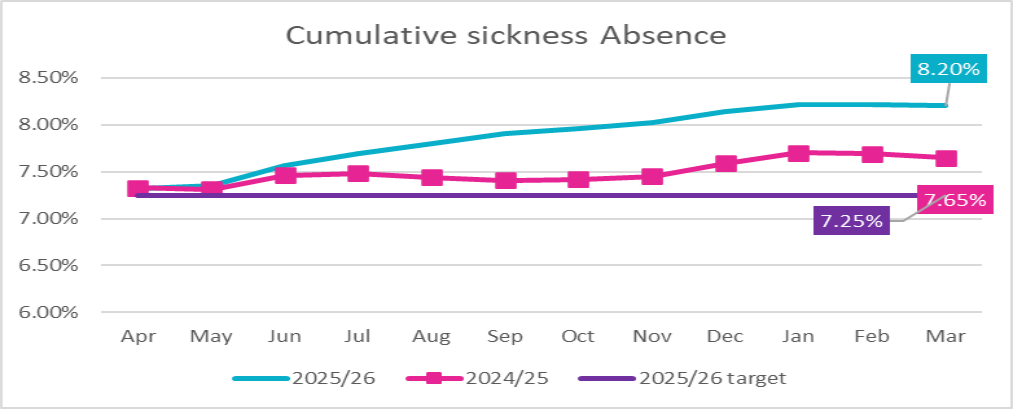
The Trust cumulative sickness absence percentage for 2025/26 was 8.20% against the Trust target of 7.25%.
The chart below compares the cumulative absence position over the past 2 years.
Top 10 reasons for absence from 1 April 2025 to 31 March 2026
- Stress – 18.35%
- Stress-Work related – 7.41%
- Grief-Bereavement – 7.06%
- Post-Surgical Debilitation – 5.83%
- Anxiety – 4.14%
- Back ache/pain – 3.93%
- Other pregnancy related absence – 3.05%
- Other debility – 3.03%
- Influenza – 2.16%
- Injury to knee/lower leg – 1.67%
The Trust’s Supporting Attendance Management (SAM) group continues to oversee attendance management in the Trust, reviewing trends and hotspots, promoting key managing attendance and health and wellbeing updates and resources and encouraging shared learning across the Trust. In 2025/26, the SAM Group prompted a piece of work, supported by HR Business Partners, focused on Divisions developing actions and support to address absence related to stress / work-related stress (both being the highest cause of long-term absence). Guidance on Divisional Absence Case Discussions (ACDs) was revised in January 2026 and ACDs continue to be held regularly to provide advice and guidance to managers on effective case management of long-term and/or complex absence cases. HR continue to run scheduled Absence Hearings each month to enable effective and timely progression of cases.
Following the achievement of IIP Silver accreditation in 2023, the Trust successfully secured reaccreditation at Silver level in January 2026, for a further three years (2025–2028). The Trust-wide assessment involved significant staff engagement across all divisions, including 4,036 staff survey responses and 181 staff conversations, providing a robust evidence base for the accreditation outcome.
The assessment recognised the progress made in delivering the Trust’s People and Culture ambitions and highlighted areas of strength, whilst also providing valuable insight to inform future improvement priorities. The feedback has informed a focused programme of work centred on leadership visibility, recognition and appreciation, and strengthening people management capability.
Staff achievements
During 2025/26, the Trust received a number of awards, both regionally and nationally for achievements in driving improvement and engendering a culture of excellence across health and social care.
Listed below are only a few examples of the external awards received by our staff:
2025 Royal College of Nursing (RCN) Northern Ireland Nurse of the Year Awards
Team North enjoyed a highly successful night at the 2025 RCN Northern Ireland Nurse of the Year Awards, securing three category wins, five runner-up awards and one highly commended recognition. Aaron Smyth won the Chief Nursing Officer Rising Star Award, Gráinne McCusker was named Healthcare Support Worker of the Year, and Christina Faulkner received the Public Health Award. Runner-up honours went to Maria Loughran and Caroline Riddell in the Digital and Data Innovation category, Una Marie McAuley in the Patient Choice Award, Maria Betts in the Nursing Research Award, and Orla Mathews, who was joint runner-up in the Nurse of the Year category. Ward Manager Steven Kelly was also highly commended in the Nurse of the Year category for his leadership in developing the Same Day Emergency Care Unit at Causeway Hospital.
NI Healthcare Awards
The Nurture Clinic team won the Management of Substance Use Award at the NI Healthcare Awards. Led by Specialist Midwife Paula Morrison and Advanced Nurse Practitioner Debbie Pinkerton, the midwife and nurse-led service provides compassionate, specialist support for women using substances during pregnancy and the postnatal period. By offering coordinated outpatient and inpatient care through a single point of contact, the clinic helps improve access to treatment and delivers joined-up support for the health and wellbeing of both mother and baby.
June Nunn Award
The Specialist Dental Unit Team at Antrim Area Hospital received the June Nunn Award from the Irish Society of Disability and Oral Health (ISDH) for their innovative use of the sedative Penthrox in dental extractions. Introduced during the COVID-19 pandemic to improve access to treatment, the initiative was recognised for its impact in special care dentistry. Dr Sarah McNally and Dr Sinead Preston presented the team’s work at the ISDH conference in Dun Laoghaire. Well done to everyone involved.
Autism NI Impact Award
In April 2025, the Northern Trust became the first Trust in Northern Ireland to achieve the Autism NI Impact Award across a number of service areas, demonstrating its commitment to creating more autism-friendly services. Through specialist training and the work of the Trust’s autism champions, staff have implemented changes across a range of settings to improve the experience of autistic service users and their families. The achievement was celebrated at a special event recognising the dedication of champions whose work will continue to drive best practice and inclusive care across Team North.
Bliss Baby Charter
The Neonatal Unit at Antrim Area Hospital became the first in Northern Ireland to receive the Gold accreditation award from the Bliss Baby Charter. The team were officially awarded their accreditation by Bliss Chief Executive Caroline Lee-Davey. Health Minister Mike Nesbitt and Northern Ireland’s Chief Midwifery Officer, Caroline Keown, were also in attendance. The Bliss Baby Charter is a detailed framework which helps neonatal units assess and audit the service they provide to babies and families and is a key tool in delivering excellent family centred care and evidencing the positive difference it makes.
Northern Trust Interim Chief Executive, Suzanne Pullins, said: “I am immensely proud of our multi-disciplinary neonatal unit team. To be recognised at this level by the Bliss Baby Charter is not only an outstanding achievement, but it is also so richly deserved. My heartfelt thanks to all the staff in the unit who go above and beyond every day and whose professionalism and compassion shines through in everything that they do.”
Congratulating the Northern Trust, Bliss Chief Executive, Caroline Lee-Davey, said: “This is a fantastic achievement for the team at Antrim Area Hospital – we are delighted that the unit is now the first in Northern Ireland to be awarded Bliss Baby Charter Gold accreditation. Throughout the process, it has been clear that the team is delivering the highest level of family-integrated care for all babies, which we know is best for these babies and their families. The whole team should rightly be very proud of their achievement – well done!”
Public Relations and Communications Association (PRCA) DARE Awards
The Trust’s Corporate Communications team won the Employee Engagement or Internal Communications Award at the PRCA DARE Awards for the Trust’s ‘Well at Work’ staff newsletter. Introduced in September 2024, the newsletter provides staff with information and signposting to a wide range of health, wellbeing and inclusion resources, supporting delivery of the Trust’s Health, Wellbeing and Inclusion (HWBI) Strategy. Since its launch, visits to the HWBI staff resource hub have increased by 57%, while the number of HWBI champions has grown by 52%, helping to further promote health, wellbeing and inclusion across Team North.
NI Farming awards
The Farm Families Health Check team was recognised at the 2025 NI Farming Awards, winning the Farm Safety Affiliate Award for its work bringing healthcare directly to rural communities. The programme has helped improve the health and wellbeing of thousands of farmers and rural residents through early intervention, education and health screening.
Gay NI Mag Award
The Rowan Sexual Assault Referral centre was delighted to win the Health and Wellbeing Award at the Gay NI Mag (GNI) Award Ceremony on 15 November 2025 at Crowne Plaza Belfast. The award was voted for by the readers of GNI magazine, and recognises contribution to supporting mental, physical, and emotional health and wellbeing for those within the LGBTQIA+ community. We are so grateful to everyone who voted for us. The Rowan celebrates diversity and offers inclusive non-judgmental service to all, accessible to all victims of sexual assault, our telephone lines are open 24/7 for help support and advice and are answered by a registered nurse.
National Award for Patient Education Resource
Two clinical pharmacists at Antrim Area Hospital have won a UK-wide award for an innovative approach to patient care which merges medicine with technology.
Diane Holden and Donna Houston took home first prize at the PrescQIPP UK National Awards in Nottingham in the ‘Technology to support medicines optimisation’ category.
Their quality improvement project centred around a new approach to the self-management of medicines in the Trust where patients are given access to an online video demonstrating how to safely administer essential blood-clotting injections (Enoxaparin) at home. The videos included:
- Step-by step injection technique
- Indication and rationale for treatment
- Key safety reminders
The standardisation of information given to patients who have to self-inject anticoagulants at home has provided an assurance that all relevant safety points and patient concerns have been addressed. Patient feedback was extremely positive for the new videos and patient information leaflets, some of the comments included:
“Clear, simple and easy to replay, the video gave me the confidence at home.”
“In the chaos of the Emergency Department I forgot, but the video reminded me exactly what to do!”
“The video turned confusion into confidence.”
Theme 3: Measuring the improvements
Healthcare Associated Infections
Preventing and reducing Healthcare Associated Infections (HCAIs) remains a key priority for the Northern Trust. Ongoing surveillance, robust infection prevention and control practices, antimicrobial stewardship and a clean safe environment continue to support efforts to reduce the incidence and transmission of infection across all care settings.
How we measure performance
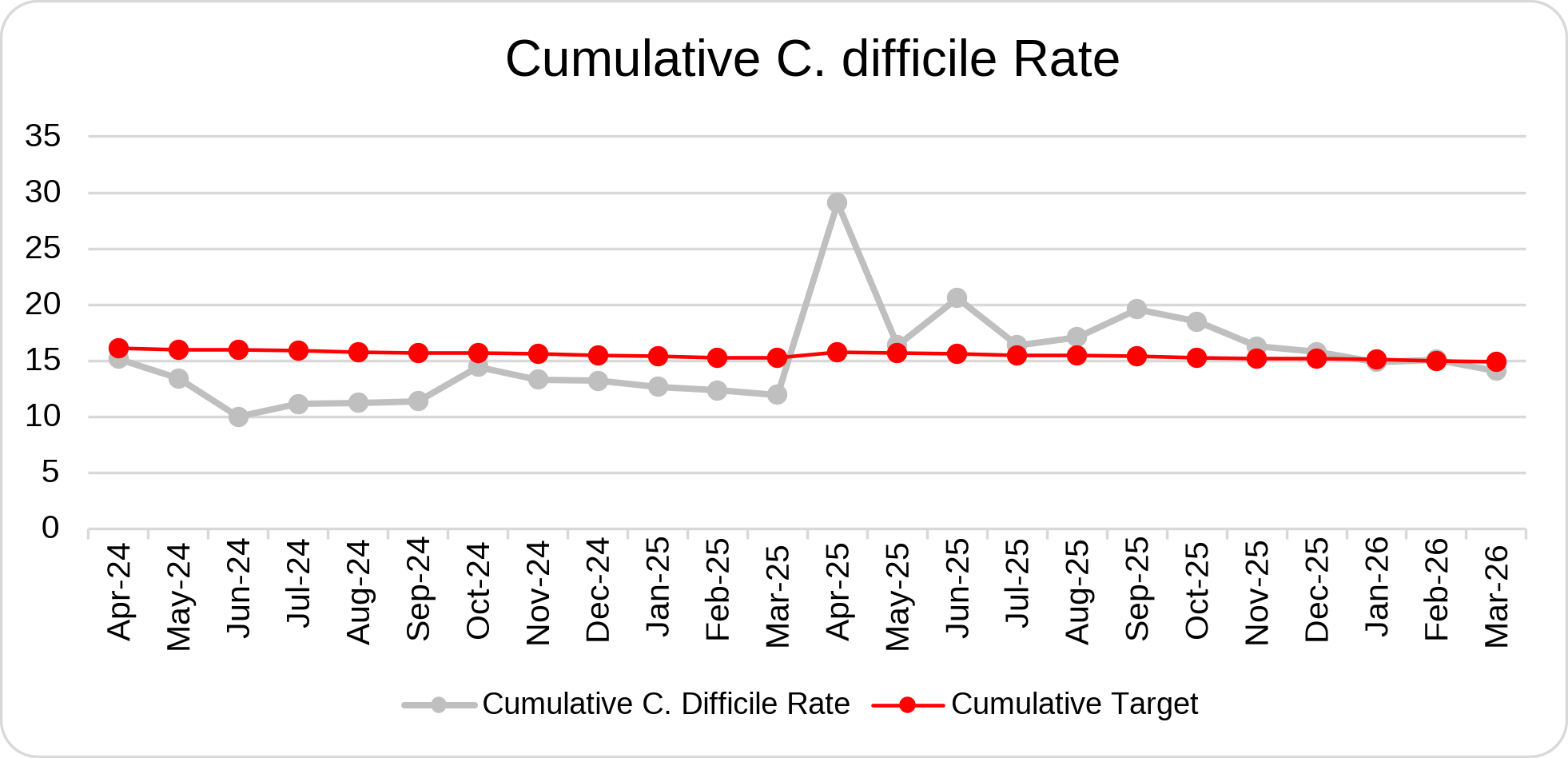
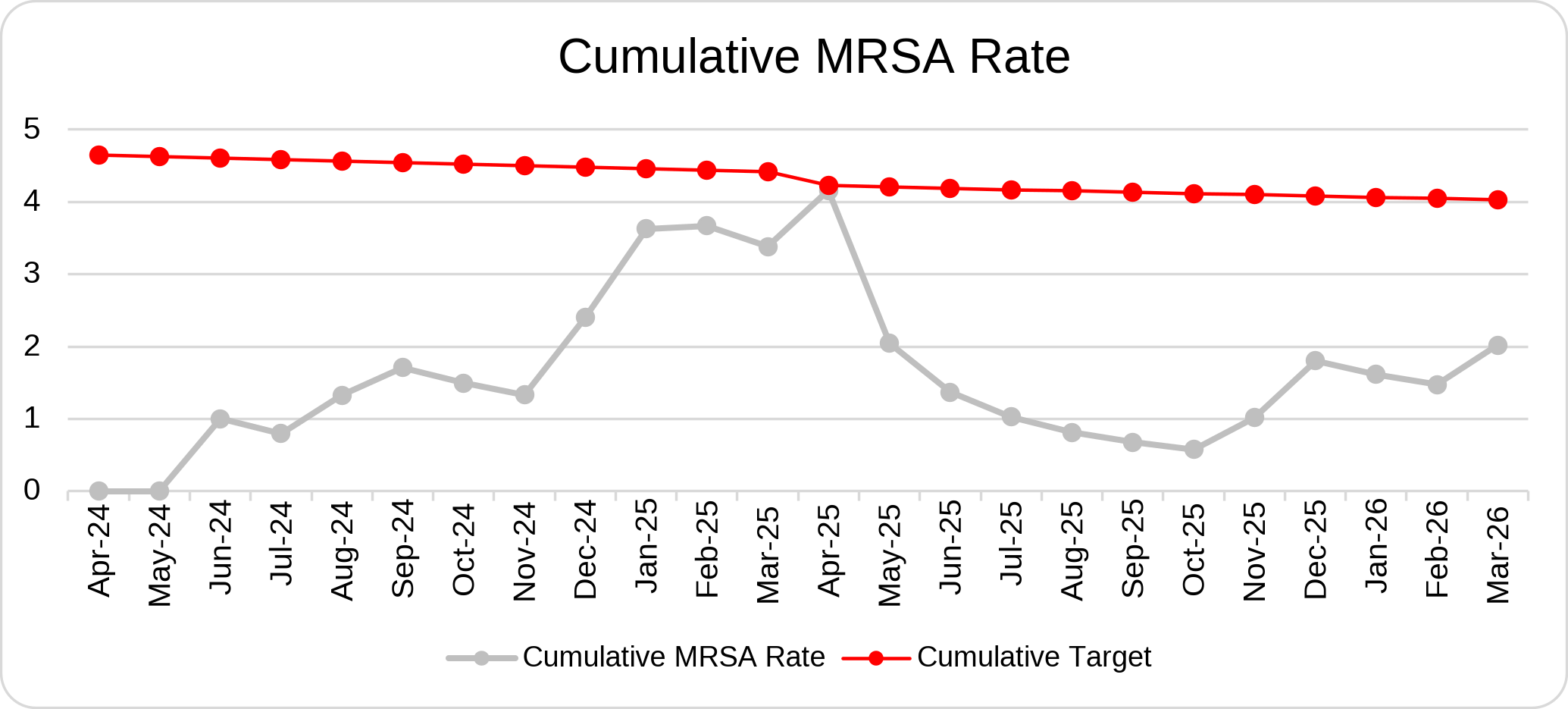
In 2024/25, a revised methodology for monitoring Clostridioides difficile (C. difficile) and Methicillin-resistant Staphylococcus aureus (MRSA) bloodstream infections was introduced in line with the UK National Action Plan 2024-2029 for Antimicrobial Resistance. Targets are now expressed as a rate of infections per 100,000 occupied bed days, replacing the previous approach of measuring the number of patient cases or episodes.
This change enables a more standardised and meaningful comparison of infection rates over time and across healthcare organisations, taking account of differences in hospital capacity and patient activity levels.
Clostridioides difficile (C. difficile)
C. difficile remains a significant cause of healthcare-associated infection and is more commonly associated with exposure to antibiotics, which can disrupt the normal gut flora and allow the organism to multiply. Older adults, immunocompromised patients and those receiving antibiotic therapy are at increased risk of infection.
The Trust continues to promote a range of measures to reduce the incidence and transmission of C. difficile, including prudent antimicrobial prescribing, early identification of cases, prompt isolation of symptomatic patients, enhanced environmental cleaning and ongoing staff education.
At year-end, the Trust achieved a cumulative C. difficile infection rate of 14.1 per 100,000 occupied bed days, performing better than the Public Health Agency target rate of 14.9 per 100,000 occupied bed days.
Methicillin-resistant Staphylococcus aureus (MRSA)
MRSA bloodstream infection is a serious healthcare-associated infection that can occur when MRSA enters the bloodstream, often in association with invasive procedures or the use of medical devices such as vascular access devices and urinary catheters. Patients with underlying health conditions, weakened immune systems and prolonged hospital stays are at greater risk.
The Trust maintains a comprehensive programme of MRSA prevention measures, including screening of at-risk patients, compliance with hand hygiene and aseptic practice, device management, environmental cleanliness and continuous monitoring of infection trends.
At year-end, the Trust reported a cumulative MRSA bloodstream infection rate of 2.018 per 100,000 occupied bed days, performing favourably against the Public Health Agency target rate of 4.028 per 100,000 occupied bed days.
Summary
The Trust achieved and performed better than the target rates set by the Public Health Agency for both C. difficile and MRSA bloodstream infections during the reporting period. This demonstrates the ongoing commitment of staff to effective infection prevention and control practices and the provision of safe patient care.
Safer Surgery / World Health Organisation Checklist
The World Health Organisation (WHO) Surgical Safety Checklist is a tool used by clinical teams to improve the safety of surgery and reduce deaths and complications. The checklist was designed to reduce the number of errors and complications resulting from surgical procedures by improving team communication and checking essential care interventions. During 2025/26 the Trust achieved 94% compliance with the WHO Surgical Checklist.
A Band 6 Clinical Sister/Clinical Charge Nurse in each area completes WHO audits monthly to ensure compliance of completion. With the introduction of encompass these audits have had to be adapted to the new digital way of working. There are also three-monthly observational audits carried out where the Clinical Sister/Clinical Charge Nurse will observe all parts of the WHO Checklist within the theatre environment. Compliance with these three-monthly observational audits for 2025/26 was 99%.
Maternity services
Connected at Birth
“Connected at Birth” was a quality improvement initiative focused on optimising the use of MyChart within maternity services by introducing the granting of proxy access for mothers during the birth encounter.
Using quality improvement methodology and a series of stakeholder engagement activities, a thorough understanding of the system and preventative risk analysis an implementation plan was developed. Staff education, awareness raising and ongoing monitoring were implemented to support reliable uptake and sustainability. The project aimed to grant proxy access to 75% of eligible mothers by December 2025.
By providing women with real-time access to their baby’s health information, appointments, results and communication through MyChart, the project has enhanced family-centred care, improved engagement with digital services and reduced delays associated with account activation in the future. Sustaining this approach will continue to empower families, improve access to information and support the digital transformation of maternity services.
Aspirin Midwifery Patient Group Direction (PGD)
A review of Perinatal Mortality Review (PMRT) cases identified an emerging pattern in which high-dose aspirin prophylaxis was either initiated later than recommended or not commenced at all, despite the presence of recognised maternal or fetal risk factors. This finding highlighted a gap in the timely implementation of evidence-based interventions aimed at reducing the incidence of pre-eclampsia and fetal growth restriction (FGR), both of which are associated with significant maternal and neonatal morbidity.
In response, a Midwifery Patient Group Direction (PGD) was developed and implemented to enable midwives to assess eligibility and supply higher-dose aspirin directly at the booking appointment. By removing the need for an additional medical review before initiation, the PGD supports earlier access to treatment and reduces delays in commencing prophylaxis during the critical early stages of pregnancy.
The intervention specifically targets women identified as being at increased risk of pre-eclampsia, as well as those found to have moderate or high-risk factors for FGR following a structured risk assessment. The introduction of the PGD has strengthened compliance with national guidance, improved consistency of practice across services and empowered midwives to take a more proactive role in risk reduction. Ultimately, this approach aims to improve pregnancy outcomes through the timely initiation of preventative therapy and enhanced antenatal care pathways.
Sexual & Reproductive Health – Specialist Menopause Service
Between 75% & 95% of women experience menopausal symptoms, with approximately 25% describing their symptoms as severe. Symptoms can significantly disrupt personal, social and working lives with one third of working women reporting a negative impact on their job and over half admitting to having time off work due to severe symptoms (Chartered Institute of Personnel and Development (CIPD), Menopause in the workplace report 2023). Thus, due to an increase in menopausal awareness and more patients wanting to take hormone replacement therapy (HRT), there have been growing waiting lists for the specialist menopause clinic within the Trust with patients waiting up to three years, on already lengthy Gynae waiting lists for intervention.
The Clinical Lead within Sexual & Reproductive Health Services in conjunction with the Gynaecology team identified the need to reduce waiting times for specialist menopause care, provide better education for patients and Primary Care and ultimately improve access to specialist menopause services. In February 2024 a validation process commenced. At this stage there were 486 patients on the waiting list (159 week wait). Following a validation process where 471 were triaged, 338 (72%) of these were discharged with advice, 117 remained on the waiting list (25%) due to red flags/other reasons and 16 were redirected/expedited (3%). Reasons for initial referral ranged from request for treatment, bleeding on HRT, dose adjustment, side effects and medical complexities.
The overall aim of this project was for a 50% reduction in the percentage of patients added to the Trust’s specialist menopause clinic waiting list by June 2025. An electronic triage system for incoming referrals to the HRT clinic was introduced providing specialist advice to GPs at the point of referral. This work has resulted in a 72% reduction in the waiting list for specialist menopause clinics, far exceeding the aim of 50% reduction, providing ‘right care at the right time’. Average waiting time for routine referrals pre-validation was 159 weeks, 13 weeks post validation and 1.5 weeks for urgent referrals. The impact of this is immense for women, both emotionally, physically and financially, and the cost savings to the NHS will be huge. The service is further developing this work with a Specialist Doctor now working alongside the Clinical Lead and specialist menopause clinics now running at 3 out of 4 sites each week.
GU/HIV Services
Since August 2025, gay, bisexual and other men who have sex with men (GBMSM) identified as being at higher risk of gonorrhoea infection have been offered the meningococcal group B (MenB) vaccine. Evidence indicates that receiving two doses of the MenB vaccine, administered 4 weeks apart, can reduce the incidence of gonorrhoea by approximately 30–40%, providing an important additional public health intervention alongside existing sexual health measures.
Since August 2025 to present day, the Trust has administered 301 MenB vaccinations as part of this programme. The Trust has also achieved the highest rate in the region for service users returning for their second dose, demonstrating strong engagement and adherence within the programme, and lessening the incidence of gonorrhoea infection.
Post Incident Peer Support for Maternity Staff
A pioneering Post Incident Peer Support service for Midwifery staff has been introduced within the Northern Health and Social Care Trust by a Practice Development Midwife who completed the Northern Ireland Regional Quality Improvement (QI) Programme.
Recognising the emotional impact that clinical incidents can have on healthcare professionals, the project addressed a previously unmet need by establishing a structured, compassionate support pathway for staff following distressing events. The service provides both immediate and ongoing support aimed at promoting physical and emotional wellbeing, helping colleagues to process challenging experiences in a safe and supportive environment.
Through the initiative, staff have access to trained peer supporters who are skilled in Psychological First Aid. These peers offer a confidential space for reflection, help colleagues recognise signs of distress, and act as a bridge to additional support services and resources where required.
As an example of effective quality assurance and continuous improvement, the project demonstrates how listening to staff experiences and implementing evidence-based interventions can enhance both workforce wellbeing and service-user care. By reducing emotional strain, burnout, secondary trauma and stress-related absence, the service supports workforce sustainability and helps maintain the high standards of care expected within maternity services. The overwhelmingly positive feedback and strong staff engagement have highlighted the value of the service, and its contribution to fostering a culture where staff wellbeing is prioritised alongside clinical excellence.
The project has received significant regional recognition, being awarded Special Recognition for Best Poster at the Northern Ireland Regional QI Programme Awards. The initiative was also presented to the Strategic Midwifery Sub-Committee of the Central Nursing and Midwifery Advisory Committee as an example of good practice. Following its success, other Health and Social Care Trusts are now exploring the introduction of similar services, demonstrating its potential to improve staff support across the wider region.
The Practice Development Midwife has further strengthened this initiative by becoming a Critical Incident Support Meeting Facilitator, contributing to a Trust-wide service dedicated to supporting staff in the aftermath of workplace critical incidents. This role enables the delivery of a compassionate, trauma-informed approach that prioritises psychological safety, empowers staff to process challenging experiences, and promotes recovery and resilience. By fostering a supportive culture where staff feel heard, valued and cared for, the service plays a vital role in maintaining workforce wellbeing and ensuring high-quality service-user care.
Sterile Water Injections for Back Pain Relief in Labour
The Trust has led a regional midwifery-led service improvement initiative, aligned with UK guidance, by introducing sterile water injections (SWI) as an additional pain relief option for women experiencing back pain during labour.
SWI are a simple, drug-free method of pain relief that involve the administration of small amounts of sterile water just beneath the skin at four points on the lower back. While the injections cause a brief, intense stinging sensation lasting around 30 seconds, many women experience significant relief from labour-related back pain within minutes, with the effect lasting for up to three hours.
SWI are thought to work through the “gate control” theory, whereby the temporary stimulation from the injections interrupts pain signals travelling to the brain, reducing the perception of back pain. They may also stimulate the release of the body’s natural pain-relieving hormones, endorphins, further enhancing comfort during labour.
The introduction of SWI offers women a safe, effective, and non-pharmacological option for managing back pain in labour. As they contain no medication, there is no risk of allergic reaction, drug interaction, or known adverse effects for either the woman or her baby. SWI can be administered in both hospital and community settings, repeated when required, and used alongside all other labour coping strategies and pain relief methods.
By making SWI available within the NHSCT and across the region, midwifery services are expanding women’s choices in labour and supporting personalised, evidence-based maternity care that promotes positive birth experiences.
Improving Maternity Care for Women with Autism and Learning Disability
Maternity Services within the Northern Health and Social Care Trust were proud to be shortlisted for the 2026 UK Royal College of Midwives Awards in recognition of an innovative service improvement project that is transforming maternity care for Autistic women and families.
Recognising that neurodivergent individuals can face unique challenges throughout pregnancy, childbirth and early parenthood, the Trust established a multidisciplinary working group to improve experiences and outcomes for women with Autism and Learning Disabilities (LD). The group brought together midwives, LD nurses, speech and language therapists, clinical psychologists and healthcare facilitators, united by a shared vision: to ensure women receive personalised, coordinated support from the earliest stages of pregnancy.
Using Quality Improvement methodology, the team adopted a structured, evidence-based approach to identify barriers, implement meaningful changes, and deliver measurable improvements in care. Central to this work was a commitment to listening to women and families, and adapting services to meet their individual needs.
Building on its achievement as the first maternity unit in Northern Ireland to receive the Autism Impact Award, the Trust further demonstrated its commitment to inclusive care by promoting the UK’s first-ever Neurodivergent Birth Awareness Week in December 2025. Accessibility has also been embedded into maternity referral processes, with the Trust’s self-referral form now offering an Easy Read option for maternity correspondence and information resources.
The Trust’s Autism Champions Group continues to drive improvement, meeting regularly to share learning, best practice and ideas for further development. The Trust is also supporting other Health and Social Care Trusts across Northern Ireland to achieve Autism Friendly Accreditation, helping to extend the benefits of this pioneering work to families throughout the region.
More recently, the project has expanded to strengthen support for women with Learning Disabilities. A dedicated multidisciplinary pathway now ensures seamless, joined-up care from the very first maternity appointment, enabling earlier intervention, improved communication and better outcomes for women, babies and families.
This innovative programme demonstrates how collaboration, compassion and co-designed care can break down barriers, improve accessibility and ensure every woman receives the personalised support she needs to thrive throughout her maternity journey.
Paediatric services
Paediatric Allergy Waiting List Initiative
The Paediatric Allergy Team delivered a series of additional evening clinics at Antrim Area Hospital, reducing waiting times and improving access to specialist care for children and their families.
Funded through a Department of Health waiting list initiative, the programme targeted children at greatest clinical risk following a review of the paediatric allergy waiting list. These patients were prioritised for assessment within the additional clinics.
A multidisciplinary team (MDT), comprising a Paediatric Consultant, Paediatric Asthma and Allergy Nurse Specialist, and Allergy Dietitian, provided comprehensive assessment, diagnosis, education and follow-up support during a single visit. This streamlined approach reduced the need for multiple appointments and improved the patient journey.
A total of 23 paediatric patients were seen. The MDT model enabled earlier assessment, timely diagnosis and quicker access to treatment and support, contributing to improved outcomes and more efficient service delivery.
Feedback from families was very positive. One parent stated:
“We were referred by the GP and thankfully didn’t have too long to wait. Overall, we had a positive experience. The staff were very welcoming and child-friendly. The education aspect was particularly valuable, helping me feel confident in managing my child’s allergies going forward.”
The initiative demonstrated the benefits of coordinated MDT care, improving access to services, enhancing patient experience and enabling children to receive specialist assessment and support sooner than would otherwise have been possible. It has made a valuable contribution to reducing waiting lists while supporting better outcomes for paediatric patients and their families.
Supporting Safe Transition: Allergy Education for Children Moving from P7 to Post-Primary School
This education event was developed in response to feedback from a parent whose child, due to transition from primary to post-primary school, was experiencing significant anxiety about managing severe allergies independently. The parent felt it would be beneficial for children with allergies to meet others facing a similar transition.
Working in partnership with Public Health Nursing colleagues, the Paediatric Allergy Team identified children across the Trust who carried adrenaline auto-injectors and were due to start post-primary education. Invitations were issued and families were given the opportunity to register via a QR code, providing details of their child’s allergies and any topics they wished to be covered.
The event was held at Mid Ulster Hospital and attended by 15 children and 17 parents. A multidisciplinary programme was delivered by consultants, nurse specialists, dietitians and catering staff, focusing on allergy management, anaphylaxis awareness, use of adrenaline auto-injectors, managing allergies in school and navigating the school canteen safely. Separate sessions were provided for parents, including information on immunotherapy.
Children were also given the opportunity to practise using expired adrenaline auto-injectors in a supervised setting, helping to build confidence and familiarity with emergency treatment.
Feedback from parents was overwhelmingly positive, with participants valuing both the educational content and the opportunity to meet others with shared experiences. Following the success of the initiative, a further event is planned to support the next cohort of children transitioning to post-primary education.
Public Health Nursing
Northern Health and Social Care Trust Phase 2 of the UK-wide Alarm Distress Baby Scale (ADBB) project
During 2025/26, the Trust participated in Phase 2 of the UK-wide ADBB project, led by the Institute of Health Visiting, funded by the Royal Foundation. This work supports the Trust’s commitment to early intervention, prevention, and improving outcomes for infants and families in line with quality improvement priorities. The ADBB is an evidence-based observational tool designed to support early identification of sustained social withdrawal in infants aged 0–24 months.
Phase 2 focused on the expansion of ADBB and modified ADBB (m-ADBB) training across health visiting teams, nationally 7 health trusts took part:
- Ayrshire and Arran
- Northern Health and Social Care Trust
- Cwm Taf Morgannwg
- Hampshire
- Hull
- North Lincs and Doncaster
- South Warwickshire
The project aimed to embed the tool within routine 6–8 week reviews and evaluate its impact on practice, referral pathways, and parent experience. Thirty-four health visitors from across four Northern Trust teams were trained in m-ADBB, with three practitioners completing full ADBB training. The Trust’s Project Lead, Claire Green Public Health Consultant Nurse also completed ADBB referent training to support the expansion of research and education in social withdrawal.
Findings demonstrated that ADBB training strengthened health visitors’ skills in observing and interpreting infant behaviour, with significant increases in confidence in identifying early social withdrawal. Parents’ feedback indicated that conversations were experienced as supportive, collaborative, and non-judgemental, enhancing engagement and openness to support.
Overall, the Trust’s contribution to Phase 2 highlights the value of the ADBB as a practical early identification tool within universal services. It supports a shift towards proactive, relational, and strengths-based care, enabling earlier intervention and improved outcomes for infants and their families.
Chairs – Population Health Award
The Ballywillan Community Support Hub was established in Portrush in response to the complex needs of asylum-seeking families residing in the Magherabuoy Hotel. Many families arrived with significant unmet health, social and emotional needs, often following experiences of trauma and with limited access to resources.
Led by Public Health Nursing and Social Work, the initiative adopted a population health approach, bringing together statutory, community and voluntary partners to deliver a coordinated, place-based response.
The weekly hub has provided holistic support, including health and social care input, access to basic necessities, signposting to services, and therapeutic and social activities for both adults and children.
The hub has supported hundreds of individuals from over 38 countries, offering a safe, welcoming space that promotes health, wellbeing, social connection, and early identification of need.
Its success lies in strong partnership working, proactive outreach, and its ability to reduce health inequalities for a highly vulnerable population, despite operating without dedicated funding.
The project was recognised with the Trust’s Chair’s Population Health Award 2025 due to its innovative, collaborative and preventative approach, demonstrating how integrated, community-led solutions can effectively address health inequalities and improve outcomes for marginalised groups.
World Tuberculosis (TB) Day
To mark World TB Day, the Health Protection Team actively engaged with staff across both acute hospital sites to raise awareness of tuberculosis, promoting understanding of symptoms, prevention, and the importance of early detection.
Staff were encouraged to participate in a TB quiz, with the opportunity to win a small voucher, which generated strong engagement. Over two mornings, 200 quiz sheets were distributed, with an excellent return of 110 completed entries (83 from Antrim and 27 from Causeway), reflecting high levels of staff interest and participation. The Trust extends its thanks to all staff who engaged with the initiative.
In addition, Becky Murphy, Health Protection Nurse Specialist, delivered a bespoke TB training session to 20 District Nursing Managers as part of World TB Day activities, further strengthening knowledge and awareness across community services.
This year’s winners where Laura McKelvie and Joanne O’Hagan.
encompass Dashboards
The move to encompass, an integrated digital care record for the people receiving health and social care services in NI, has provided us with the opportunity to digitalise the Regional Nursing Key Performance Indicators (KPIs); this will be transformational as it will move from small samples (10 records per KPI per area) to complete dataset availability, and from point-in-time monthly reports to real-time reporting. This will enable a significant shift in practice by providing the service leads the opportunity to address issues at the time rather than use the reports retrospectively; however quarterly reports will still be produced to ensure trends and areas for improvement are identified.
During this year, the Senior Lead Nurse for Nursing & Midwifery Assurance and Quality has continued to work with the Cogito team from encompass, Nursing and Midwifery Quality Assurance Network (NMQAN) and professional leads across the region to build and validate the data produced by both the Adult Inpatient KPI dashboard, and the District Nursing KPI Dashboard. Socialisation of the use of digital dashboards within Nursing and Midwifery has been led by both Digital Nursing and the Lead Nurse for Nursing and Midwifery Assurance and Quality.
It is hoped that both these dashboards will be available for staff within the Trust, by the end of Quarter 1 next year.
Prevention of Falls
‘Slips, Trips & Falls’ remain one of the most common incident types within the Trust during 2025/26.
The National Institute for Health and Care Excellence (NICE) guideline NG249: Falls – assessment and prevention in older people and in people aged 50 and over at higher risk was updated in April 2025. A fall is defined as ‘an unexpected event in which the participant comes to rest on the ground, floor or lower level’. Although falls can occur at any age, they are more common in older people, with approximately one third of people aged 65 and over, and half of those aged 80 and over, experiencing at least one fall per year. The consequences of falls include injury, fractures, loss of confidence, loss of independence and mortality.
Following the publication of the updated NICE guidance, the Trust has completed a baseline audit against the new recommendations and is currently reviewing areas of unmet or partially met compliance.
The number of falls during 2025/26 increased to 1,835. The following factors continue to contribute to these rates:
- Increasing ageing population
- Increasing prevalence of multi-morbidity, polypharmacy and frailty
- Deconditioning of the elderly population and associated social isolation
The Trust continues to recognise the importance of falls prevention as a key component of healthy ageing. This is supported through the Falls Steering Group, which promotes a multidisciplinary and multi-agency approach to falls prevention and management. Falls reduction remains a key priority, with the Falls Prevention and Management in Hospital and Care Homes Programme identified as one of the Trust’s Level 1 Strategic Improvement Programmes. This programme will run over the next 2–3 years, with a focus on improving organisational and patient outcomes.
The Falls Coordinator has been working alongside regional colleagues in the development of new revised adult inpatient Key Performance Indicators (KPIs) following the implementation of encompass. These are anticipated to go live in April 2026, supported by a KPI dashboard to enable wards and departments to monitor compliance.
The KPIs now focus on five key domains of multifactorial falls assessment, taken from the National Audit of Inpatient Falls (NAIF) guidance:
- Mobility
- Vision
- Elimination/toileting needs
- Lying and standing blood pressure
- Delirium assessment
These domains aim to support safe activity and proactive risk reduction. In advance of implementation, the Falls Coordinator is contributing to the development of a regional training package to support accurate assessment, documentation and delivery of high-quality falls care in inpatient settings.
A suite of Regional Falls Awareness e-learning modules remains available to all staff, including:
- Universal awareness module
- Acute setting module
- Community setting module
- Care home module
The Trust continues to develop the Acute Falls and Frailty Link Nurse Programme, aligned with the Department of Health Link Nurse Framework, to strengthen leadership and practice improvement at ward level.
Within inpatient settings, the Fallsafe Bundle contributes to the systematic completion of multifactorial falls risk assessments and the delivery of appropriate interventions based on individual patient needs and identified risk factors.
The Trust continues to undertake post-fall reviews for all moderate to catastrophic harm incidents, with:
- Learning shared with ward teams and senior management
- Action plans developed to address gaps in care
- Findings shared with the PHA
This learning informs the annual ‘Learning from Falls’ newsletter developed by the Public Health Agency (PHA) and is disseminated across all Health and Social Care Trusts.
The Falls Coordinator, working with the Nursing Innovation Team, has established the Frailty and Flow Programme. This multidisciplinary quality improvement initiative is testing the impact of focused work in 4 key areas, to support a reduction in deconditioning
- Nutrition and hydration
- Mobility
- Cognition
- Therapeutic engagement
The programme is currently piloted in one inpatient ward, with plans for scale and spread following evaluation.
During 2025/26, the Nursing Innovation Team and Falls Team have continued to support implementation and improvement of Safety at a Glance Boards.
These boards enhance:
- Communication
- Situational awareness
- Patient safety
A key component is the identification of patients at risk of falls, ensuring risk is visible and acted upon by all staff.
Within the care home setting, the Trust continues to support implementation of the Regional Falls Pathway and Care Home Bundle developed by the PHA.
A mapping exercise has been completed to review how falls are currently managed for care home residents across the Trust. This will inform a multi-professional, multi-agency workshop (planned April 2026) to review current practice and explore future service models.
The Falls Screening Service continues to accept referrals from:
- Northern Ireland Ambulance Service (NIAS)
- Emergency Departments (ED)
- Minor Injury Units
- Fracture Liaison Service
- General Practitioners
- Multidisciplinary teams
- Self-referrals
Following a multifactorial falls assessment, patients are referred to appropriate services to reduce future risk and injury.
In addition, two new pilot pathways have been introduced:
- Support and home assessment for patients attending the Frailty Direct Unit (Antrim)
- Follow-up for patients conveyed by ambulance and discharged from ED
These pilots aim to reduce repeat ED attendance and prevent further falls.
In addition, the Falls Prevention team continue to attend community events to raise awareness of the service and falls prevention strategies.
Falls Data
Falls rate per 1000 bed days:
- 2025/26 overall falls rate: 5.21
- Moderate to catastrophic harm rate: 0.09
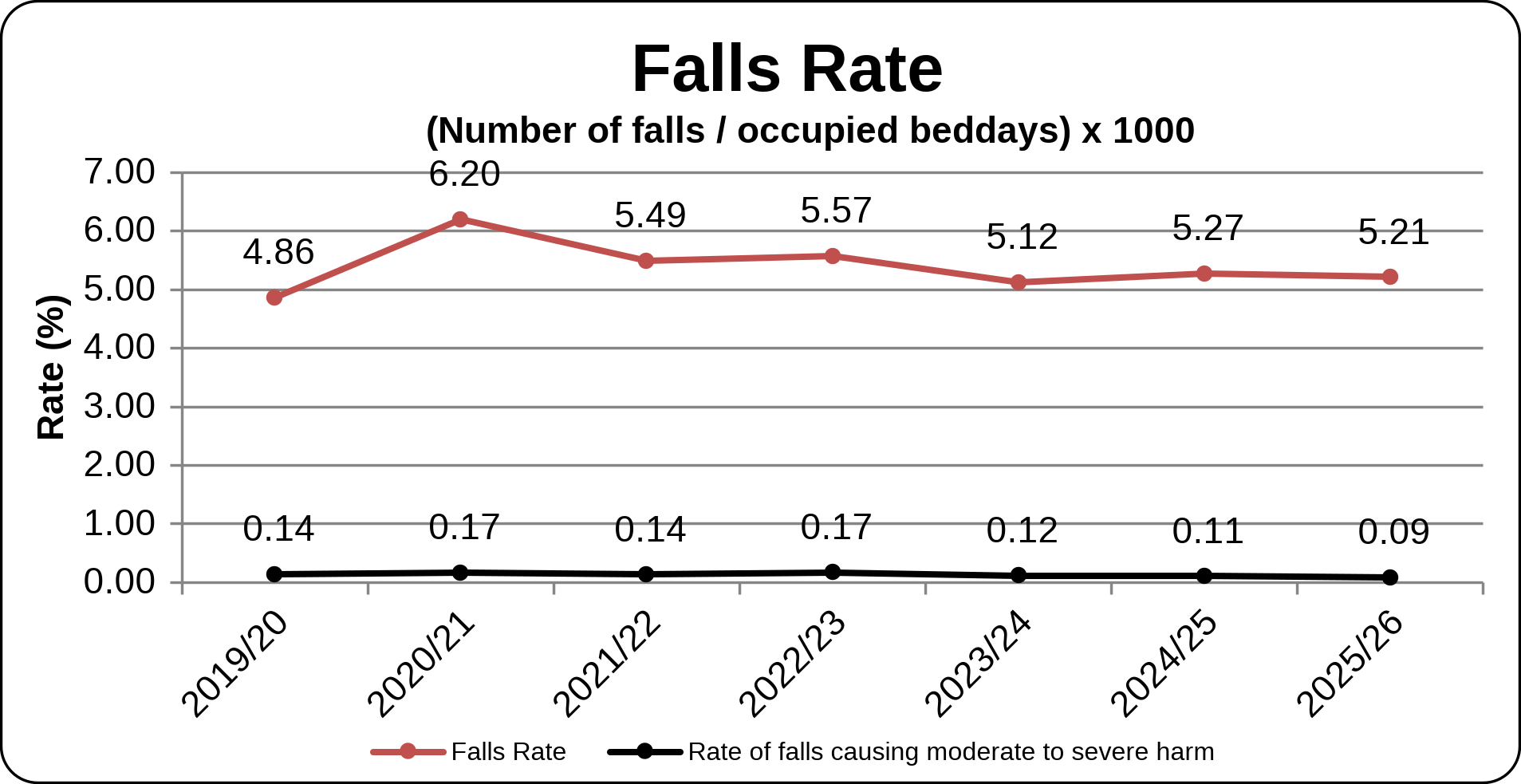
Occupied beddays data prior to implementation of encompass was based on KH03a returns. Since 7th November 2024, occupied beddays figures are taken from encompass, and cannot be fully validated as it does not include patient level detail like the KH03a. The figures may also include specialties that had previously been excluded from KH03a returns.
Progress on Previous Year Priorities
From 2024/25, two key priorities were identified:
- Standardisation of post-fall assessments within encompass
Update: Ongoing regional work is in progress, including development of a regional medical post-fall assessment template. - Development of a digital falls dashboard
Update: KPI dashboard is in development and scheduled to go live April 2026.
Prevention of Pressure Ulcers
Pressure ulcers are defined as localised damage to the skin and/or underlying tissue, as a result of sustained pressure or pressure in combination with shear. Pressure ulcers usually occur over a bony prominence, but can be related to a medical device or other object (NPUAP/EPUAP/PPPIA, 2019). Many patients are at risk of pressure ulcers due to multiple co-morbidities and key contributory factors such as, immobility, poor nutrition, weight loss, skin moisture, sensory deficiency, and advancing age.
Pressure ulcers are a major patient safety concern and a quality indicator of care. The Trust therefore, in line with the rest of the region, has a focus on the prevention of pressure ulcers. Preventing pressure ulcers involves firstly, promptly identifying those patients at risk and secondly, reliably implementing prevention strategies for all patents identified as being at risk. In the Trust, this is currently supported by the use of the Pressure UlceR Primary or Secondary Evaluation Tool (PURPOSE T) risk assessment tool and the SSKIN bundle:
- S – Surface
- S – Skin Assessment
- K – Keep Moving
- I – Increased moisture management
- N – Nutrition
Key facts
During 2025/26, the Trust has built upon the foundations laid in previous years aiming to reduce the number of avoidable pressure ulcers. During 2025/26 the Trust reported 561 (1.59 rate) hospital acquired pressure ulcers which were graded stage 2 and above (compared to 567 in 2024/25). Of these, 218 (rate 0.62) were stages 3 and 4 (compared to 199 in 2024/25). Of the total number of Stage 3 and 4 pressure ulcers, 102 were deemed avoidable (rate 0.29) (compared to 78 in 2024/25).
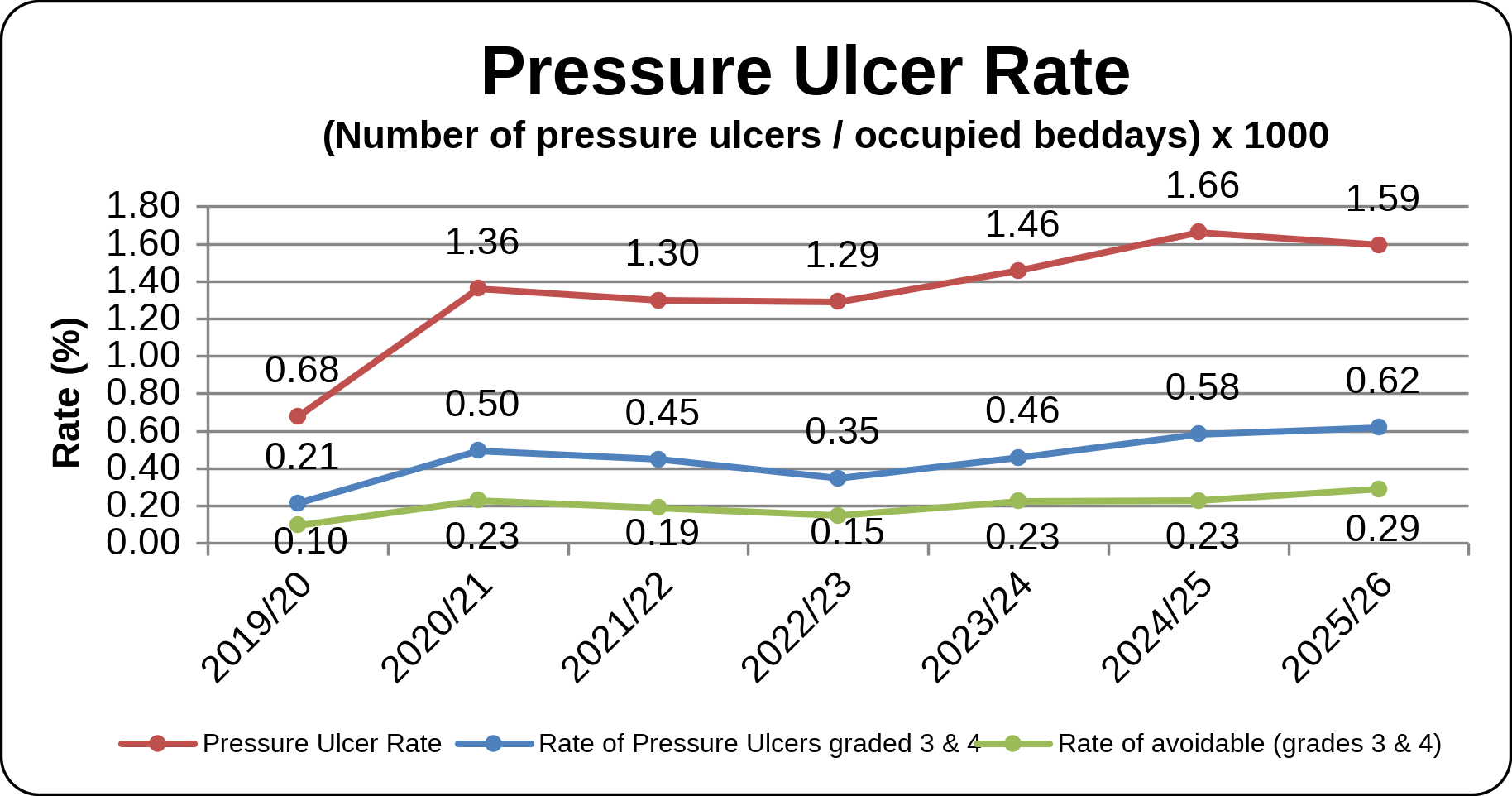
Occupied beddays data prior to implementation of encompass was based on KH03a returns. Since 7th November 2024, occupied beddays figures are taken from encompass, and cannot be fully validated as it does not include patient level detail like the KH03a. The figures may also include specialties that had previously been excluded from KH03a returns.
It is uncertain if the increase in reported pressure ulcers is related to the implementation of encompass, to occupied bed days data still undergoing validation or improved reporting of pressure ulcers has resulted from focused improvements in the post incident review process. A Trust-wide improvement group has been established to analyse the data, contributory factors and use the newly available Nursing KPI dashboard in encompass to identify key areas for improvement.
Using the Department of Health (DoH) Link Nurse Framework, 70 Tissue Viability Link Nurses have been recruited to support the Tissue Viability Nurses (TVNs) and both inpatient and outpatient departments across all acute and community hospitals. Their role is to help deliver safe, effective, and person-centred wound care.
The TVN team continued to support successful learning events throughout the year. In April 2025, a key learning event was attended by attended by 92 staff from acute and community hospitals, treatment rooms, and district nursing services. The event was also supported by multidisciplinary colleagues, including representatives from the lymphoedema service, podiatry, medical teams, and lead nurses. The primary aim of the session was to launch the Trust’s wound care guidance document for secondary care, while also providing an opportunity to enhance staff knowledge and skills in wound assessment and dressing selection.
In addition, the TVN team delivered two Link Nurse learning events in November 2025 at Causeway Hospital and Antrim Area Hospital as part of the STOP Pressure Ulcer Campaign, with a total of 30 staff in attendance. Staff benefited from practical sessions focusing on the learning themes from Pressure ulcer incidents post incident reviews.
Action the Trust is taking
Quality improvement (QI) initiatives are underway to enhance patient safety in pressure ulcer prevention:
The Trust’s TVN Lead is actively working with a regional group to develop a regional encompass imaging policy. In addition, the TVN Lead has collaborated with Trust colleagues to develop a Standard Operating Procedure (SOP) to guide staff in maintaining patient privacy, dignity, and safety when capturing wound images on encompass via the Rover app. This SOP is available on the policy library as an appendix within the updated TVN Operational Policy. Staff continue to embrace the use of wound photography on encompass. These images support the TVN to appropriately triage referrals and improve the timeliness of TVN patient advice.
The Trust TVN Lead has been working collaboratively with regional and encompass colleagues to develop a suite of resources to support staff navigate the new system and document care efficiently.
The TVN Lead has collaborated with colleagues to update the Pressure Ulcer Prevention and Management Policy for adult hospital settings. This update incorporates encompass flowsheet changes and Key Performance Indicator (KPI) standards, providing clear and consistent guidance for staff.
The TVN team has implemented an improved process to enhance the timeliness of review and learning from pressure ulcer incidents. This approach has eliminated previous backlogs, ensuring that incidents are reviewed promptly and that learning is identified and disseminated in a timely manner to support quality improvement in patient care.
All registered nursing staff and non-registered staff working in hospital and community settings should complete the regional e-learning programme for Prevention of Pressure Ulcers in Adults for Registered Practitioners, every 2 years. All non-registered staff including nursing assistants, Health and Social Care (HSC) employed domiciliary care workers and Allied Health Professionals (AHP) support workers can access this e-learning programme.
Plans are underway to develop a community Tissue Viability Link Nurse group to offer the same opportunity for learning and networking.
The Tissue Viability Team Lead has collaborated with Community Nursing Leads on a QI project to develop a shared decision-making document. This resource is designed to support nurses in helping patients make informed decisions regarding pressure ulcer prevention. Early outcomes from this initiative have been positive.
The TVN Lead collaborated with a service user to strengthen patient involvement in pressure ulcer prevention and management, with a focus on shared decision-making (SDM). The service user shared their lived experience at the Tissue Viability Nurse Network NI conference (November 2025), providing valuable patient insight for healthcare professionals. Feedback was very positive, with the session being described as impactful and insightful.
Action the Region is taking
The Tissue Viability Team actively participates in the PHA’s Regional Pressure Ulcer Group alongside other Trusts to plan regional strategy, KPI monitoring and improvement work in the area of pressure ulcer prevention.
The Tissue Viability Team continues to contribute regionally to the development and optimisation of Safeguarding criteria, to assist staff with decision-making in relation to appropriate referral to the adult protection team following a pressure ulcer incident.
The TVN team lead collaborated with regional colleagues to develop a pressure ulcer definition document. This has been reviewed in line with encompass, and shared with Digital Health and Care Northern Ireland (DHCNI) to ensure there are clear definitions to support the categorisation and measurement of pressure ulcers at both local and national level.
The Regional Pressure Ulcer group have developed and launched an updated version of the Pressure Ulcer Prevention Information leaflet for patient and carers. The Trust continues to provide service users and their families with information on the risks of pressure ulceration, and provides patients with example images of pressure ulcers. This is helping patients to make informed decisions regarding pressure ulcer prevention and management.
Prevention of Venous Thromboembolism
Venous Thromboembolism (VTE) is a condition in which blood clots form (most often) in the deep veins of the legs. This is known as deep vein thrombosis (DVT) and sometimes the clot can travel through the blood circulation and lodge in the lungs causing a pulmonary embolism (PE).
Admission to hospital increases the risk of blood clots (DVT, PE); however, VTE can be preventable.
To help prevent VTE in patients admitted to hospitals, a risk assessment is carried out at admission to determine the level of risk in developing VTE, and anti-clotting medicines are prescribed if appropriate.
Historically, the Trust has always aimed to ensure 95% of patients admitted to hospital are risk assessed. However, since the introduction of encompass across the region in November 2024, measuring compliance with the completion of VTE risk assessment has not been feasible using the new electronic system (encompass). Therefore, between April 2025 and March 2026, data has not been available to monitor the degree of compliance with this safety measure.
Next steps: A number of Trust staff continue to work with the regional encompass team to build suitable reports within encompass to provide the Trust with assurance on the percentage compliance with completion of VTE risk assessment within 24 hours of admission to hospital. In the meantime, the Trust is exploring a move back to manual data collection on VTE risk assessment and thromboprophylaxis prescribing, to identify potential gaps in compliance and areas for improvement.
Cardiac Arrest Rates
A ‘cardiac arrest’ is where a patient requires chest compressions and/or defibrillation by the hospital resuscitation team. Evidence suggests that the number of hospital cardiac arrests can be reduced through earlier recognition and treatment of patients whose clinical condition is deteriorating. The compassionate care of those patients acknowledged to be nearing the end of their lives may also help to reduce the number of patients treated for cardiac arrests.
Following the introduction of encompass in November 2024, the Cardiac Arrest Rate continues to be unavailable at this time.
Evidence indicates that the incidence of in-hospital cardiac arrests can be reduced through the early recognition and timely management of patients experiencing clinical deterioration. To support this objective, the Trust’s Resuscitation Training Team continues to deliver a comprehensive range of educational programmes for clinical staff. These courses are designed to enhance the early detection of deteriorating patients, promote timely and appropriate clinical intervention, and equip staff with the knowledge and skills required to effectively manage both clinical deterioration and cardiac arrest situations.
Corridor Care
Across Health & Social Care (HSC), Emergency and Unscheduled Care services remain under sustained pressures due to increasing patient demand, rising acuity, delayed discharges and ongoing workforce challenges. In response to these system wide challenges, HSC organisations have implemented various surge measures, including opening up additional inpatient beds to deal with demand and maintain safe and effective care delivery.
In response to the increasing use of undesignated beds (Corridor Care), the Chief Nursing Officer (CNO) in Northern Ireland (NI), requested that Directors of Nursing across the HSC system undertake an audit of ‘Corridor Care’, from the perspective of nursing care and the standards expected in respect of same. A Trust specific audit was completed by all Trusts in early 2025.
Within the Trust, the audit findings highlighted significant disparities in both clinical care and patient experience between those placed in non-designated bed spaces (Corridor Care) and those accommodated in designated spaces, both within ED or inpatient wards across both acute sites.
In 2026/27 the Trust will embark on undertaking a regionally agreed audit of Corridor Care which will allow benchmarking against other Trusts in the region and development of both a regional and Trust action plan for improvement.
Omitted and Delayed Medicines
The Trust is engaged with a regional collaborative around Medication Safety, which is being led by Transforming Medication Safety Northern Ireland (TMSNI), with the support of Health and Social Care Quality Improvement (HSCQI). The aim of this work is broken down over 2 years as follows:
Year 1 (2025/26): Develop encompass Medication Safety Dashboard metrics for specific high-risk medicines and clinical situations, including baseline data collection.
Year 2 (2026/27): Conduct analysis of data obtained through the Dashboard to inform and support delivery of a regional medication safety quality improvement programme
Along with regional colleagues, Trust staff from Nursing, Digital Nursing and Pharmacy helped to identified 4 regional priorities for the Medication Safety Dashboard.
- Omitted / Delayed Time Critical Medication (TCMs)
- Inappropriate prescribing of Anticoagulants
- Medication reconciliation
- Allergens
Work specifically looking at omitted / delayed medication is taken forward via the Expert Advisory Group (EAG) Time Critical Medications (TCM) Meetings facilitated by TMSNI and HSCQI. The region is now well advanced in the production of two Regional Medication Safety dashboards, for Omitted / Delayed TCMs and Anticoagulants, with hopes to have this data available in April 2026.
Insulin
Going into hospital can create risks for patients with diabetes. Patients have come to harm or died in hospital because their diabetes requiring treatment with insulin has not been appropriately managed1. Therefore, it is important that healthcare professionals take appropriate action to reduce the risk of errors when using insulin.
1Insulin: supporting safe administration in inpatient settings
Insulin Safety Week 2025
The Trust participated in Insulin Safety Week (ISW) which took place from 12th – 18th May 2025. ISW is a national campaign to raise awareness of insulin safety, and this year, the Diabetes Team, along with the Emergency Department (ED) Team focused on insulin safety within the ED. Campaign activities included:
- A mobile education trolley providing small group education sessions to >100 staff in ED. Staff enjoyed playing ‘Match the insulin’ game and seeing demonstrations of various diabetes devices
- Insulin safety cards and bulletin distributed
- Insulin Safety poster displayed in staff areas
- Teaching sessions and Top Tips shared on insulin safety including safe electronic prescribing
- QR codes linking to E-learning on safe use of insulin and diabetes technology
- Insulin Safety quiz with prizes
Improving access to Insulin Self-management in Antrim hospital
A quality improvement project was undertaken by the diabetes lead pharmacist to expand the access to self-management of insulin in hospital. Prior to the project, insulin self- management (ISM) was available on wards A4 and B3/CCU, and patients were assessed for ISM by a band 6 or 7 nurse. The project included training of nursing staff on B1, B2 and AAA to enable access to insulin self-management for patients on these wards, and training of band 5 nursing staff on A4 to expand the number of nurses who can assess patients for insulin self-management. A Smartphrase was also introduced to improve documentation of the assessment of patients for ISM. The results of the project were:
- Approximately 75 nurses were trained on ISM on wards B1, B2 and AAA, increasing availability of ISM to an additional 3 wards
- Approximately 25 nurses were trained on ISM assessment on ward A4
- 80% of eligible patients were enabled to self-manage their insulin while in hospital
- 100% of patients who were eligible for ISM had a completed documented assessment following introduction of a Smartphrase for documenting patient assessment.
Next steps: further expansion of ISM to the Antrim hospital site is in progress.
Medicines Reconciliation
Medicines reconciliation is the process of compiling a complete and accurate list of what medicines a person is taking. The ward clinical pharmacist completes medicines reconciliation for people admitted and discharged from hospital, both of which are important steps in the patient journey. On admission, medicines reconciliation provides the information necessary to support safe prescribing decisions, identify adverse drug reactions, identify medicines that are no longer required, optimise the prescribed medicines for the patient’s needs and ensure timely and accurate administration of medicines. On discharge, medicines reconciliation provides a clear picture of what has changed during the hospital stay and identifies important medicines information for transfer to the GP.
Medicines reconciliation is recorded in encompass and this has provided the Trust with a mechanism to identify people who are awaiting a pharmacist medicines reconciliation and to monitor activity. In 2025/26, 70% of all patients admitted to wards and departments had their medicines reconciled and where there is a ward clinical pharmacy service, 80-100% of patients had medicines reconciled.
Improving Patient Education and Side Effect Monitoring of Psychiatric Medicines in Holywell Hospital
The Lead Clinical Pharmacist for inpatient care at Holywell Hospital conducted a quality improvement project across four wards to enhance patient education and side effect monitoring of psychiatric medicines. The project involved delivering education sessions to patients and/or their carers when starting new medications, followed by side effect assessments and management. During the project, the lead pharmacist provided at least one education session and side effect assessment using a validated rating scale to every patient commencing a psychiatric medicine.
Next steps include sustaining these interventions, expanding the programme to other mental health wards and exploring ways to improve adherence, support patients’ physical health management and reduce hospital admissions.
Feedback from medical staff:
- “…helped free up medical staff time… ensured side effects can be monitored in a timely manner…”
- “…Service is invaluable…”
- …Simple way to ensure prescribing is patient-centred…”
Feedback from patients:
- “…He’s talked through what I was on and what for, and checked in with me about side-effects and helped with getting them sorted if they were bothering me”.
HSDU Delivers End-to-End Digital Traceability Through encompass Integration
The Trust reached a significant digital milestone through the successful integration of the Hospital Sterilisation and Disinfection Unit (HSDU) decontamination traceability system with the encompass electronic patient record (EPR).
The development represents a major advancement in patient safety, clinical governance and digital healthcare, creating a seamless connection between decontamination records and patient records. The project was led by the Trust’s Decontamination Manager in collaboration with the Trust’s traceability system provider and the encompass programme team. Following extensive planning, testing and validation, a fully compatible digital interface has been established that enables reusable medical devices processed within HSDU to be automatically and securely recorded within the patient’s electronic healthcare record.
As the Trust’s specialist healthcare science service for the cleaning, disinfection and sterilisation of reusable medical devices, HSDU identified the opportunity to strengthen traceability arrangements and ensure decontamination information was directly accessible through encompass. The integration supports the Trust’s commitment to enhancing patient safety while modernising clinical processes and governance systems.
The new functionality completes the full traceability pathway for reusable medical devices. Instrument sets processed by HSDU are assigned unique barcodes and tracked throughout validated decontamination processes. At the point of care, clinical staff scan device barcodes, linking them directly to the patient’s encompass record and creating a complete, auditable history from decontamination through to patient use.
The initial implementation phase focused on surgical devices used within acute hospital services, and has delivered substantial benefits for clinical services and governance teams.
Historically, audits, investigations and product recalls often required extensive manual review of paper-based records and multiple information systems to establish device usage and patient exposure. By incorporating decontamination traceability information directly into encompass, clinicians and investigators can now instantly access the complete processing history of a device within the EPR, thus improving patient safety and operational efficiency.
In the unlikely event of a device recall or safety concern, affected devices and patients can be identified rapidly and accurately, enabling timely investigation and response. Clinicians also benefit from increased assurance that reusable medical devices have completed all required validated decontamination processes before use.
The project highlights the important contribution of healthcare science and decontamination services to patient care and digital innovation. Through leadership, collaboration and technical expertise, HSDU has delivered a transformational improvement that enhances patient safety, supports regulatory compliance and contributes to the Trust’s wider digital transformation programme.
Next steps involve further development work to extend digital traceability to reusable medical devices used across community healthcare settings, providing a consistent approach to device traceability across the Trust.
Introduction of a Prescribing Qualification for all Trainee Pharmacists
New UK Standards for the Initial Education and Training of pharmacists were introduced in 2021. The standards outlined the need for a shift in training of pharmacists to ensure the workforce can deliver person-centred care and can prescribe proficiently to support the wider, complex healthcare systems.
In August 2025, all hospital trusts in Northern Ireland introduced a new programme for the pre-registration or foundation training year (FTY) completed by pharmacy graduates after university.
The new model increased the number of trainee pharmacist places in the Northern Trust from three to forty per year. In addition to the significant increase in trainee pharmacist placements, the model also introduced the delivery of an on-site non-medical prescribing qualification.
A new FTY Pharmacy team led by Senior Pharmacist Rachel McGaw and four pharmacist prescribing practitioners developed the programme on Antrim and Causeway Hospital sites, supported by a further thirty-two Trust pharmacists acting as Educational Supervisors. The trainee pharmacists undertake clinical activities which include ward rounds, attending clinics and patient assessment.
Prescriber-ready pharmacists will improve Northern Ireland’s healthcare workforce by increasing patient access to medicines, easing pressure on other healthcare providers, and enhancing services for chronic disease management, mental health, and palliative care.
Theme 4: Raising the standards
Risk Adjusted Mortality Index
Due to the implementation of the new encompass system, data has only recently become available to our healthcare benchmarking provider for analysis of the Risk Adjusted Mortality Index (RAMI). As the data is currently undergoing validation by the Trust, it is too early to share any findings or draw conclusions until this assurance process has been completed.
Emergency Readmission Rate
Emergency Inpatient Readmissions within 30 days is not included in this year’s report due to low data confidence regarding an elective / non-elective issue. This issue is being resolved by encompass.
Emergency Department (ED)
Emergency department performance for the past three years for:
- Antrim
- 2023/24
- Total number of attendances – 100,163
- Percentage of patients seen and admitted or discharged within 4 hours of arrival at ED – 40.02%
- Number of patients spending more than 12 hours in ED – 17,078 patients waited over 12 hours;
- Percentage of patients seen by a clinician within 1 hour of arrival – 16.70%
- Percentage of patients who did not wait to be seen – 6.92% did not wait;
- Percentage of patients who re-attended within 7 days with the same complaint – 3.63%
- 2024/25*
- Total number of attendances – 96,058
- Percentage of patients seen and admitted or discharged within 4 hours of arrival at ED – 35.11%
- Number of patients spending more than 12 hours in ED – 19,919
- Percentage of patients seen by a clinician within 1 hour of arrival – 18.15%
- Percentage of patients who did not wait to be seen – 6.81%
- Percentage of patients who re-attended within 7 days with the same complaint – 3.51%
- 2025/26
- Total number of attendances – 96,547
- Percentage of patients seen and admitted or discharged within 4 hours of arrival at ED – 33.64%
- Number of patients spending more than 12 hours in ED – 19,169
- Percentage of patients seen by a clinician within 1 hour of arrival – Not available
- Percentage of patients who did not wait to be seen – 4.85%
- Percentage of patients who re-attended within 7 days with the same complaint – 3.34%
- 2023/24
- Causeway
- 2023/24
- Total number of attendances – 49,694
- Percentage of patients seen and admitted or discharged within 4 hours of arrival at ED – 51.72%
- Number of patients spending more than 12 hours in ED – 6,164
- Percentage of patients seen by a clinician within 1 hour of arrival – 21.88%
- Percentage of patients who did not wait to be seen – 6.11%
- Percentage of patients who re-attended within 7 days with the same complaint – 4.70%
- 2024/25*
- Total number of attendances – 48,175
- Percentage of patients seen and admitted or discharged within 4 hours of arrival at ED – 49.86%
- Number of patients spending more than 12 hours in ED – 6,998
- Percentage of patients seen by a clinician within 1 hour of arrival – 24.34%
- Percentage of patients who did not wait to be seen – 5.70%
- Percentage of patients who re-attended within 7 days with the same complaint – 4.66%
- 2025/26
- Total number of attendances – 52,741
- Percentage of patients seen and admitted or discharged within 4 hours of arrival at ED – 46.79%
- Number of patients spending more than 12 hours in ED – 7,682
- Percentage of patients seen by a clinician within 1 hour of arrival – Data not available
- Percentage of patients who did not wait to be seen – 3.40%
- Percentage of patients who re-attended within 7 days with the same complaint – 4.81%
- 2023/24
*Data source from November 2024 is the new encompass system.
The following chart shows the percentage of patients who re-attended within 7 days.
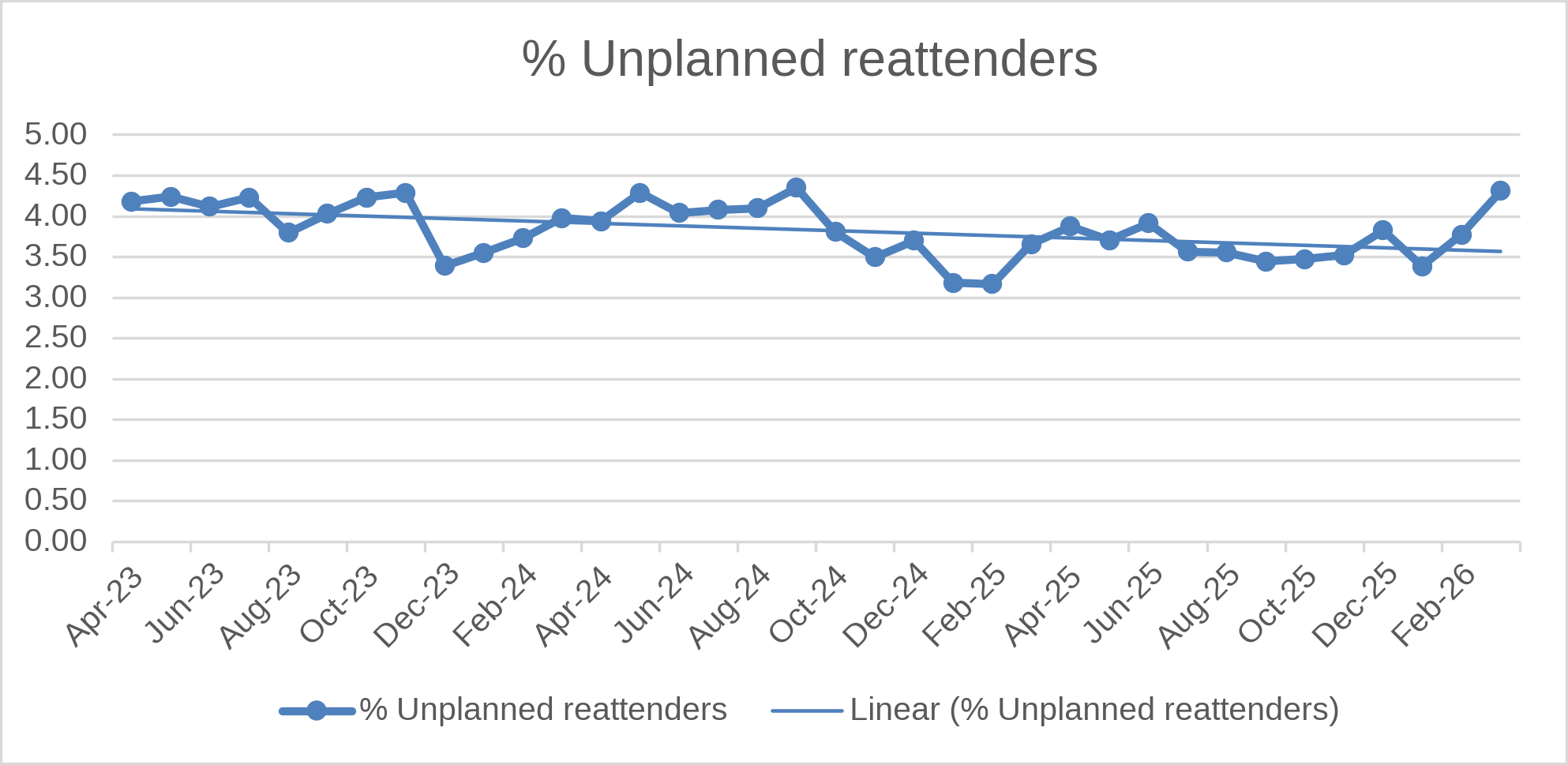
Actions taken to improve standards
Both Antrim and Causeway Emergency Departments have remained challenged over 2025/26 with high number of patients with decisions to admit remaining in both EDs for a prolonged period. The introduction of the 2-hour ambulance backstop in the winter plan has provided a challenge for both departments due to the overcrowding within both EDs. This has been an area of focus for the departments with some additional senior nursing provided to ensure senior oversight of flow within the EDs. The trust has continued to work with NIAS colleagues to expand and promote alternative pathways to ED to maximise ambulance turnaround.
Reducing the risk of Hyponatraemia
The Trust continues to participate in the regional implementation programme in response to the 2018 Inquiry into Hyponatraemia-related Deaths (IHRD). The Trust’s IHRD task and finish group continues to review implementation of phase 2a and 2b of the programme, with 29 of the 37 actions relating to the Trust complete, and the remainder paused whilst awaiting further regional direction. These are linked to the new SAI process and are unresolved because the final regional methodology has not yet been issued.
The Trust monitors ongoing compliance with corporate mandatory training for all intravenous (IV) fluid prescribers, with particular reference to prevention of hyponatraemia, as one of its key patient safety markers.
The Trust IV Fluid Therapy steering group reviews IV fluid related incidents in order to identify themes and circulate transferable learning, and Trust IV fluid prescribing policies for both children and adults are being updated to reflect the Trust’s transition to patient management and IV fluid prescribing via the encompass system.
Right Patient, Right Blood
Right Patient Right Blood (RPRB) training via the E-Learning For Healthcare (ELFH) platform is no longer accessible to staff working in Northern Ireland; all RPRB e-learning can be accessed via the LearnHSCNI platform. Blood Collection and Phlebotomy Pathway modules are currently being developed by the Regional and UK Haemovigilance teams. In the interim, Healthcare assistants and phlebotomists can complete the “Essential Transfusion Practice” module as an alternative, or attend a classroom session with a Haemovigilance Practitioner. The UK and Ireland Editorial board are also reviewing the current Essential Transfusion Practice module, creating a paediatric version of this module and reviewing the content of the Consent module following the publication of new Safety of Blood, Tissues and Organs (SaBTO) guidelines for Consent for transfusion in June 2025.
Haemovigilance continue to facilitate classroom-based sessions for RPRB training and Assessor training for nursing and midwifery staff, RPRB training for Healthcare Assistants and Phlebotomists and competency assessment sessions for medical staff. The NI Regional Haemovigilance team is also looking at developing a simulated/virtual based RPRB competency assessment for the future, although this project is currently at an early stage.
RPRB compliance is monitored continually by Haemovigilance via incident investigation and sample error monitoring. Data collection is also currently underway for the Trust’s biannual RPRB monitoring compliance audit, the results and recommendations from which will available for presentation and dissemination at the next Hospital Transfusion Committee meeting. Following the introduction of encompass, Haemovigilance continue to monitor compliance of patient wristband scanning for pre-transfusion sampling, patient wristband scanning for blood component administration, blood component barcode code scanning, porter collection slips and accurate transfusion documentation in encompass.
Haemovigilance continue to support staff on the ground with queries related to safe transfusion practice, adherence to national transfusion guidelines and transfusion documentation within encompass. The Haemovigilance team continue to engage with the encompass project to achieve full integration for transfusion between encompass and the Laboratory Information System, while also engaging with the Blood Production and Tracking Project which aims to deliver a full vein to vein IT blood tracking solution.
Identification and management of Sepsis within Emergency Departments
Sepsis is a life-threatening condition that arises when the body’s response to an infection injures its own tissues and organs.
Currently, directly comparable audit data is not available via the encompass system. The Trust is seeking alternative metrics to identify and define performance in the sepsis / deteriorating patient domain. More targeted work to identify patients actively developing sepsis is being considered as part of a live safety and governance initiative.
Cancer targets
Performance against the three cancer targets:
- Urgent suspected breast cancer referrals seen within 14 days target (100%)
- 2023/24: 31%
- 2024/25: 10%
- 2025/26: 5%
- Patients diagnosed with cancer who receive their first definitive treatment within 31 day target of a decision to treat (98%)
- 2023/24: 93%
- 2024/25: 90%
- 2025/26: 93%
- Patients urgently referred with a suspected cancer who begin their first definitive treatment within 62 days target (95%)
- 2023/24: 36%
- 2024/25: 29%
- 2025/26: 32%
The 14-day target continued to be a significant challenge, with only 5% of patients being seen within the target timeframe. In May 2025, a regional waiting list for Red Flag Breast referrals was introduced to help address inequalities in access and waiting times across Trusts; however, capacity constraints across the region continued to affect performance.
The 31-day and 62-day performance saw small improvements compared with 2024/25. Overall, 93% of patients received their first definitive treatment within 31 days against a target of 98%. The 62-day performance was 32% against a target of 95%, with delays to outpatient appointments and diagnostic interventions continuing to have the greatest impact on performance.
NICE Guidance
The role of the National Institute for Health and Care Excellence (NICE) is to improve outcomes for people using the National Health Service (NHS) and other public health and social care services. One way it does this is by producing evidence-based guidance and advice for health, public health and social care practitioners.
A wide range of different resources published by NICE are used by the Trust in the development and review of policies and guidelines. Examples include clinical guidelines, public health guidelines, antimicrobial guidelines, technology appraisals and clinical knowledge summaries, which are utilised by Trust staff in the development and review of Trust policies and guidelines. Once the Trust policies are approved, they are disseminated for reference by staff and are available within the Trust Policy Library.
The Department of Health (DoH) endorses the implementation, monitoring and assurance of NICE Clinical Guidelines and Public Health Guidelines. A total of 9 newly endorsed NICE Clinical Guidelines, and 18 updates to previously published Clinical Guidelines were received during 2025/26. A total of 67 NICE Technology Appraisals and 5 NICE Technology Appraisals not recommended were issued during 2025/26. There was 1 new Public Health guideline endorsed in 2025/26.
NICE COVID-19 Rapid Guidelines have been developed in collaboration with NHS England and NHS Improvement and a cross-specialty clinical group supported by specialist societies and Royal Colleges to assist with the active management of people with suspected and confirmed COVID-19 in a number of clinical areas.
No NICE COVID-19 Rapid Guidelines were published during the 2025/26 financial year. However, there was an update to 1 previously issued NICE COVID-19 Rapid Guideline.
All such guidelines and related updates published to date have been issued to divisions within the Trust and confirmation sought regarding dissemination and implementation being taken forward, where applicable. Services identified any implementation issues.
Regular update reports were provided to relevant Committees and Groups within the Trust’s Integrated Governance and Assurance Framework Committee Structure.
International, National and Regional Audits
Clinical and social care audit is a way to find out if care and professional practice is in line with standards, and informs care providers and service users where a service is doing well and identifies what is not working with the aim of changing it. This allows quality improvement to take place where it is most needed and as a result improve treatment, care, safety and service quality for service users.
Trust staff have continued to engage in clinical and social care audit work, including international, national and regional audit projects.
International and national clinical or social care audit projects provide an opportunity to measure practice and services against evidence-based standards, using validated tools enabling comparison and benchmarking with other HSC Trusts and Hospitals elsewhere in the UK.
Such audits are managed or led by another organisation, with the Trust, along with other organisations, contributing to the audit. The lead organisation is responsible for reporting on the audit outcomes; however, the Trust recognises the importance of identifying learning and introducing any necessary improvements within the Trust.
During the 2025/26 financial year clinical teams contributed to a number of specific audit projects and service evaluations including:
- Antimicrobial use in ICUs, no intervention
- Breast Reduction Of Surgical Site Infection using several Novel Interventions (ROSSINI)
- Evaluating Variation in management following admission with Acute Decompensation of cirrhosis is a trainee-led national multicentre audit, and our first study with a prospective design (EVADE)
- Guy’s and St. Thomas’ NHS Foundation Trust GLIMPSE- GLP-1/GIP receptor agonists in UK surgical patients: a prospective observational multicentre service evaluation
- Managing Frailty in a Bed-Based Setting project
- NHS Blood and Transplant – Major Haemorrhage Audit
- Royal College of Psychiatrists: Improving the quality of valproate prescribing in adult mental health services
- Royal College of Psychiatrists: Use of medicines with anticholinergic (antimuscarinic) properties in older people’s mental health services
- Society for Acute Medicine Benchmarking Audit (SAMBA 25)
- Service Evaluation of Cross-Specialty UK Rapid sequence intubation (RSI) Events (SECURE)
- TRIC BLOCK – Evaluating the prevalence and practice of neuromuscular blockade by infusion within UK Intensive Care Units.
The Trust also contributes to National Confidential Enquiry into Patient Outcome and Death (NCEPOD) audits. NCEPOD audits contributed to during 2025/26 include:
- Acute Illness in People with a Learning Disability study
- Stabilisation of the Critically Ill Child study
- Pleural Procedures
- Rib Fractures
The above audits have provided an opportunity to review patient management, outcomes, safety and clinical effectiveness. A number of these audit projects are ongoing. The results generated from these audits will help inform clinical practice and improve patient care. For example, the TRIC BLOCK – Evaluating the prevalence and practice of neuromuscular blockade by infusion within UK Intensive Care Units – audit seeks to evaluate current UK ICU practice in prescribing, maintaining, monitoring, and discontinuing Neuromuscular Blocking Drug (NMBD) infusions in critically ill adults and children and to capture national variation in practice and assess prevalence, indications, dosing regimens, monitoring strategies, and adverse events associated with continuous NMBD use.
Regional Audits
The Trust continues to participate in regional audits with fellow Trusts and other lead organisations. Regional audits participated in during 2025/26 include:
- Regional Audit of Consent for Hospital Post Mortem Examination of a Baby
- Northern Ireland Transfusion Committee 2026 Audit on Preventable Transfusion by Anaemia Optimisation
- Audit of adherence to guideline: Opioid Toxicity and Use of Naloxone for Adult Inpatients on Long-Term Opioids for Pain.
Additional Audit Programmes
In addition to participation in international, national and regional audit programmes, the Trust also has a mandatory clinical and social care audit assurance programme. The programme content is directed by audit assurances or monitoring required by external organisations and internal Trust obligations for example, learning from serious adverse incidents, complaints, litigation or to provide assurance over new policy or guidance. Clinical and social care professionals are also involved in a range of audits at service/departmental level.
The Trust’s Clinical and Social Care Audit and NICE Implementation Committee monitors progress with projects and the implementation of recommendations and learning following project completion. An annual clinical and social care audit report for the 2025/26 year will be produced during 2026.
Theme 5: Integrating the care
Building Partnerships and Integrating Care
During 2025/26, the Trust strengthened its commitment to partnership working and integrated care through the establishment and ongoing development of the Northern Partnership and Population Health Committee, a unique sub-committee of the Trust Board that brings together service users, carers, community and voluntary sector representatives, and statutory partners in a shared governance forum.
The Committee provides strategic leadership for improving population health and wellbeing, reducing health and social inequalities, supporting carers, and promoting prevention and early intervention through collaborative action.
By aligning the efforts of health and social care services with community and voluntary organisations, the Committee seeks to support a more coordinated, place-based approach to service delivery, recognising that improving outcomes requires collective action across the whole system. Working with partners, it also offers space to drive innovative approaches which have been demonstrated through initiatives such as Community Appointment Days for memory services, children’s services and physiotherapy. These have provided accessible, community-based opportunities for assessment, advice, support and signposting within a single “one stop shop” setting.
Going forward the Committee is ambitious about promoting stronger integration between health, social care and community support services to closer align with community planning priorities, Area Integrated Partnership Boards and the emerging neighbourhood models of care.
Trust / GP Partnership
The Trust / GP Partnership has revised and refreshed its Terms of Reference, with a full GP Forum meeting quarterly alongside a smaller Operational Group and an annual Open Meeting, for all GPs in the Northern Area.
The Trust’s focus in 2026/27 will be on the development of the Neighbourhood Model of Health and Wellbeing, which will see the establishment of four Integrated Neighbourhood Teams in the Northern area, planning and delivering care based on local population needs.
Community Care
Community Care services have delivered demonstrable progress in integrating care, improving access, and strengthening community-based delivery models. This includes the establishment of multi-disciplinary teams across all Causeway GP practices evidencing increased capacity, improved access and reduced reliance on acute services.
District Nurses at the Heart of the Community
District Nursing explored the theme of population health and wellbeing during a conference in April 2025. Neighbourhood District Nursing, a regional community-nurse led model of care piloted in Ballycastle and Cushendall evidenced the importance of Population Health Management. District Nursing highlighted that population health profiling is the first step in producing a Population Health Improvement Plan; an upstream approach to proactive health promotion and public health. Multi-disciplinary learning and interaction was gained from a wide range of speakers including the Public Health Authority’s District Nurse Consultant, Primary Care Multi-disciplinary Team Lead, Connect North Leads, Rural Health and Wellbeing Manager, Causeway Coast and Glens Borough Council Home Safety Officer and the Regional Lead and Project Lead for Care Opinion.
District Nurses Reach Out to Community Based Events
District Nursing recognises the importance of sharing information with service users and carers and understand the information and support available from the community and voluntary sector. Subsequently, District Nursing have attended a number of events – Big Lunch, Ballymena Farmers’ Market (May 2025); Carers Week Information Fair – NNSCT/Causeway GP Federation (June 2025); Mid and East Antrim Agewell Community Wellbeing Event (October 2025).
A career presentation delivered by a District Nurse at Cullybackey High School was warmly received whilst recognition of loneliness triggered a joint initiative between District Nursing, the Rural Health and Wellbeing Manager, Bann Main West Community Group and a local supermarket with the delivery of Christmas hampers to a number of patients on the caseload of local District Nursing Teams.
District Nursing Service Test the iMPAKT Application Software
Mid-Ulster District Nurses are taking part in pioneering research, as a global partner, testing the commercial grade iMPAKT app and eight Key Performance Indicators measuring person-centredness and patient experience. The acronym iMPAKT represents the title of both the research and the app – Implementing and Measuring Person-centredness using an APP for Knowledge Transfer. This research also explores the iMPAKT app’s usability, acceptability and feasibility.
A convergent, multiple-methods approach to evaluate implementation of the iMPAKT app has enabled data to be collected across patient stories, patient surveys, time observation practice and the review of nursing documentation across two six-week cycles.
Qualitative data identified the iMPAKT app as user friendly with some technological barriers with the District Nursing working environment. The iMPAKT app evidenced the unique contribution made by nurses and recognised the intrinsic value of nursing.
Patient feedback boosted morale and was important for staff to share, learn and speak with patients when any issue was identified. The iMPAKT app was an effective method to measure the patient experience and generated clear, concise reports in real time. Outcomes helped staff recognise the whole person they were caring for. The data also indicated a direct link between the outcomes and a key focus on enhancing the patients’ quality and safety.
International Forum on Quality and Safety in Healthcare 2025
At the International Forum on Quality and Safety in Healthcare 2025, Maria Betts, Advanced Nurse Practitioner, was chosen to present her poster (Frailty Focus – Empowering Rural Health with Advanced Nurse Practitioners) as an oral presentation at the Populations Stage in Utrecht in May 2025. In her presentation, Maria highlighted the impact that the Advanced Nurse Practitioner in District Nursing role, could make to support people to remain as independent as possible and to remain in their own homes safely. Maria has been working on developing frailty identification in District Nursing services and plans to complete a quality improvement project to embed the Clinical Frailty Score into holistic person-centred nursing assessments.
Establishment of a Multi-Sensory Room within the Macmillan Unit, Antrim Area Hospital
The Northern Health and Social Care Trust is committed to delivering person-centred, compassionate, and holistic care in line with regional palliative and end-of-life care strategies and the Trust’s values of compassion, respect, and excellence. The Macmillan Unit is a 12 bedded Hospice Unit, on the Antrim Hospital site and provides multi-disciplinary end-of-life care and symptom management to patients and support to their relatives and loved ones.
The Unit is known to provide a caring environment for loved ones with a quiet room, family room and supportive Macmillan Volunteers and we actively seek feedback from patients, staff and family. Recent feedback highlighted the benefits a Sensory Room would provide.
The establishment / introduction of a multi-sensory room directly supports several strategic priorities and frameworks. At the outset, there was no multi-sensory provision in any adult palliative setting in Northern Ireland, including at the Macmillan Unit. The need to introduce a sensory space within the Macmillan unit, with controlled lighting, sound, aroma, visual stimulation, and tactile experiences which would help promote calm and relaxation. This facilitates spiritual care and reflection, provides a comforting environment for family visits and memory-making and supports symptom management, particularly for patients with agitation, restlessness or cognitive impairment/decline. Additionally, this room benefits families with additional needs, such as autism or sensory processing difficulties by offering a safe, calm space. This space has been a collaborative exercise between staff, patients’ families, estates and finance, and is a true reflection of the Trust’s Palliative Care service understanding and meeting patients’ needs.
Mental Health
Crisis planning within Mental Health Services has been enhanced through a number of initiatives as follows:
Review of Urgent Mental Health Services and Enhanced Crisis Provision at Causeway Emergency Department
A review of Urgent Mental Health Services commenced in 2024, culminating in a Management of Change proposal which supports the development of a single integrated Urgent Mental Health Service, incorporating both Crisis Resolution Home Treatment Team (CRHTT) and Mental Health Liaison Service (MHLS).
As part of this transformation, the services now operate under a unified management and medical leadership structure, promoting consistency in clinical practice, governance, and service delivery. The integrated model has also supported the implementation of an enhanced overnight crisis response service within Causeway Emergency Department.
The introduction of a dedicated night-shift model has ensured that all service users referred between 22:00 and 07:00 are assessed within two hours of referral. This arrangement has replaced the previous sleep-in on-call model and has significantly strengthened overnight service provision. In addition, all out-of-hours community contacts are now received and managed by a dedicated mental health practitioner, improving responsiveness and access to urgent support.
Purposeful Admission Statement
A Purposeful Admission Statement was introduced across Urgent Mental Health Services (CRHTT and MHLS) during 2023/24, supported by the Health and Social Care Quality Improvement Northern Ireland (HSCQNI) programme.
The initiative was designed to support collaborative decision-making regarding inpatient admission and to ensure that admissions are goal-orientated, clinically indicated, and focused on achieving specific recovery outcomes. Initial evaluation demonstrated a 12% reduction in requests for inpatient admission.
Following the implementation of the encompass electronic patient record system, Urgent Mental Health Services are undertaking a further review of the Purposeful Admission Statement. This work will focus on optimising documentation processes, enhancing communication with service users and inpatient teams, and maximising the opportunities presented through encompass to support person-centred care and effective discharge planning.
Regional Safety Planning Tool
Acute Mental Health Services, including CRHTT, MHLS and inpatient mental health services, continue to support the implementation and embedding of the Regional Safety Planning Tool.
Over the past year, significant progress has been made both locally and regionally to standardise the use of safety plans and improve accessibility. As part of this work, safety plans are now uploaded directly to the encompass system and can be accessed by service users through the MyCare patient portal.
This development enhances service user involvement in their own care, improves accessibility to personalised safety planning information, and supports a more consistent approach to risk management and crisis prevention across acute mental health services.
Physical Health Monitoring Service for individuals with severe mental illness
The Physical Health Monitoring Service for individuals with Severe Mental Illness (SMI) was established within the Northern Health and Social Care Trust in 2021. Following a recent review of the Standard Operating Procedure (SOP) a number of improvements to strengthen the service and ensure robust and consistent processes are implemented across all nine Community Mental Health Teams (CMHTs) have been put in place.
Key improvements include:
- Additional Physical Health Support Worker sessions allocated across each CMHT
- Expansion of monitoring requirements to include antipsychotic medications beyond clozapine
- A designated CMHT nurse responsible for overseeing clinics and completing the appropriate clinical assessments
- Arrangements to ensure continuity of service when a Physical Health Support Worker is unavailable to facilitate a clinic
- Development of a service user information leaflet
- Inclusion of a guide outlining the required investigations and monitoring standards
- Introduction of a more comprehensive lifestyle questionnaire, supported by guidance, resources, and signposting based on individual responses
- An updated encompass process whereby CMHT staff can initiate investigation requests, with Physical Health Support Workers completing the ordering process
Information and training sessions will be delivered to all CMHTs during September 2026 to support implementation and ensure staff are familiar with the revised processes.
The Physical Health Monitoring Service forms part of the wider SMI Pathway Group, which continues to drive improvements in the care and support provided to individuals living with severe and enduring mental illness. The team monitors Community Psychiatric Nurse (CPN) compliance with electrocardiograph training requirements, ensuring appropriately trained staff are always available to maintain clinic service delivery. A personalised health handbook is currently being developed to support service users in understanding, monitoring, and managing their physical health needs. It is anticipated that the handbook will be implemented across services during October/November 2026. These developments aim to promote consistency across CMHTs, enhance patient safety, improve service user experience, and ensure compliance with best practice standards for physical health monitoring.
Delirium
Work has taken place to include Delirium as part of encompass. Delirium assessment is included as part of admission navigator and then if required staff utilise and complete delirium flowsheet daily as part of delirium prevention plan, consideration and implementation of prevention strategy measures.
Social Work and Social Care Quality Performance
Social work and social care services support children, families and adults at times when they may be experiencing profound change, risk or vulnerability. Quality is therefore measured not only through activity and compliance, but through the safety and consistency of the support people receive. During 2025/26, the Northern Health and Social Care Trust continued to discharge its statutory social work functions while responding to sustained demand, increasingly complex need, workforce movement and significant pressure on placements, home care and specialist beds.
The overall position is one of continued delivery with clear and active oversight. Important progress has been achieved, including reductions in several unallocated caseloads, a 90% frontline social work retention rate, the appointment of 48 newly qualified social workers and the safe completion of all remaining Trust resettlements from Muckamore Abbey Hospital. At the same time, some people have waited longer than the Trust would want for allocation, review, care, short breaks or the right placement. These pressures can affect experience and continuity, and they require sustained action.
A clear line of sight on quality and risk
The Trust exercises statutory functions under the Health and Personal Social Services (Northern Ireland) Order 1994 and retains full accountability for how those functions are delivered. Assurance is provided through twice-yearly statutory function reports to Trust Board, six-monthly Corporate Parenting reporting, the Social Care Governance Steering Group, quarterly action-plan oversight through Trust Board Governance Committees and reporting to the Standards and Compliance Committee. Divisional, Corporate and Principal Risk Registers record significant risks, identify owners and controls, and provide routes for escalation to senior leaders and the Strategic Planning and Performance Group (SPPG).
These arrangements connect individual service pressures with organisational decision-making. They require teams to report not only the scale of a problem but its potential effect on safety, experience and statutory compliance. The 2026/27 Statutory Functions Action Plan is the single control document for this work. It brings together 20 issues across Children and Family Services, Mental Health, Learning Disability, Older People and Adult Services, and Physical Disability. Progress will be reviewed through Trust governance and at formal interfaces with SPPG, with updates at mid-year and year-end.
The controls do not remove pressure. They do, however, ensure that risk is not hidden, that urgent concerns can be escalated and that professional judgement is supported. This is particularly important where vacancies, absence or demand affect allocation and timeliness.
Children, young people and families
Children’s Services have faced exceptional growth in demand. The number of looked after children increased from 732 in April 2021 to 907 in March 2026, an increase of 175 children, or approximately 24%, over five years. Behind each number is a child who needs stability, meaningful relationships and a placement able to meet their individual needs. The growth has placed pressure on social work capacity, fostering and kinship services, residential provision, statutory visits and reviews, and the wider responsibilities of corporate parenting.
Placement sufficiency remains one of the most significant quality challenges. The Trust continues to make progress on an updated Placement Sufficiency Plan with clear milestones and escalation triggers and monthly reporting.
Kinship care enables many children to remain within their family or trusted network and is an important strength of the care system. It also requires timely assessment, supervision and practical support. At the reporting point, 404 children were living in kinship placements; 174 of them were living in 109 unregulated placements where assessment had not started or had not been completed within the required timescale, and 104 kinship carers did not have an allocated social worker. The action plan therefore requires a time-bound reduction in the assessment backlog, stronger support for carers pending assessment and continued work towards the capacity required for a third kinship team. This must remain a priority because good kinship care depends on carers and children being seen, supported and reviewed consistently.
There has been encouraging improvement in unallocated activity. Looked After Children services reported 57 unallocated cases in March 2026, 125 fewer than at the previous interim reporting point. Gateway and Family Support and Intervention Teams together reduced unallocated cases by 71 over the year. At year-end, Gateway held 70 unallocated cases and Family Support and Intervention Teams held 55. These gains show that recovery planning, recruitment and senior oversight can make a difference. However, performance can change quickly as vacancies move between teams, and the scale of current caseloads means monthly monitoring, risk-based prioritisation and quality assurance must continue.
Pressure has increased in Children with a Disability services, where 69 cases were unallocated, 38 more than at the previous year’s interim reporting point. Residential short-break capacity also remains constrained. Whitehaven has partially reopened but at reduced capacity, while Edenview has remained unavailable for short breaks because of workforce challenges; 352 fewer overnight breaks were delivered than in the previous year. The Trust will maintain monthly capacity and demand reporting, protect the provision that is available, set out a trajectory for restoring capacity and maintain contingency support for families.
Child protection activity demonstrates both active safeguarding and the need to improve timeliness. Of 218 scheduled Child Protection Case Conferences, 59% proceeded as planned. Among conferences that required rescheduling, 11% breached the timescale set by Safeguarding Board policy. Chair and family availability, quorum, delayed reports and staff sickness all contributed. The response is clear: strengthen chairing capacity, monitor reasons for delay, escalate breaches and maintain senior oversight so that children’s plans are considered without avoidable delay.
Early Years daycare governance has become a significant improvement focus. The Trust began an internal review in January 2026. The programme includes review of daycare settings, a Social Work Governance audit, a Service Improvement Plan, clearer incident triggers, revised panel guidance, an Early Years Board chaired by an Assistant Director and formal risk-register oversight. The required outcome is consistent regulation, timely enforcement and evidence that improvement is sustained.
There is significant work ongoing within Children’s Services in respect of the Together for Families Programme (£60M investment) funded jointly by the Public Sector Transformation Fund and The National Lottery Community Fund. This is the first strategic investment of its kind by The National Lottery Community Fund anywhere in the UK. The programme is designed to transform how families are supported and will operate across a continuum of need ranging from low level practical supports through to more intensive services – aimed at reducing the number of children in care or at risk of being taken into care. Aligned to the Department of Health’s Reset Plan, Together for Families is based on collaboration across the statutory and Voluntary, Community and Social Enterprise sectors and will involve strengthening and enhancing services that already exist, delivering new services or taking different approaches to service delivery. Families – children and parents are central to implementation of the model.
Over the past year, the Trust has continued to deliver high-quality, child-centred care to children and young people open to the Trust’s Child and Adolescent Mental Health Service Step 2 and Step 3 services. The teams have remained focused on providing timely, evidence-based support that responds to the needs of each child and their family, and on working closely with their partner agencies to make sure that support is joined up. Alongside this, the Trust’s specialist services have continued to develop and respond to growing need.
Reform is under way within the Trust’s Attention Deficit Hyperactivity Disorder (ADHD) service, with the aim of improving the experience of children, young people and families and strengthening the pathway from referral through to assessment and support. The Trust also continues to support autistic young people before, during and after diagnosis, recognising that families need help at every stage, not only at the point of assessment.
In addition, the Child Learning Disability Therapeutic Service continues to provide a specialist therapeutic service to children with severe learning disabilities, ensuring that some of the Trust’s most vulnerable children and their families have access to skilled, compassionate and tailored support.
Adult Services
Adult services continue to manage high demand, workforce gaps and increasing complexity. Unallocated cases remain a serious pressure because delay can affect assessment, independence, carer support and timely access to services. There has nevertheless been substantial progress. Community Care unallocated cases reduced from 1,422 in April 2025 to 889 in March 2026, a reduction of 533 or approximately 37%. This direction of travel is positive, but the remaining volume is unprecedented and requires continued senior review, clear escalation, recruitment, demand management and safe triage.
Timely annual care management reviews are another important measure of quality. Reviews provide an opportunity to hear what matters to the person and carer, confirm that support remains appropriate and identify changing need before it becomes a crisis. During the reporting period 22.2% of reviews in Older People’s Services were outstanding. Learning Disability review compliance was approximately 79-80%. Recovery plans will set monthly trajectories towards at least 90% compliance, with routine reporting and escalation when performance deteriorates. The Trust will also continue engagement on Department of Health guidance about who may undertake reviews of non-complex cases, while ensuring that professional accountability and quality are protected.
Home-care capacity remains a material system pressure. At 31 March 2026, 332 older people and 179 people using Physical Disability services were waiting for a full package of care; a further 58 people across the two service areas were waiting for a partial package. In total, 569 people were awaiting some or all of their assessed home-care support. The issue is being managed through regional planning and oversight processes as well as local work to maximise capacity. While people wait, services must continue to prioritise by risk, maintain communication, support carers where possible and escalate any deterioration in need.
Mental Health services have continued to experience protracted waits for acute beds, including for people who require admission under the Mental Health (Northern Ireland) Order 1986. Delays create pressure for the person, their family, Emergency Departments, Approved Social Workers and inpatient teams. Daily bed huddles, twice-daily oversight of capacity and allocation, senior escalation and reporting of delayed admissions are in place. The Trust will continue to report the effectiveness of contingency arrangements, improve flow across inpatient and community services and monitor the effect on Approved Social Work response times. Recruitment of four new Approved Social Worker candidates and continued regional work on emergency and out-of-hours pathways are positive steps, but timely access to an appropriate bed remains the required standard.
During the reporting period all remaining Northern Trust patients were safely discharged from Muckamore Abbey Hospital. This is a significant achievement for the individuals involved and for the staff and partners who supported carefully planned transitions. Pressure remains on specialist inpatient access, with risks of delayed admission, care outside the area or use of a non-specialist setting. The Trust will continue regional collaboration, protect clear clinical escalation and strengthen community alternatives, including crisis response and step-up/step-down planning.
Adult safeguarding and Mental Capacity Act arrangements have also been strengthened. A single adult protection officer structure, improved audit arrangements and new programme-level reports support more consistent oversight and earlier identification of trends. Completed safeguarding documentation has been transferred into encompass to improve the quality of available data. Mental Capacity Act assurance includes a satisfactory Business Services Organisation audit, further work on proportionality, management-of-change planning and development of a Nominated Person forum. Training compliance in acute services remains a risk and has been escalated, with remedial action in place. Carers remain essential partners in care, and the Trust will continue to promote carers’ assessments using the Northern Ireland Single Assessment Tool and Carer’s Conversation Wheel while improving recording and reporting.
Workforce
The quality of social work depends on having enough people with the right knowledge, experience, supervision and support. Frontline social work retention is now 90%, providing positive evidence that local recruitment, professional support and retention initiatives are having an effect. A total of 48 newly qualified social workers joined the Trust during the reporting period. All available Adult Services posts were filled, although 11 Children and Young People’s Services vacancies remained – eight temporary and three permanent. These vacancies will continue to be targeted, and new appointees must be deployed into teams able to provide safe induction, supervision and early-career support.
This work now sits within the Department of Health’s Ten-Year Plan to Attract, Recruit and Retain Social Workers 2026-2036. The plan moves the regional response beyond short-term stabilisation and is organised around three connected priorities: attract people into a diverse and respected profession; recruit through reliable workforce intelligence and timely processes; and support and retain staff through safer staffing, wellbeing, professional development and clear career pathways. It also recognises that proposed regional developments could require around 521 additional social work and social care posts over time. Growth must therefore be planned and phased so that new services do not unintentionally destabilise established statutory teams.
Implementation of Safer and Effective Staffing in Social Work has progressed from familiarisation to evidence gathering. The guidance is not a mechanical caseload formula: safe staffing also depends on complexity, staff experience, team composition, supervision, absence cover and professional judgement. The Trust submitted 88% of social work caseload data for the regional gap analysis with the Department of Health and the Northern Ireland Statistics and Research Agency. Managers and senior social workers validated and categorised individual cases to improve the reliability of the evidence. The findings must now inform practical decisions about workforce growth, skill mix, process improvement and phased investment, while teams continue regular workload review and escalate unsafe or unmanageable demand.
Professional development remains a quality control, not an optional extra. During 2025/26 the Trust supported 117 practice-learning opportunities, 46 social workers through their Assessed Year in Employment and 66 Assessed Year in Employment staff in post at 31 March 2026. Every portfolio was audited before sign-off. Fifteen additional experienced social workers completed mentoring training during the year, and a further 12 mentors are now being trained. The first Social Work Schwartz Round created a structured space to reflect on the emotional, social and ethical impact of practice; feedback is being evaluated before the model is expanded. Supervision audit actions continue to strengthen service plans, agreements, recording and professional supervision for social workers in multidisciplinary teams.
Recognition also matters. The Trust submitted 35 nominations for the forthcoming Social Work Awards, representing every service area. These nominations celebrate compassion, innovation, leadership and sustained professional commitment. They also help the public see the skill and humanity of a workforce that regularly makes a life-changing difference in difficult circumstances.
Our priorities for 2026/27
The direction for the coming year is clear. The Trust will:
- strengthen placement sufficiency, continue efforts to reduce exceptional and unregulated arrangements, and deliver time-bound improvement in kinship assessment and support;
- continue work to reduce unallocated cases and improve statutory visits, reviews and conferences through monthly trajectories, risk-based prioritisation, quality assurance and senior escalation;
- develop plans to restore and stabilise short-break capacity for children with disabilities and strengthen Personal Adviser provision for young people leaving care;
- drive adult care-review performance towards at least 90% and maintain safe oversight, communication and escalation for people awaiting allocation or home care;
- deliver on actions to improve access and flow for specialist Mental Health and Learning Disability beds while strengthening community and crisis alternatives;
- translate safer-staffing evidence into clear workforce, skill-mix and resource decisions, while sustaining recruitment, supervision, mentoring, wellbeing and professional development; and
- complete Early Years assurance actions, strengthen social care governance and use audit, incidents, complaints, safeguarding information and feedback to demonstrate sustained learning.
Annual Health Checks
Trust Healthcare Facilitators (HCFs) have continued to engage with GP practices to ensure that the GP registers for people with a learning disability are kept up-to-date. HCFs are working within the community learning disability teams to identify transitions and ensure they are added to the learning disability register. It has been observed during register reviews that some practices have not carried out health checks during the financial year of 2025/26. Whilst other practices are seeking more support from HCFs to complete these, there has been an increase in requests for HCFs to complete annual health checks without any input from the GP practice; a differing view from how the health check process was set up. HCFs feel the change in funding to the annual health checks from 2024 continues to have a direct impact on the completion of these by GP practices.
During the reporting period, 987 health checks were completed by GPs; of which 348 were completed with support from HCFs. Staffing levels from June 2025 to the present day there is only two HCFs working 30 hours per week. The third HCF currently works 2 days per week in her HCF role due to secondment the other 3 days.
The HCFs continue to liaise with GP practices and work closely with them to promote the completion of annual health checks, offering assistance as required and ensuring reasonable adjustments are made. The HCFs completed health checks across the Trust, either in service users’ own homes or in a clinic setting. Other settings are considered depending on the service users’ needs and wishes.
The HCF complete one-to-one health promotion sessions via referral from the community learning disability services. Group work has been completed in adult centres, bases and supported living units.
HCFs continue to collaboratively work with the breast screening service in identifying people with learning disability who require reasonable adjustments. HCFs are currently building links with Abdominal Aortic Aneurysm screening to ensure uptake from the learning disability population.
- Larne / Carrick / Newtownabbey
- 157 health checks completed (21%)
- 53 completed with health facilitator support (36%)
- Causeway / Ballymena
- 375 health checks completed (32%)
- 231 completed with health facilitator support (65%)
- Magherafelt / Antrim
- 455 health checks completed (52%)
- 64 completed with health facilitator support (14%)
Alternative formats
Annual Quality Report 25-26 (PDF, 22.8MB)