
Contents
- Overview
- Non-Executive Directors’ Report
- Directors’ Report
- Statement of Accounting Officer’s Responsibilities
- Governance Statement
- Remuneration and Staff Report
- Assembly Accountability and Audit Report
Corporate Governance Report
Overview
The purpose of the Accountability Report is to meet our key accountability requirements to the Northern Ireland Assembly. The report contains three sections: the Corporate Governance Report, the Remuneration and Staff Report; and the Accountability and Audit Report.
The purpose of the Corporate Governance Report is to explain the composition and organisation of the Trust’s governance structures and how these support the achievement of the Trust’s objectives.
The Remuneration and Staff Report sets out the Trust’s remuneration policy for Directors, reports on how that policy has been implemented and sets out the amounts awarded to Directors. In addition the report provides details on overall staff numbers, composition and associated costs.
The Accountability and Audit Reports bring together the key financial accountability documents within the annual accounts. This report includes an overview of the financial resources and performance of the Trust and the External Auditor’s certificate and opinion on the financial statements.
Non-Executive Directors’ Report
In 2025/26 the challenge for the Trust has been the effective planning and delivery of services under increasing demand and shortage of resources. In that context, the Trust Management Board is focused on determining the key operational priorities and balancing corporate risks in the prioritisation of front line services to manage delivery. We share a common goal to promote the health and wellbeing of our local population by supporting the continued efforts of our incredible staff and our heartfelt thanks go to all of our staff, our volunteers and our independent/ community sector stakeholders for all that you do in partnership to deliver the myriad of services to our communities.
The primary role of Non-Executive Directors (NEDs) is to provide support, challenge and an independent voice, at a corporate level, across all the work of the Trust. The NEDs sit on the Trust Board and provide a wide range of expertise on public and community and voluntary sectors, as well as commercial matters.
During 2025/26, we welcomed the appointment of Paul Turley and Michael Keating as a NEDs.
We would like to pay tribute to George Platt whose tenure as a NED ended during 2025/26 and thank them for the support, wisdom, insight and the independent voice he brought to the Trust Board.
Despite changes in post holders during the year, the role of the NEDs has provided continuity of support, challenge and guidance through the Board and its sub-committees, to assist the Trust in delivering for everyone using our services, both at our hospitals and in our many community settings. In delivering their roles, the NEDs act as chairs of sub-committees of the Board, namely the:
- Audit Committee;
- Remuneration Committee;
- Charitable Trust Funds Advisory Committee;
- Outcomes and Assurance Committee;
- Organ Donation Committee; and
- Strategic Change and Improvement Capability
Leadership of these Committees focuses on continuous improvement and strong governance and accountability throughout the Trust. We recognise the importance of high quality documentation for decision-making and record keeping, as well as active management and regular review of corporate risks. The Governance Statement provides additional detail on all Committees and Board meetings held during 2025/26.
In their roles, the NEDs provide assurance that the Board has complied with its Section 75 equality and good relations duties by ensuring any policies developed or renewed are subject to the consideration of the groups that may be impacted.
The Board has complied with the Corporate Governance Code in the key areas of leadership, ensuring that a clear vision for the Trust was articulated. In considering any new policies, the NEDs look to satisfy themselves as to how these will contribute to achievement of the Trust’s vision and objectives, and are influenced by the Trust’s appetite to risk.
In summary, it is the collective view of the NEDs that the Trust Board has been effective in managing and controlling the resources for which it is responsible. Whilst there will always be room for improvement, e.g., adherence to Social Care Procurement and Contract Management arrangements, NEDs are satisfied that the Trust has undertaken significant work to improve its compliance with policies and procedures issued by the Department of Health which contribute to the governance, assurance and risk management processes throughout the Trust.
Directors’ Report
The role of the Trust Board is to direct and control the key strategic and managerial issues facing the Trust in carrying out its statutory and other functions.
The Trust Board is comprised of the Executive Directors of the Trust and Non-Executive Directors. There was considerable turnover in the composition of the Trust Board during the year (as outlined within the Governance Statement) but the final membership at year end was:
- Non-Executive Directors
- Anne O’Reilly Chair;
- Glenn Houston;
- Carol Diffin;
- Kathy Mackenzie;
- George Platt; (finished term 31 January 2026)
- Scott Armstrong;
- Paul Douglas;
- Paul Turley; ( joined 1 April 2025)
- Janet Gray and
- Michael ( joined 1 February 2026)
- Executive Directors
- Jennifer Welsh – Chief Executive (Resigned 30 September 2025)
- Suzanne Pullins – Interim Chief Executive (Started 1 October 2025)
- Owen Harkin – Executive Director of Finance (and Deputy Chief Executive)
- Stevie Lennon – Interim Executive Director of Finance (Started 18 August 2025)
- David Watkins – Executive Director of Medicine (Ended 19 September 2025)
- George Gardiner – Executive Director of Medicine (Started 1 November 2025)
- Maura Dargan – (Executive Director of Social Work (and Divisional Director of Children and Young People’s Division)
- Suzanne Pullins – Executive Director of Nursing, Midwifery and Allied Health Professionals (and Interim Divisional Director of Paediatrics, Women’s Services and Corporate Support) (Ended 30 September 2025)
- Gill Murphy – Interim Executive Director of Nursing, Midwifery and Allied Health Professionals (and Interim Divisional Director of Paediatrics, Women’s Services and Corporate Support) (Started 23 October 2025)
- Directors
- Jacqui Reid – Director of Human Resources, Organisation Development and Corporate Communications
- Gillian Traub – Director of Operations
Please see the Governance Statement for a full listing of other senior staff who are Divisional Directors.
A declaration of Board Members’ interests is maintained and available on the Trust’s website under the following link:
https://www.northerntrust.hscni.net/registerofinterests
Any relevant disclosures are detailed in Annual Accounts Note 20 Related Party Transactions, where applicable.
The Executive and Senior Management Teams, in supplement to the Director of Finance, have responsibility for the preparation of the Annual Report and Accounts. As far as the Directors are aware, there is no relevant audit information which has not been shared with the Trust’s auditor. They have taken all steps that they ought to have taken as Directors in order to make themselves aware of such information and to ensure that the Trust’s auditor, in turn, has been made aware of that information. The Board are content with the quality and accuracy of the data presented to assist them in the decision making process.
Since April 2025, eleven personal data related incidents were reported to the Information Commissioner’s Office (ICO). Further information is disclosed within the Governance Statement.
The auditor for the Trust is the Comptroller and Auditor General (C&AG). The notional cost of the audit for the year ending 31 March 2026 which pertained solely to the audit of the accounts is £92,800 made up as follows, Public Funds £85,000 and Charitable Trust Funds £7,800.
Statement of Accounting Officer’s Responsibilities
Under the Health and Personal Social Services (NI) Order 1972 (as amended by Article 6 of the Audit and Accountability (NI) Order 2003), the DoH has directed the Trust to prepare for each financial year, a consolidated statement of accounts in the form and on the basis set out in the Accounts Direction. The financial statements are prepared on an accruals basis and must give a true and fair view of the state of affairs of the Trust of its income and expenditure, changes in taxpayers equity and cash flow for the financial year.
In preparing the financial statements the Accounting Officer is required to comply with the requirements of the Government Financial Reporting Manual (FReM) and in particular to:
- Observe the Accounts Direction issued by the DoH including relevant accounting and disclosure requirements, and apply suitable accounting policies on a consistent basis;
- Make judgements and estimates on a reasonable basis, including those judgements involved in consolidating the accounting information;
- State whether applicable accounting standards as set out in FReM have been followed, are disclosed and explain any material departures in the financial statements;
- Prepare the financial statements on the going concern basis; and
- Confirm that the Annual Report and Accounts as a whole is fair, balanced and understandable and take personal responsibility for the Annual Report and Accounts and the judgements required for determining that it is fair, balanced and
The Permanent Secretary of the DoH as Principal Accounting Officer for Health and Personal Social Services resources in NI has designated the Chief Executive of the Trust as the Accounting Officer for the Trust. The responsibilities of an Accounting Officer, including responsibility for the regularity and propriety of the public finances for which the Accounting Officer is answerable, for keeping proper records and for safeguarding the Trust’s assets, are set out in the formal letter of appointment of the Accounting Officer issued by the DoH, Chapter 3 of Managing Public Money NI (MPMNI) and the HM Treasury Handbook: Regularity and Propriety.
As the Accounting Officer, I have taken all the steps that I ought to have taken to make myself aware of any relevant audit information and to establish that the NI Audit Office auditors are aware of that information. So far as I am aware, there is no relevant audit information of which the auditors are unaware.
Governance Statement
The Board of the Northern Health and Social Care Trust (NHSCT) is accountable for internal control. As Accounting Officer and Chief Executive of the Trust, I have responsibility for maintaining a sound system of internal governance that supports the achievement of the organisation’s policies, aims and objectives, whilst safeguarding the public funds and assets for which I am responsible in accordance with the responsibilities assigned to me by the Department of Health.
The Partnership Agreement between the Department of Health and the NHSCT sets out the partnership arrangements and in particular, it explains the overall governance framework within which the NHSCT operates, including the framework through which the necessary assurances are provided to stakeholders.
For 2025/26, the Trust had the following key relationships through which it demonstrated the required level of accountability:
- With the Strategic Planning and Performance Group Commissioners through service level agreements, to deliver health and social care services to agreed The Trust has established engagement processes with the Strategic Planning and Performance Group, which includes the Public Health Agency for appropriate areas. For example, regular meetings are held with Local Commissioning Group (LCG) representatives to discuss local services;
- With colleague agencies in HSC, through close and positive working arrangements;
- With local communities, through holding public Board meetings, and publishing an annual report and accounts;
- With patients and service users, through involvement and engagement, carer support and more broadly via the delivery of health and social care in line with best practice standards, regional guidelines and in the fulfilment of our statutory functions; and
- With the Department of Health, through the performance of functions and meeting statutory financial These are monitored through formal reporting mechanisms and Accountability Review meetings which are held twice yearly with relevant Trust senior staff in attendance.
Compliance with Corporate Governance Best Practice
The Board of the Trust applied the principles of good practice in Corporate Governance and continued to further strengthen its governance arrangements. The Trust does this by undertaking continuous assessment of its compliance with Corporate Governance Best Practice. The current Integrated Governance and Assurance Framework Strategy and Committee Structure was reviewed and updated during 2024/25 year. This updated strategy was approved by Trust Board on 24 April 2025 and became operational on 27 May 2025. The Terms of Reference for a Patient Safety and Quality Committee have been drafted, and work is progressing to incorporate this into the Trust’s Integrated Governance and Assurance Framework.
The current strategy sets out the strategic context, responsibilities, management and accountability arrangements, to manage risk effectively in the organisation. The current framework continues to facilitate Trust Board members in their role of focusing on risks and events that may compromise the achievement of strategic objectives and assessing the effectiveness of the management of principal risks.
The framework includes arrangements by which assurance is provided to the Board on risk management, governance and internal control, clearly setting out the complex structure within the organisation. To ensure the quality and robustness of the Integrated Governance and Assurance Framework, it is evaluated and reviewed by the Board annually to ensure that it is achieving its principal objective.
Following an independent review of the Trust’s Self-Assessment in Autumn 2025, which provided an assurance to Trust Board, and correspondence indicating that the Board Governance Self-Assessment Tool was being withdrawn, the Chair, Vice-Chair, Head of Office and Business Support Manager carried out a light-touch review in April 2026. The Trust will develop an assessment method based on NIAO guidance going forward.
The Trust Board receives reports and assurances, both through its delegated Committees and from independent sources as described within this Governance Statement. The quality of these assurances is assessed by the Trust Board by way of challenge and scrutiny, at both Committee and Board level.
The Trust Board has complied with the Corporate Governance Code, in particular in the key area of leadership and how a clear vision for the organisation is articulated in line with the organisation’s
strategy and objectives. Policy activities contribute towards the achievement of this vision including the management of risk. The review of the Integrated Governance and Assurance Framework Strategy and Committee Structure which were approved by Trust Board in April 2025 took into account the requirements of The UK Corporate Governance Code 2024.
Governance Framework
The Trust Board is the primary governing body of the Trust. It is constituted by the Department of Health and is responsible for the strategic direction and control of the Trust. The membership is shown in the table below, together with attendance at Board meetings. There is no minimum
attendance requirement and the quorum for a Board Meeting is half the total number of the Board (including at least two Executive Directors and two Non-Executive members). The notice of Board meetings is advertised on the Trust’s website and social media channels, along with Board agenda, minutes and papers, where appropriate. Non-Executive Directors and Executive Directors are members of the Board, and the other Directors and Divisional Directors attend Trust Board meetings.
During 2025/26, seven Trust Board meetings were held in public, and the following table provides information on attendance.
| Name of Director | No of Meetings attended | No of Possible Meetings | Comments |
|---|---|---|---|
| A O’Reilly Chair* | 7 | 7 | |
| C Diffin
Non Executive Director* |
7 | 7 | |
| K Mackenzie
Non Executive Director* |
6 | 7 | |
| S Armstrong
Non Executive Director* |
6 | 7 | |
| G Platt
Non Executive Director* |
5 | 6 | Term ended 31st January 2026 |
| P Douglas Non Executive Director* |
7 | 7 | |
| Dr J Gray
Non Executive Director* |
6 | 7 | |
| P Turley
Non Executive Director* |
7 | 7 | |
| M Keating
Non Executive Director* |
1 | 1 | Term commenced 1st February 2026 |
| J Welsh
Chief Executive* |
3 | 3 | Left Trust 30th September 2025 |
| S Pullins
Interim Chief Executive* |
4 | 4 | Appointed from 1st October 2025 |
| O Harkin
Deputy Chief Executive/Executive Director of Finance* |
2 | 2 | |
| S Lennon
Interim Executive Director of Finance* |
5 | 5 | In post from 18th August 2025 |
| Dr D Watkins
Executive Director of Medicine* |
3 | 3 | Term ended 21st September 2025 |
| Dr G Gardiner
Executive Director of Medicine * |
3 | 3 | In post from 1st November 2025 |
| M Dargan
Executive Director of Social Work/Divisional Director of Children and Young People’s Division* |
3 | 3 | |
| Tracy Magill
Interim Executive Director of Social Work/ Divisional Director of Children and Young People’s Division* |
4 | 4 | In post from 27th May 2025 to 31st December 2025 |
| S Pullins
Executive Director of Nursing, Midwifery and Allied Health Professionals/Divisional Director of Paediatrics, Women’s Services and Corporate Support* |
2 | 3 | |
| G Murphy
Interim Executive Director of Nursing, Midwifery and Allied Health Professionals/Divisional Director of Paediatrics, Women’s Services and Corporate Support* |
3 | 3 | In post from 23rd
October 2025 |
| G Traub
Director of Operations |
7 | 7 | |
| J Reid
Director of Human Resources, Organisation Development and Corporate Communications |
7 | 7 | |
| D Spence
Divisional Director of Community Care |
5 | 7 | |
| Dr P Corr
Divisional Director Mental Health, Learning Disability and Community Wellbeing |
6 | 7 | |
| L McCartney
Interim Divisional Director of Surgical and Clinical Services |
5 | 7 | |
| A Harris
Divisional Director of Medicine and Emergency Medicine |
3 | 7 | |
| N Martin
Divisional Director of Strategic Planning Performance and ICT |
7 | 7 | |
| P Graffin
Divisional Director of Infrastructure |
7 | 7 |
* Indicates voting Board Member. Other Directors are required to attend Trust Board but may not vote.
The governance arrangements for the Trust are based on an Integrated Governance model that links financial governance, risk management and clinical and social care governance into a single framework (see chart overleaf).
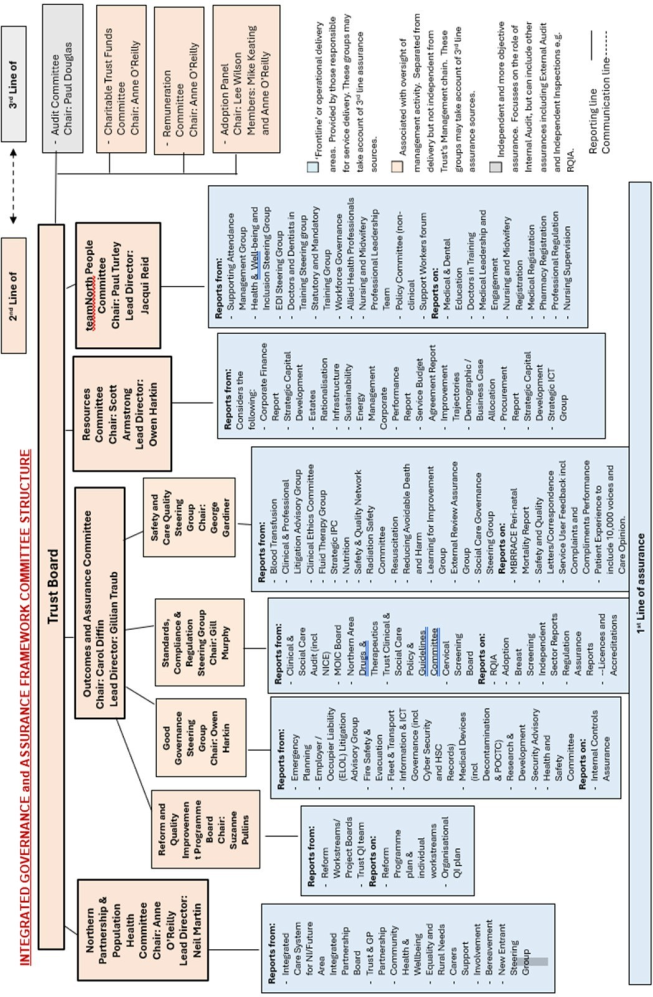
The Trust Board has four Committees to scrutinise the Trust’s governance systems and to provide assurance to the Trust Board on their effectiveness;
- Audit Committee;
- Remuneration Committee;
- Charitable Trust Funds Advisory Committee; and
- Outcomes and Assurance
The Audit Committee
The Audit Committee is a Board Committee which has a central role in the Trust’s Governance Framework. Its Terms of Reference include the duties set out below:
- To work with the Assurance Committee collectively to ensure an overall system of integrated governance in the Trust;
- To review the establishment and maintenance of an effective system of internal control, across the whole of the organisation’s activities (both clinical and non-clinical) that supports the achievement of the organisation’s objectives;
- To ensure that there is an effective internal audit function, established by management, that meets the Global Internal Audit Standards and provides appropriate independent assurance to the Audit Committee, Chief Executive and Board;
- To review the findings of the external auditor and consider the implications of, and management’s responses to, their work;
- To review the financial extract of the Trust’s Annual Report and the Financial Statements before recommendation to the Board; and
- To oversee the adequacy of the Trust’s arrangements for ensuring that value for money is obtained in the expenditure of all public funds entrusted to its
The Committee has three Non-Executive members, including the Chair, and met four times during 2025/26.
The Committee, supported by the Audit Steering Group, reports to the Trust Board and provided the Board and the Accounting Officer with assurance on the adequacy and effective operation of the systems of internal control. Minutes of meetings are presented to the Trust Board detailing the key issues discussed at meetings, including the consideration of: changing financial policy; financial risk management; internal audit work plans and reports; the annual report and resource accounts and the Northern Ireland Audit Office annual Audit Strategy and Report to Those Charged with Governance.
The annual Audit Committee Report for 2025/26 summarised the work of the Committee and provided its satisfactory opinion on the comprehensiveness and reliability of the assurances available to support the Board, and specifically, the Interim Chief Executive as Accounting Officer in her accountability obligations.
The Audit Committee functions in accordance with best practice contained in the Audit and Risk Assurance Committee Handbook (NI) (March 2018) and operates under agreed Terms of Reference which are reviewed annually. During the year, the Audit Committee completed the Northern Ireland Audit Office Self-Assessment Checklist and no issues were identified.
The Audit Committee has unfettered access to internal and external auditors in order to gather independent assurance over the adequacy of the governance framework and the Chair meets independently with representatives at intervals during each year. Northern Ireland Audit Office has subcontracted the audit for 2025/26, and representatives of the Northern Ireland Audit Office, their subcontractors and the Head of Internal Audit attend Audit Committee meetings.
The Remuneration Committee
The Remuneration Committee is a Committee of the Trust Board tasked with the responsibility for approving the remuneration of Executives. The Committee is chaired by the Trust Chair and is comprised of three Non-Executive Directors in total. It met three times during 2025/26.
The main functions of the Committee are as follows:
- To advise and make recommendations to the Board on performance, development, succession planning, appropriate remuneration and terms of service for the Chief Executive and all Senior Executives, guided by Department of Health policy and best practice, and on the advice of the Chief Executive and other Senior Executives as appropriate;
- To provide advice to the Board on remuneration, including all aspects of salary and other contractual terms, as well as arrangements for termination of employment of Senior Executives;
- To ensure robust objectives, performance measures and evaluation processes are in place within the Trust in respect of Senior Executives;
- To ensure that the Chief Executive and Senior Executives are fairly rewarded for their individual contribution to the organisation, having proper regard to the organisation’s circumstances and performance and to the provision of national arrangements;
- To monitor and evaluate the performance and development of the Chief Executive; and
- To oversee appropriate contractual arrangements for the Chief Executive and Senior Executives including the proper calculation and scrutiny of termination payments, taking account of relevant guidance as
The Outcomes and Assurance Committee
The Outcomes and Assurance Committee met on four occasions during 2025/26. The Outcomes and Assurance Committee is a standing committee of Trust Board. The purpose of the Outcomes and Assurance Committee is to review the effectiveness and reliability of the Trust’s assurances regarding governance arrangements, risk management and the control environment. The committee is chaired by a Non Executive Director.
The Outcomes and Assurance Committee is a key committee of the Trust Board, carrying significant responsibility and a large volume of work. This work is dispensed through three Steering Groups and a Programme Board:
- Safety and Care Quality Steering Group;
- Good Governance Steering Group;
- Standards, Compliance and Regulation Steering Group; and
- Reform and Quality Improvement Programme
The Steering Groups are chaired by Executive Directors and form part of the second line of assurance within the Integrated Governance and Assurance Framework. The Steering Groups support the delivery of the Trust’s vision, goals and corporate objectives, identifying the gaps in controls and the constraints that prevent their achievement.
The Charitable Trust Funds Advisory Committee
A Non-Executive Director chairs the Charitable Trust Funds Advisory Committee with senior staff, including the Director of Finance, in attendance. The Committee oversees the administration of Charitable Trust Funds in line with the Trust’s Standing Financial Instructions. During 2025/26 the Committee met on three occasions. The role of the Committee is to oversee the administration, including banking arrangements, investment and disbursement of Charitable Trust Funds. It also ensures that a strategic approach is adopted with regard to charitable expenditure and that Directorates produce and implement annual expenditure plans relating to all funds at their disposal. While financial activity is included within the consolidated accounts of the Trust, a separate annual report and accounts in respect of Charitable Trust Funds and the work of the Advisory Committee are prepared annually and approved by Trust Board.
Other Assurance Groups
The Trust has a Procurement Board with representation from key procuring Directorates and Business Services Organisation Procurement and Logistics Service (PaLS). It oversees and reports on the procurement and contract management arrangements for the Trust, ensuring best practice in compliance with Northern Ireland procurement policy and internal controls for all non-payroll expenditure. The Procurement Board is supported in its work and planning by the Operational Procurement Group which addresses the practical implications of change management for the Trust and provides highlight reports and assurance to the Board.
The Trust is supported in its procurement by the Department’s two Centres of Procurement Excellence (CoPEs): Business Services Organisation Procurement and Logistics Service (BSO PaLS) and the Department of Finance Construction and Procurement Delivery Health Projects Division (CPD–Health Projects).
Social Care procurement is an area of particular importance and is reviewed in the context of the Light Touch Regime (LTR). In order to minimise the risk of non-compliance with the Procurement Act Regulations (2023), all Department of Health Arm’s-Length Bodies rely on CoPE cover for social services under the LTR. Over-threshold procurement for Social Care is being progressed by PaLS via the Social Care Procurement Board reporting to the Regional Procurement Board.
Business Planning and Risk Management
Business planning and risk management are at the heart of governance arrangements, in order to ensure that statutory obligations and ministerial priorities are properly reflected in the management of operations at all levels within the organisation.
Business Planning Processes
The Trust’s vision, values and corporate priorities are set out in a Corporate Plan, which is subject to Departmental approval. The current Corporate Plan covers the years 2024/25 to 2027/28. Flowing from the Corporate Plan, each Division produces an annual Divisional Plan, which details its aims and objectives for the year.
The Department established a Strategic Outcomes Framework (SOF) for 2024/25 and 2025/26, with a suite of strategic outcomes depicting the condition of health and wellbeing that we want to achieve for our population and associated key indicators. It is accompanied by a set of System Oversight Measures (SOMs), which provide the short-term Ministerial and Departmental priorities to the HSC system. The SOMs were monitored throughout 2025/26 as a measure of performance for all Trusts.
The achievement of plans and performance internal to the Trust are progressed through Divisional Accountability meetings across the year, as well as through the Trust’s performance management arrangements and Service Delivery Plans. The Trust received a Limited Assurance finding from an Internal Audit into the revenue business case process and has updated its RBC policy and PPE reporting processes to implement the agreed recommendations.
Two Trust Board committees, the Resources Committee and Outcomes and Assurance Committee, monitor the Trust’s performance against objectives in service delivery and reform. The Trust Board receives a monthly Performance Report setting out performance against regional targets, System Oversight measures trajectories and other key performance indicators.
System Oversight Measures (SOMS) submissions have been submitted with varying levels of confidence due to ongoing work to develop reports from the encompass system. Validation continues to progress to ensure confidence levels reach a high standard for the Trust’s performance reporting.
Risk Management
The Trust complies with The Orange Book on management of risk and is committed to ensuring
that risk management arrangements are an integral part of the organisation’s culture. The Assurance Framework including the Principal Risk Document describes the Trust’s objectives, identifies potential risks to their achievement, the key controls through which these risks will be managed and the sources of assurance about the effectiveness of these controls.
The Risk Management Strategy describes the ongoing processes in place to identify and prioritise the risks to the achievement of the organisation’s objectives and the systems that are in place for the identification, analysis, control and review of risks and explains its approach to risk appetite.
The strategy is underpinned by the Trust’s Risk Register Production and Management Guidance. All Directors, Assistant Directors, Clinical Directors, Clinical Leads, Clinicians, Senior Managers, Facility/Ward Managers and Heads of Department ensure that all activities within their area of responsibility are assessed for risk and that any identified risk is eliminated, mitigated or controlled.
Managers and staff at all levels have responsibility to proactively identify hazards and potential risks to meeting objectives. These may relate to patient and service user safety and wellbeing, quality of service, staff wellbeing, financial resources, targets / standards and reputation.
Risk can be identified from a number of information sources such as adverse incidents, complaints, legal proceedings or risk assessments. Each risk record includes a description of the risk, current control measures in place to manage the risk, an assessment of the impact and likelihood of realisation of the risk (initial, current and target risk levels) as well as action necessary to treat/remove the risk.
The Trust has documented its Risk Appetite Statement within its Risk Management Strategy, and this was approved by Trust Board at a workshop in February 2026. The Trust defines risk appetite as ‘The amount of risk that an organisation is prepared to accept, tolerate, or be exposed to at any point in time.’ Trust Board has considered the level of risk that it is prepared to accept for key aspects of the delivery of health and social care.
The Principal Risk Document highlights the key risks to the achievement of the organisation’s objectives. This tool was developed to ensure there is a comprehensive method for the effective, focused identification and management of the principal risks that arise in meeting the corporate objectives. The Principal Risk Document is used to provide the Trust Board with a simple and comprehensive account of those risks identified, actions required and outstanding gaps in control. There were no risks added to or removed from the Principal Risk Document during the year. This document was last presented to the Trust Board in January 2026 and the Outcomes and Assurance Committee in March 2026. During the year assurance maps for 6 Principal Risks and 3 Corporate Risks, providing assurance over key controls and control gaps, were presented to Outcomes and Assurance Committee.
The Corporate and Divisional Risk Registers are used to support ongoing review and update of the Principal Risk Document. The Trust’s Risk Management Strategy sets out the systems and processes by which risks are identified and controlled.
An Internal Audit of Risk Management was last undertaken during 2024/25, and this provided a satisfactory level of assurance.
There are structured processes in place for incident reporting and the review and learning from Serious Adverse Incidents (SAIs). The Trust has in place a Corporate Trigger List, which identifies incidents that must be reported by all staff, onto the Trust’s Incident Reporting System, Datixweb. In addition, Trigger Lists are in place within all Divisions, which also include service specific reportable incidents. These arrangements are supported by Risk Management Awareness training, which is available as an e-learning package and is mandatory for all staff.
As at 20 March 2026 the Trust had a total of 14 overdue SAI Reports compared to 75 as at 31 March 2025. The Trust continues to work towards Strategic Planning and Performance Group agreed targets for the reduction in the number of overdue reports. Progress is monitored through bimonthly meetings between the Strategic Planning and Performance Group and the Trust and also the HSC Support and Intervention Framework.
During the year, the Trust trained 100 staff in the methodology and processes for completing a SAI review. Family/service user involvement is intrinsic within the SAI review process, and the outcome of each SAI is focused on internal and regional learning.
The Trust is committed to promoting and maintaining an open, just and learning environment in which the emphasis is placed on learning lessons and being open and transparent when care goes wrong. The Trust has processes in place for learning from experience, learning from serious adverse incidents, complaints, litigation and external reviews/inspections.
Information Risk
Information risks are managed within the context of the Trust’s Risk Management Strategy. Such risks are identified and documented at a number of levels including the Corporate Risk Register. Information Governance (IG) is a Principal Risk for the Trust, and this is reviewed at the quarterly Information Governance Forum chaired by the Trust’s Senior Information Risk Owner (SIRO). Assurances are provided to the Good Governance Steering Group and up to Assurance Committee, on IG Incidents, Freedom of Information and Data Protection Act request compliance, mandatory training compliance and update on internal audit recommendations progress.
Information Governance incidents are reported through the Trust’s incident reporting system, Datixweb. The number of Information Governance incidents reported during the period 1st April 2025 to 31st December 2025 was 368, which is an increase of 58 for the same period in the previous year, attributed in part to the implementation of encompass and also in part to an increase in lost/missing records. Incidents and trends are reviewed by the Trust’s Information Governance and ICT Forum and learning is shared across divisions. There were 7 personal data breach incidents reported to the Information Commissioner’s Office (ICO) during the period 1 April 2025 to 28 February 2026. Three incidents have been closed by the ICO with no further regulatory action. The Trust awaits a response in respect of the remaining four.
Information security remains as a Principal Risk during the year due to the increasing sophistication of cyber attacks. The Trust Information and Communications Technology (ICT) Service continues to hold ISO270001 and achieved recertification in July 2025. This gives assurance with regards to Cyber and Information Security, along with ISO20000 (International standard for IT Service
Management) Accreditations, most recently achieved in 2024. The Trust is also working with the Competent Authority (DoF) to address the requirements of the Network and Information Security (NIS) Regulations. Assurances are provided to the Good Governance Steering Group and up to the Assurance Committee in respect of ICT compliance in this regard.
The Trust has identified and provided training to its Senior Information Risk Owner (SIRO), Information Asset Owners (IAO), Assistant Information Asset Owners (AIAO) and Information Asset Administrators (IAA). Other roles, such as the Trust’s Personal Data Guardian, Information Governance staff (includes the Data Protection Officer and the Freedom of Information Practitioner), ICT Governance Manager and Information System Managers, all contribute to the management of information risk. In addition, the Trust has an established Information Governance and ICT Forum, which reports to the Risk and Assurance Group via the Good Governance Steering Group. The Information Governance Forum oversees and directs an improvement programme that addresses the risk areas identified.
The Trust has an Information Asset Register with assets aligned to relevant business areas and identified responsible Information Asset Owners. This along with the development of the Trust’s Information Sharing Register ensures that all information used for operational and reporting purposes is handled appropriately and in accordance with Trust policies, particularly where it is used by third parties or other government bodies.
Fraud Risk
The Trust takes a zero-tolerance approach to fraud in order to protect and support its key public services. The Trust Fraud Liaison Officer (FLO) promotes fraud awareness, and provides advice to employees on what may constitute fraud and reporting arrangements. The FLO co-ordinates investigations, in conjunction with the Counter Fraud and Probity Services (CFPS), provided regionally by the Business Services Organisation and in accordance with the Trust’s Anti-Fraud and Bribery Policy and Response Plan.
The Trust requires mandatory triennial training of all staff in fraud awareness and issues regular reminders to staff on the risk of fraud.
Raising Concerns (Whistleblowing)
The Trust is committed to Raising Concerns (Whistleblowing) as a key component of our Open, Just and Learning (OJL) Culture with several Raising Concerns promotional events included in the Trust’s OJL week in September 2025. The Trust’s Openness Champion also participated in these events. The ’See Something, Say Something’ campaign was also promoted at the Trust’s Leadership Conference on 19th June 2025 – with staff available to provide advice and respond to any questions.
The Trust’s Raising Concerns in the Public Interest (Whistleblowing) Policy, based on the HSC Framework & Model Policy was approved by Policy Committee on 13 June 2024 and is made available on the Trust Policy Library and through the dedicated page on the Trust’s staff intranet where staff are encouraged to ‘See something, say something’.
A dedicated Raising Concerns email account to enable staff to directly contact Human Resources (HR) staff with their concerns is available. Throughout 2025/26, eight formal concerns were raised, and impartial and independent investigating officers were appointed. In each instance, relevant Directors agree the Terms of Reference for the investigations. The outcomes of investigations are shared with the Divisional Director and relevant Executive Director, for professional scrutiny and sign-off.
The Team North Welcome for new staff is based on the NURTURE programme which sets out the Trust’s expectations in relation to an open, just and learning culture, including our Raising Concerns in the Public Interest (Whistleblowing) Policy. Regular updates on all formal concerns are provided to Executive Team, and the annual Raising Concerns (Whistleblowing) Report is submitted to the
Audit Committee and subsequently made available on Staffnet. Action Plans for all recommendations from the investigations are follow up and signed off by the Divisional Director and Executive Director.
All Managers are required to complete the mandatory e-learning Openness programme every three years with 62% compliance as at 31 March 2026.
Equality and Personal and Public Involvement
The Board has complied with its Section 75 equality and good relations duties. Section 75 duties are integral to the Trust’s Assurance Framework; the Trust prioritises Section 75 within all aspects of its business agenda and has established a range of governance, management and reporting mechanisms to reflect this.
The Trust’s Northern Partnership and Population Health Committee (formerly Equality, Engagement, Experience and Employment Steering Group) ensures compliance, advice and monitoring of the Trust’s statutory obligations under Section 75, providing assurance the Trust is acting in line with relevant legislative requirements in relation to Equality and Rural Needs. The Committee ensures a shared vision for population health with partners external to the organisation, including oversight and accountability for the Trust’s focus on population health and wellbeing, health and social care inequalities and support for carers. The Committee reports to Trust Board and meets formally four times yearly. The Committee is chaired by the Trust Chair or nominated Non-Executive Director and has a unique membership of internal and external stakeholders including representatives from service users, carers and the community and voluntary sector.
The Trust’s policy development process ensures all Trust policies are screened for equality impact during development and review. All quarterly screening outcome reports are made available on the Trust’s website.
Service users and carers are at the heart of everything the Trust does. The involvement of service users and carers enables the Trust to shape services, improve patient experience, and use resources in the ways that have the greatest impact on health and wellbeing. The Trust actively and regularly involves people, who receive and deliver services, in its decision-making and planning processes to make sure its priorities are influenced by the people who supply and use its services.
The Trust stakeholder involvement plan, entitled ‘Connecting Patient and Client Experience, Personal and Public Involvement, and Co-production 2022-2025’, sets out the Trust’s vision, commitment and integrated approach to Patient and Client Experience (PCE), Personal and Public Involvement (PPI) and Co-Production – activities. Within the Trust, this includes Patient Experience Standards, the Patient Experience Collaborative, real time feedback, Care Opinion and 10,000 More Voices, Personal and Public Involvement and Co-Production. The Plan is underpinned by the Trust’s strategic vision, to provide compassionate care with our community, in our community and was co-produced with services users, carers and staff. The Trust is currently co-designing a new Involvement and Engagement Strategy 2026 to 3031, which will ensure that the voice of patients, carers, families and communities are embedded at every level of the organisation, shaping how we design, deliver, and improve services.
Ensuring involvement is at the core of the Trust’s business agenda, a range of governance, management and monitoring mechanisms are in place to reflect this.
The Northern Partnership and Population Health Committee provides assurance that the Trust is meeting all of its statutory responsibilities and is responsible for overseeing the Trust’s approach to personal and public involvement and patient experience.
The Trust evaluates and evidences the effectiveness and impact of involvement through the completion of the regional PPI monitoring tool and assurance framework and submits it to the PHA on a six-monthly basis. A three-monthly Care Opinion accountability framework monitoring report is submitted to the PHA. Information and data from both of these mechanisms are included in the Involvement Annual Report to evidence performance reporting requirements.
Having the best health and wellbeing for everyone in the Trust’s communities can only be achieved by putting people at the heart of its work. For effective involvement, people need to feel supported, and for their contribution to be valued, respected and have an impact. The Trust has established, and continues to support, a number of service user panels in partnership with service users, carers and the community and voluntary sector. These User Panels are established groups of individuals and representative organisations who have a keen interest in the standard and quality of Trust services.
They work in partnership with Trust staff to ensure their views are part of the planning, delivery and monitoring of services. Each panel is user-led, chaired by a service user or carer, and provides an opportunity for stakeholders and their representatives to be involved in the developing and planning of services.
The Trust’s new co-produced five-year Carer Strategy 2026 to 2031 is currently open for public consultation to seek views from carers, families, staff and community partners. The strategy aims to improve and coordinate support for carers and is based on feedback from carers and staff.
The Trust’s Involvement Network continues to offer a number of involvement opportunities. There are over 300 service users, carers and community representatives working with Trust staff to develop services. Whether this is co-designing a new service, co-producing training or having input into information provided, they are a key resource for the Trust. Over the last year, members have participated in 100 involvement opportunities.
The Engagement Advisory Board continues to ensure that the Trust is approaching engagement in a way that meets the needs and interests of all communities, with a focus on targeting the most hard to reach. Board Members have a wealth of lived experience and are active members within their communities. The Engagement Advisory Board meets on a three-monthly basis and is chaired by a service user. This year members have been involved in and provided guidance on the review of the Delayed Discharge Policy, Patient Initiated Follow Up project, and the consultation and pilot of Body Worn Cameras.
It is important that Trust staff have the appropriate training and support to achieve effective service user and carer involvement. This year 914 staff have taken part in the Trust’s Specialist Involvement training programme.
As the Trust continues to deliver on transformation, using involvement methodologies will support it to listen to the voices of those people within communities who have lived experience of using services. The Trust continues to embed Care Opinion across the Trust. This online user feedback system allows service users and carers to provide anonymous feedback about health and social care services. Since the launch of Care Opinion in August 2020, 3820 stories have been received. Of the stories received, 83% of those that left feedback had a positive experience. The other stories enable the Trust to support learning and improvements.
The Trust is piloting live patient feedback at the point of care. This initiative supports the Northern Trust Quality Strategy 2024–2027 and aims to make services more responsive to what matters most to patients. By gathering feedback in real time, we can identify areas for improvement quickly, celebrate positive staff contributions, and ensure patient voices shape service design and outcomes. The feedback mechanism is designed to complement existing tools such as Care Opinion, this approach ensures that feedback is not only collected in real time, but also used to inform service improvements, staff training needs, and positive recognition for staff. In December 2025 the Trust launched our first pilot in the Causeway Ambulatory Unit. The pilot ran for 2 weeks and during this time 90% of patients were very satisfied with the overall care they had received. The Trust is now working with General Surgery and Cancer (Chemotherapy Treatment) to pilot live feedback in another two areas.
As part of the implementation of Shared Decision Making (SDM), the Trust continues to actively support SDM pilot projects across service areas, in collaboration with the 10,000 More Voices initiative. These pilots are designed to gather feedback on Service User experience of SDM in practice. The first three pilots have concluded. The fourth SDM project is on Do Not Attempt Cardiopulmonary Resuscitation (DNACPR) decisions and conversations.
The data from these projects are analysed and shared with the service for learning and improvements.
The Trust also continues to collect and report on complaints, comments and suggestions made by members of the public and service users received through the Your Views Matter process.
Main Sources of Independent Assurance
The Trust receives independent assurances from a number of sources during the financial year:
- Business Services Organisation Internal Audit – through a programme of annual audits, based on an analysis of risk, under an Annual Service Level Agreement;
- Regulation and Quality Improvement Authority (RQIA) – responsible for the registration and inspection of a wide range of health and social care services and provide assurance on the extent to which services provided by the Trust, or those commissioned from third party providers, comply with applicable quality standards;
- Annual Business Services Organisation assurance in respect of Shared Services functions via Service Level Agreements, Key Performance Indicators and customer fora;
- Medicines and Healthcare products Regulatory Agency (MHRA) regulates medicines, medical devices and blood components for transfusion through regular inspections and reports; and
- General Medical Council (GMC), General Dental Council (GDC), NI Medical and Dental Training Agency (NIMDTA) and various Royal Colleges.
Northern Ireland Audit Office also provides an external audit independent opinion to the Assembly on whether the Trust’s accounts for Public Funds, Funds held on behalf of Patients and Residents and Charitable Trust Funds present a true and fair view of the Trust’s financial activities and the regularity of transactions.
The Trust also receives assurances from internal sources, on the effectiveness and operation of controls across a range of governance areas. These include:
- Principal Risk Document;
- Risk Registers;
- Board-appointed committees including the Assurance Committee, Audit Committee, Remuneration Committee and Charitable Trust Funds Advisory Committee; and
- Reports from Directors at Board Meetings
The Board assures itself on the quality of information that comes to it, through various methods, including:
- Feedback from Directors on whether the information meets their needs;
- Open debate, via workshops, on issues facing the Trust; and
- Use of patient and staff stories to confirm/assure on the Trust’s standard of
Until encompass go-live in November 2024 the Trust Board received a monthly Performance Report on progress against Service Delivery Plan and other Ministerial targets. Each operational Division has a monthly performance scorecard to provide feedback at Divisional Accountability meetings. The Trust Director of Finance provides a report to the Trust Board each month on its financial performance and its capital schemes. Commentary is included on the statutory duty of breakeven, financial risk, budgetary position and assumptions.
Internal Audit
The Trust utilises the Internal Audit function provided by the Business Services Organisation, which operates to defined standards and whose work is informed by an analysis of the risks to which the Trust is exposed, against which annual audit plans are based.
Internal Audit’s review of the status of recommendations, due to have been implemented by 31 March 2026, determined that a total of 82% (2024/25 – 83%) were fully implemented, with 17% (2024/25 – 15%) partially implemented and 1% (2024/25 – 2%) in which implementation had not yet begun. This outcome was in line with the corporate target and represents the importance placed by the Trust on compliance with recommendations. The Audit Committee and Audit Steering Group
have been focused, and will continue to focus, on Priority 1 recommendations and those not yet fully implemented.
In addition, there are four outstanding regional IT recommendations dating from 2018/19, which are the responsibility of Digital Health and Care Northern Ireland in the Department of Health, to implement. The risk to cyber security which the recommendations seek to address remains with the HSC.
At year end, fifty-two of the open outstanding Priority 1 and 2 audit recommendations related to significant findings which caused limited / unacceptable assurance to be provided in individual previous audit reports. Of these 52 recommendations, 26 (50%) were implemented, leaving 26 (50%) open, outstanding significant audit recommendations, all of which are partially implemented.
In 2025/26 Internal Audit completed the full programme of audits planned. The table below provides a summary of the outcome of the Internal Audit Assignments for 2025/26.
| AUDIT ASSIGNMENT | LEVEL OF ASSURANCE | SUMMARY OF SIGNIFICANT FINDINGS RE LIMITED / PARTIALLY LIMITED REPORTS |
|---|---|---|
| Corporate Risk Based Audits | ||
| Management of General Surgical Triage (Substantive Follow Up on previous Unacceptable assurance report in 2024/25) | Limited | Internal Audit provide limited assurance in relation to the management of General Surgery Triaging on the basis that organisation and management of triage sessions is not effective even though triage sessions are included on Consultant job plans.
There is not yet reporting within the Trust assurance framework on time taken to triage against IEAP targets, this despite Internal Audit being able to obtain these reports within the Trust during fieldwork |
| Laboratory Services | Limited | Internal Audit can provide limited assurance in relation to Laboratory Services. Limited assurance has been provided on the basis of governance and reporting of Laboratory Services through the Trust / Divisional assurance framework is not sufficiently defined or developed |
| Health Visiting | Limited | Internal Audit are providing limited assurance in relation to Health Visiting on the basis that this service has significant resourcing challenges which results in delays in conducting visits and health promotion activities. This has an impact on the KPIs and governance arrangement across this service. |
| Mental Capacity Act | Satisfactory | |
| Medical Recruitment and Retention | Limited | Internal Audit has provided limited assurance on Medical Recruitment and Retention, due to the Trust having no formal strategy in place, and the Trust is failing to meet 5 of the 6 recruitment timeliness KPIs. Additionally, there is no end-to-end measurement of recruitment timeliness from resignation or leaver notification through to requisition submission to HR. |
| Medicines Homecare Services | Limited | Internal Audit is providing limited assurance in relation to Medicines Homecare Management, this is where there is a requirement for clinical checks on Homecare Medicines prescriptions, prior to order and administration |
| IT Audit – Asset Management | Split Assurance:
Satisfactory: IT Asset Lifecycle Management (that are the responsibility of Digital Services to allocate)
Limited: Trust wide utilization of IT Assets and IT Asset Lifecycle Management (that are the responsibility of Estates i.e. iPhones, telephony) |
Internal Audit are providing Satisfactory assurance in relation to the IT Asset lifecycle management of those IT assets that are the responsibility of ICT to procure, configure and deploy and to ensure security posture. We found that there are generally robust controls across the management of these IT Assets.
Internal Audit are providing Limited assurance in relation to the utilisation of some types of IT Assets types across the Trust |
| Governance including Controls Assurance Audits | ||
| Delivery of the People and Culture Plan | Satisfactory | |
| Management of Clinical Audit | Satisfactory | |
| Claims Management | Satisfactory | |
| Business Continuity Planning (Sudstantive Follow Up on previous Limited assurance report in 2023/2024) | Limited | Internal Audit continues to provide limited assurance on the management of Business Continuity. While some control improvements have been implemented, further work is required to fully deliver the significant recommendations.
Plan testing remains inconsistent and needs to be more fully embedded, with outcomes and learning reflected within the Trust’s assurance framework. |
| Medical Job Planning | Satisfactory | |
| AUDIT ASSIGNMENT | LEVEL OF ASSURANCE | SUMMARY OF SIGNIFICANT FINDINGS RE LIMITED/PARTIALLY LIMITED REPORTS |
|---|---|---|
| Medical Devices (Substantive Follow Up on previous Limited assurance report in 2023/24) Financial Audits | Satisfactory | |
| Financial Audits | ||
| Payments to Staff – with a focus on Nursing and Midwifery | Split Assurance: Satisfactory: Payments to Staff – with a focus on Nursing and Midwifery
Limited: Management of Hours Owed as per eRoster and Management of Enhanced Shift Payments
|
Internal Audit are providing satisfactory assurance in relation to Payments to Staff with a specific focus on payments to nursing and midwifery staff
Limited assurance is being provided in relation to Management of Hours Owed as per eRoster and Management of Enhanced Shift Payments |
| Non-Pay Expenditures – Children and Young Person Division | Split Assurance: Satisfactory for Non-Pay Expenditure but Limited for Contract Management arrangements | Internal Audit provided satisfactory assurance in relation to Non-Pay Expenditure on the basis that controls over expenditure are generally operating effectively.
Limited assurance is being provided in relation to contract management arrangements. Limited assurance is provided on the basis that across the sample tested, robust contracts were not always in place. There is a need for training programme to help build understanding of the process for robust management of contracts going forward. |
| Management of Waiting List Initiative Contracts with Independent Sector Providers | Limited | Internal Audit is providing Limited assurance in relation to the Management of Waiting List Initiatives Contracts with Independent Sector Providers (ISP). Oversight / governance arrangements need to be reviewed and strengthened as assurances in respect to key clinical governance areas from ISPs are not requested for review and sharing within the Trusts assurance framework. |
| Management of Client Monies in Independent Sector Homes and Adult Supported Living Facilities | Split Assurance:
Satisfactory: Management of Client Monies in all 8 homes visited Limited: Trust Monitoring Arrangements of Service Users Finance |
Internal Audit are providing Satisfactory assurance in relation to the Management of Client Monies however Limited Assurance in relation to the Trust’s monitoring arrangements for residents’ finances by Key Workers as this does not occur consistently |
| Private, Paying and Change of Status Patients | Limited | Internal Audit are providing Limited assurance in relation to Private, Paying and Change of Status Patients. The functions, roles and responsibilities, performance management and oversight arrangements of the Private, Paying and Change of Status Patients process are not clearly defined. |
| Management of Non-Emergency Transport | Limited | Internal Audit is providing limited assurance in relation to Non-Emergency Transport. A root cause is a lack of robust and effective contract management of non-emergency transport (which has previously identified as a theme regionally across Health and Social Care audits of contracts in recent years). |
Business Services Organisation Assurances
The BSO provides a range of services to and on behalf of the Trust, under annual service level agreements, these include;
- The Directorate of Legal Services;
- Procurement and Logistics Services, which is the HSC’s Centre of Procurement Expertise;
- Information Technology Services;
- Counter Fraud and Probity Services; and
- Shared Services encompassing Payroll, Recruitment, Accounts Payable and Receivable and Business
A number of audits (summarised below) have been conducted in BSO Shared Services as part of the BSO Internal Audit Plan. While the recommendations in these Shared Service audit reports are the responsibility of BSO Management to take forward, the Trust closely monitors performance at a number of customer fora and takes action where necessary.
| Shared Service Audit | Assurance |
|---|---|
| Payroll Shared Service | Satisfactory |
| Accounts Receivable | Satisfactory |
| Accounts Payable Shared Service | Satisfactory |
Overall Opinion
In 2025/26 Internal Audit completed the full programme of works planned but in her annual report, the Head of Internal Audit provided the following Limited opinion on the Trust’s system of internal control.
“Overall, for the year ended 31 March 2026, I can provide Limited on the adequacy and effectiveness of the organisation’s framework of governance, risk management and control.
Limited assurance has been provided in a significant proportion (almost half) of the audits in 2025/26 and two thirds of the audits contained at least an element of Limited assurance.
The Limited assurances provided in respect of Business Continuity Planning, Management of General Surgical Triage, Laboratory Services, and Management of Private, Paying and Change of Status Patients are of particular note. The number of significant audit findings reported this year is higher than previous years.
Whilst providing Limited assurance, I acknowledge the generally good performance of the organisation in addressing Internal Audit recommendations and that Satisfactory assurance has been provided in some core areas such as: Management of Clinical Audit, Delivery of the Trust’s People and Culture Plan, Payments to Staff, and Medical Job Planning.
I advise the Trust to focus on addressing the key issues (above) and the themes identified in the 2025/26 audits, primarily the need to develop: Utilisation of and reporting from Epic; Contract Management; and implementation of recommendations in relation to Business Continuity Planning and Management of General Surgery Triage. I also advise specific Management focus on addressing the significant audit recommendations in the 2025/26 Limited assurance audits.”
Regulation and Quality Improvement Authority (RQIA)
I confirm implementation of the accepted recommendations made by RQIA, and that the Trust has received one final RQIA Review report since April 2025:
- Inspection of Outpatient Departments (Northern Health and Social Care Trust). No new RQIA reviews have
Since April 2025, the Trust received 55 reports relating to routine inspections (announced and unannounced) of Trust facilities. Areas for improvement were identified for 41 facilities inspected, for which Improvement Plans have been completed and returned to RQIA. Progress against improvement plans is monitored by the Divisional Governance Teams. In 14 of the facilities inspected no areas were identified for improvement.
Other Reports
I confirm that the Trust is not in receipt of any other inspection reports since April 2025.
Review of Effectiveness of the System of Internal Governance
As Accounting Officer, I have responsibility for the review of the effectiveness of the system of internal governance. My review is informed by the work of the internal auditors and the executive managers within the Trust who have responsibility for the development and maintenance of the internal control framework, comments made by the external auditors in their management letter and other reports.
I have been advised on the implications of the result of my review by the Trust Board, the Audit and Outcomes and Assurance Committees and other related sub-committees, and a plan to address weaknesses and ensure continuous improvement to the system is being developed.
I am concerned that significant weaknesses were identified within elements of the Trust’s governance, risk management and control framework which, if not addressed, could impact the achievement of system objectives. The Trust’s system of internal control is underpinned by a comprehensive committee structure which provides oversight of all aspects of governance, including clinical quality, risk management (including organisational controls) and financial management.
Overall, a robust system of internal control is in place which supports the delivery of the Trust’s policies, aims and objectives. However, in light of the limited overall assurance opinion issued by the Head of Internal Audit for 2025/26, and the number and breadth of internal control divergences identified, priority will be given to addressing both outstanding recommendations from previous years and those areas receiving limited assurance during the year.
The Trust Board regularly considers reports generated from the Assurance Framework. These reports contain information on levels of assurance, gaps in assurance or controls and action plans to mitigate any shortfalls.
The Audit Committee agree a programme of internal audit assignments on a three-year cycle, ratified annually, which is informed by an analysis of the risk to which the Trust is exposed, alongside discussions with members of the Executive Management Team and the Head of Internal Audit.
The Register of Interests maintained by the Board Secretary (available at https://www.northerntrust. hscni.net/registerofinterests), records declarations made by Board Members and is reviewed on an annual basis, or earlier if changes are notified by Board Members. In addition, Board members provide an annual statement confirming their compliancewith the Code of Conduct and Accountability.
In conclusion, as Accountable Officer, I am satisfied by the assurances provided by the regular 80
reports from the Outcomes and Assurance Committee and the Annual Report from Audit Committee, in respect of the reliability and integrity provided by both Committees and of their comprehensiveness in meeting the needs of the Board and myself as Accounting Officer. It is my opinion that the Committees will provide the direction needed to ensure that sustained improvements are maintained to ensure that a sound system of internal control is in place. I am
of the opinion that, when having considered the full range of assurances, the combined assurances available are sufficient to support the Trust Board and me in discharging our respective governance and accountability responsibilities.
Internal Governance Divergences
Progress on Prior Year Control Issues – Ongoing Residential Childcare and Placement Availability
Residential Care and Foster Care placement availability is challenging on a regional and local level and there continues to be a significant reduction in enquiries to the regional Foster Care Recruitment Team for the Northern Trust area. There has been a sustained increase in the number of Looked After Children within the Trust area, with a further 3% increase between 31 March 2025 (879) and 30 September 2025 (903). By 10 March 2026, the number had reduced by 4 to 899, however placement availability remains an issue. Whilst the majority of young people continue to be provided with appropriate care placements, an increasing number of young people with challenging and complex needs have been cared for in unregulated arrangements. RQIA had served an improvement notice on the Trust given that the pattern of operating unregistered Children’s Homes has persisted, and there is a continued reliance upon unregistered Children’s Homes to meet the placement needs of the increasing Looked After Children population. The Trust had implemented an action plan in an effort to minimise further use of this type of arrangement with wide ranging actions e.g. Fostering Support Hub for fragile placements; enhanced support for Foster Carers; increase in recruitment of Foster Carers and seeking to identify resource for an additional kinship team. The Trust has further plans to
increase placement availability, however these will require time to implement, and it is unlikely to avoid additional emergency unregulated arrangements in the intervening period. With respect to children with a Disability, Whitehaven has now reopened with reduced capacity for residential short breaks, given two young people are currently accommodated. Eden View remains closed to short breaks due to ongoing workforce issues. The Trust is acutely aware of the impact this has on families and young people and continues to work towards reopening services for this cohort of young people at the earliest juncture.
Aseptic Facilities
Aseptic processing is the manipulation of sterile medicinal starting materials and components in such a way that they remain sterile and uncontaminated whilst being prepared for presentation in a form suitable for administration to patients. Examples of aseptically prepared products in the Northern HSC Trust are total parenteral nutrition and parenteral systemic anti-cancer treatment
(SACT) and monoclonal antibodies. As such, it is a critical and high-risk process that must be carried out by highly trained staff in facilities with pharmaceutical clean rooms and associated equipment (e.g. isolators, laminar airflow cabinets) that comply with the current standards of
Good Manufacturing Practice (GMP).
The NI Regional Quality Assurance Service undertakes audits of all aseptic units against UK national standards. The Antrim Pharmacy and Laurel House cancer unit aseptic facilities were rated as overall HIGH risk to patient safety in the 2022/23 audits. Re-audits have been completed in 6-monthly intervals and the risk rating has remained as HIGH for both facilities. These facilities are more than 25 years old and do not meet the national standards for aseptic preparation; they require urgent
investment to prevent them presenting unacceptable risk to patient safety. A Pharmaceutical Quality System (PQS) has been established which records and reviews the microbiological and environmental monitoring of the facilities. Monthly ‘high risk facility’ meetings are held to review all aspects of the management and monitoring of the facilities and agreed actions recorded. In January 2026, the Laurel House aseptic unit closed one of the two isolator rooms to allow remedial works to the fabric
of the room. The full schedule of work could not be completed with rescheduling of contractors underway. The room will remain closed until the work is completed. Should the unit be required to evoke contingency arrangements, the room could be used following risk assessment and reduction in the expiry date of the aseptically prepared products. The PQS demonstrates that the facilities are currently maintaining a level of control in terms of the fabric and finishings and environmental monitoring. There is active engagement with the Capital Development team and a preferred location and design of a new build has been prepared which would combine both Trust facilities into one unit.
A regional review of aseptic services has been completed which includes the development
of a Strategic Outline Case for NI Trust Pharmacy Aseptic Services to address the rising demand in cancer services and unmet need. The regional capital investment proposal included replacement facilities for the Trust and the requirement has been added to the Trust’s Capital plan. Whilst the Trust has undertaken preliminary design work it awaits a decision in relation to capital funding.
The risk of not providing replacement facilities to the standard is that a decline in the ageing facilities coupled with the potential loss of environmental and microbiological control would lead to significantly reduced assurances of providing safe aseptic products for immunocompromised patients. In operational service delivery terms this would significantly jeopardise and likely prevent Pharmacy from being able to provide aseptic services to Northern Trust patients (outpatients and inpatients). There are no contingency facilities available in NI.
Dysphagia
Dysphagia management and the risks associated with the provision of food and drinks to people diagnosed with dysphagia, continues to be an area of focus and remains a principal risk to the Trust. The Trust Dysphagia Group provides leadership across the Trust to drive and embed key actions such as the implementation of the Food and Drink Safety Pause, prior to serving meals or drinks. The Trust Dysphagia Group has progressed actions to implement all of the recommendations for HSC Trusts set out in the National Confidential Enquiry into Patient Outcome and Death (NCEPOD) Report ‘Hard to Swallow’, and the RQIA of the Implementation of Recommendations to reduce Choking Incidents in the Trust.
The Clinical Education Centre regional eLearning programme is now available for staff working with adults and children (excluding neonates, where bespoke training materials are available).
An Internal Audit of Dysphagia Management was conducted in 2023/24, providing limited assurance and an action plan to take forward the recommendations of the report is overseen by the Trust Dysphagia Group. Significant progress has been made to develop electronic monitoring of role specific compliance with dysphagia training.
Regrettably, the Trust was advised by the Health and Safety Executive NI in August 2023, that it had referred a further incident, which occurred in March 2022, to their Major Investigation Team, relating to the death of a patient associated with an episode of choking. This investigation remains ongoing and a number of Trust staff have been interviewed.
Recruitment and Retention
There continues to be ongoing and significant workforce challenges across nursing, social work, and medical staffing within the Trust, with ongoing challenges to secure staffing across these professions. This remains a risk to the delivery of sustainable services.
The Trust continues to take the following actions:
- proactive nurse recruitment across Trust services, including nursing assistant recruitment, with sustained effort to recruit to areas that are challenging to staff consistently;
- proactive engagement with university students, through information sessions, careers fairs and positive practice learning experience, has supported positive recruitment of newly qualified nurses for February 2026;
- international nurse recruitment, which has continued to provide a steady number of arrivals since 2017; 286 internationally-educated nurses arrived in the Trust between April 2017 and January 2026, 10 of these being Mental Health Of the 286, 253 remain employed in the Trust. The Regional International Nurse Recruitment Campaign has now come to an end;
- continue to deliver sustained work to stabilise the substantive workforce, with the aim of reducing reliance on temporary and flexible nursing staff;
- established a Medical Workforce Recruitment Group, actively addressing current medical vacancies by working with Operational Divisions to agree and implement practical solutions to fill posts, including consideration of skill-mix options, the development of specialist posts, and targeted approaches aligned to International Medical Recruitment and wider workforce sustainability
- In parallel to the above, the outworkings of the Regional Medical and Dental Agency Framework Group – established to review the previous framework, assess agency/locum utilisation across Trusts, and identify areas of high agency demand in advance of the procurement process, has now been The new Regional Medical and Dental Agency Framework has been awarded and implemented from 2 March 2026. The Trust continues to maintain robust oversight through the ongoing review of medical locum usage via Retinue and in-house monitoring, working collaboratively with all Operational Divisions to reduce unwarranted reliance on agency cover, strengthen controls, and prioritise safe, sustainable staffing arrangements.
- The Trust’s social work vacancy position has improved during the period, with vacancies reducing following recent recruitment activity (including 49 new appointments in July 2025). However, workforce pressure remains due to sustained growth in demand and the continued creation of new posts linked to policy/legislation and service In addition, recruitment remains cyclical, with a limited annual entry point for newly qualified social workers, meaning some vacancies will persist between intakes. While the Social Work Workforce Review (2022) recommended an additional 60 university places per year to address the historic deficit, the Department of Health has agreed 40 additional places, primarily aligned to the further roll-out of Multi-Disciplinary Teams in primary care. Any material increase in workforce supply is therefore not expected to be realised until at least 2027;
- ongoing review of the efficiency of nursing resources and appointment of a safe staffing lead nurse;
- review and monitoring of utilised nursing hours to assess the usage of contract agency;
- a Nurse Stabilisation Group has been established to develop and lead the planning and actions required to achieve maximum effectiveness of the Trust’s available funding / resources associated with the Nursing and Midwifery Workforce (Funded Staffing Level) to deliver Trust workforce stability, patient safety and financial benefits realisation;
- new electronic rostering system in place for those who had existing Improved functionality and oversight will be available to support monitoring of safe staffing and efficiency and utilisation of nursing hours;
- progressing a regional refresh of Delivering Care;
- the Trust’s retention programme has progressed into its next phase, building on early learning and
- strengthening implementation. In partnership with Queen’s University Belfast and the Department of Health (Office of Social Services), the Trust continues to pilot a research-informed “theory of change” model focused on improving retention through strengthened professional identity, peer support and timely, reflective, compassionate support during critical care episodes. This work is intended to reduce burnout risk and improve staff experience and stability, recognising that retention remains a key enabler alongside ongoing recruitment activity
- collaborative work with NIMDTA, through the Single Lead Employer process, to deliver an improved employment experience for Doctors and Dentists in Training
Financial Breakeven Position
The Trust engaged with the Department of Health (DoH) and the Strategic Planning and Performance Group (SPPG) throughout the 2025/26 Financial Plan process. An initial financial plan was submitted in February 2025, identifying an estimated deficit of £41m. Following confirmation of additional allocations and review of cost pressures, this reduced to £35m in April 2025. Further savings were identified in June 2025, and DoH confirmed deficit funding of £13m, reducing the forecast deficit to £18.1m. In September 2025, the Permanent Secretary wrote to all Trusts requesting plans to achieve break-even for 2025/26, including graduated savings scenarios. During September and October 2025, the Trust identified further savings of up to £10.8m, bringing total savings and cost avoidance measures to £33.6m for the year. Against the remaining deficit of £7.3m, the Trust developed additional scenarios in line with its statutory duty to break even and Circular HSC(F) 37/2023 HSC Break-Even and Financial Recovery. These scenarios were assessed as high or catastrophic in terms of their impact on services, staff and the wider HSC system. Implementation would have required approval from the Minister, DoH, SPPG and the Trust Board; this approval was not given. As a result, the Trust was unable to eliminate the residual deficit. Subsequent additional funding from SPPG for services included within the deficit forecast reduced the remaining operational deficit to £6.6m.
In addition, the pay award for 2025/26 was not fully funded, resulting in a pay award deficit of £19.5m. Combined with the operational deficit, this gave a total in-year deficit of £26.1m. Following agreement with HM Treasury for access to a Reserve Funding Claim, and the subsequent application of funding by the Northern Ireland Executive, the Trust received £26.1m in funding, enabling it to achieve break-even in 2025/26.
While the Trust has achieved break-even for 2025/26, the underlying fundamentals have not changed and a recurrent deficit remains and there is an anticipated additional savings requirement from DoH in 2026/27, as set out in the financial section of the Planning Guidance. The Trust has submitted a response outlining the savings that can be delivered; however, these will not be sufficient to achieve break-even in 2026/27. Accordingly, this Internal Control divergence will continue into the next financial year.
Budget Position and Authority
The Budget Act (Northern Ireland) 2026, which received Royal Assent on 20 March 2026, together with the Northern Ireland Spring Supplementary Estimates 2025-26 which were agreed by the Assembly on 23 February 2026, provide the statutory authority for the Executive’s final 2025-26 expenditure plans. The Budget Act (Northern Ireland) 2026 also provides a Vote on Account to authorise expenditure by departments and other bodies into the early months of the 2026-27 financial year.
The Department is currently operating under the authority provided by the Vote on Account which provides 45% of the 2025-26 financial year’s cash and resources. The cash and resource balance to complete for the remainder of 2026-27 will be authorised by the 2026-27 Main Estimates and the associated Budget Bill based on an agreed 2026-27 Budget.
Cyber Security
The Trust continues to work with colleagues through the Regional Cyber Security Programme Board to address issues highlighted from external assessment and audit, to take common, consistent actions to monitor and continually strengthen cyber security issues.
As an Operator of Essential Services (OES) the Trust has completed a Cyber Assessment Framework (CAF) self-assessment for the Network and Information Systems (NIS) Competent Authority in May 2025 and received the report from the Competent Authority in December 2025. The Trust must also complete an external audit by the end of 2026 as specified by the Competent Authority. The Trust tracks progress against the Network and Information Security recommendations and the ongoing programme of work identified in the CAF. The Trust has brought in staff, “at risk,” to manage the ongoing legal requirement both within ICT and Governance. A proposal to increase staffing in the area of Operational Security has been agreed and recruitment for phase 1 of this plan is underway.
The Trust ICT Department has achieved the updated ISO27001 and was most recently externally audited and accredited in July 2025. An ongoing risk is the lack of momentum regarding the Business Case approval for a Regional Security Operations Centre and SIEM solution.
Neurology
The Trust is committed to the sustainability of the neurology service, in conjunction with regional colleagues and SPPG, but continues to find it difficult to secure sufficient resource to adequately meet demand.
The first of the joint Northern / Belfast HSCT Consultant Neurologist posts aimed at addressing this took up post at the start of March 2021. The Trust has secured funding for two further Consultant Neurologists but has been unable to appoint to the posts. The Trust continues to have a presence from Consultant Neurologists from the Belfast Health and Social Care Trust and active support from the Belfast Neurology Team.
Recruitment remains an issue for Neurology and the Trust has submitted this as part of the Support and Intervention Framework with SPPG. The Trust is also actively engaged in the Neurology Alliance created by SPPG to address Neurology stability and reform.
The Trust has had periods of locum cover but this causes an increased issue with need for supervision that cannot be provided on site and when a locum leaves it can create a waiting list of patients not assigned to a consultant. The Trust is currently working with the South Eastern Health and Social Care Trust (SEHSCT) to establish an alliance to provide Neurology cover from SEHSCT but funded from NHSCT. This service remains at risk until this alliance can be established and staff in place.
Acute Mental Health Inpatient Bed Pressures
Pressures on mental health inpatient bed capacity have been noted on the Corporate Risk Register since 2017. Bed pressures have been sustained and significant over the course of 2025/26. These pressures pose an associated and continued negative impact in the areas of patient safety, experience, therapeutic outcomes and staff experience. The Royal College of Psychiatrists Guidance recommends 85% occupancy level for Mental Health inpatient wards; however the Trust overall occupancy frequently runs in excess of 100%, with additional contingency beds routinely required across all admission wards. Over-occupancy increases the risk in terms of patient safety, violence and aggression, incidents of self-harm and patients absconding from the wards and potentially coming to harm or risking public safety.
In addition, frequently throughout 2025/26 it has been necessary to operate a waiting list for admissions to a mental health inpatient bed. A regionally developed clinical prioritisation tool is used to determine the order of admissions.
Patients awaiting a mental health admission, including patients being detained under the Mental Health Order (MHO), are being managed in Emergency Departments, general hospital wards and in the community. These delays create pressure in these areas and on Approved Social Work Services who are required to remain with them until a bed is available. Furthermore, due to the delay in access to assessment and treatment the individual’s assessment and treatment is delayed.
Flow across mental health beds has been limited, due to both the acuity of the patient population, (which has led to longer length of stay) and to insufficient access to placements in the community, to meet the needs of those people with complex mental health needs and dementia. Work is ongoing within the Trust on an Acute Mental Health Quality Improvement initiative, aimed at reducing the length of stay for Mental Health Inpatient Services. To date, this work has contributed to a reduction in overall numbers of delayed discharges, while also streamlining the admission process via a single point of access work stream. A Facilitated Early Discharge practitioner has been put in place in 2025 – 26 to support early discharge from inpatient care to Home Treatment Team. Engagement fora have been established to engage, prepare and support providers, regarding the likely future needs of Trust community placements, particularly those more complex requirements. As a result of this engagement, additional enhanced care and dementia beds have been opened by local providers. These beds have supported more timely and sustained discharges for some individuals, and engagement with providers continues.
Emergency General Surgery and Elective Surgery
Following the publication, in June 2022, of the Department of Health’s review of General Surgery in Northern Ireland, it became clear that Causeway Hospital was not commissioned in line with a number of standards, required to be able to deliver emergency general surgery in the longer term. To be able to meet these standards, surgical ambulatory services in Causeway Hospital have been developed resulting in the opening of the Surgical Ambulatory Unit in February 2024. The Trust held a public consultation on proposals to reconfigure General Surgery services between 23 August and 29 November 2024. The Trust consultation outcomes report was presented to Trust Board on 22 May 2025 which received approval and was subsequently submitted to the Department of Health the following day for consideration by the Minister for Health. SPPG commissioned GIRFT (Getting it Right First Time) to independently review the proposed Reconfiguration of General Surgery at Northern Health and Social Care Trust. This review was completed at the end of March 2026 and a number of recommendations including how the proposal should proceed will now go forward for Ministerial approval.
Estate Risk
The age, condition and nature of the Trust Estate, continues to pose potential risks which are exacerbated by limited capital investment in major renewal and replacement projects. In line with best practice throughout the UK, the Trust commissions independent ‘Six facet’ surveys annually to assess the condition of the estate. The most recent survey carried out in July 2025 has estimated a backlog maintenance liability of £245m. This information forms part of the Trust’s annual Property Asset Management Plan, which is submitted to the Property Management Branch at the DoH. The Trust receives an annual capital allocation from the DoH specifically for backlog maintenance. The Estates Department prioritises this funding on risk reduction works in key areas like building fabric, mechanical and electrical infrastructure, fire safety, asbestos, lifts etc.
In 2025/26 this allocation was £5m. With this relatively low level of investment, the trend is for the backlog maintenance liability to increase year on year as buildings and plant continue to deteriorate. The Trust Estates Department continues to maintain all buildings and plant whilst highlighting any concerns and escalating risks as they become apparent. One such risk, which is now on the Trust’s Corporate Risk Register, is the electrical infrastructure at Antrim Area Hospital. A planned upgrade has been fully designed however final business case approval has not yet been granted by DoH.
This scheme, when complete, will reduce the electrical risk and potential failure of medical devices on the Antrim Hospital site.
The delay in capital funding being allocated to the next stage of Birch Hill (new Mental Health Hospital) increases the risk of maintaining Holywell Hospital. There are significant concerns on the estate and without adequate funding this site will continue to deteriorate into the future.
During 2025/26, continued significant pressures were also experienced on the revenue servicing and maintenance budgets, thus increasing potential risks to the safety of medical equipment, infrastructure and deterioration of the environmental condition of the Estate.
Changes to legislation, Health Technical Memoranda and Health Building Notes put maintenance revenue budgets under further pressure. While the return of Health Estates to the Department of Health has enabled Trust staff to communicate such pressures, including the funding required to enable compliance, the lack of funding will have an overall long-term impact on the physical estate.
Waiting List Initiative Procurement
In common with the other provider Trusts, the Trust does not have a compliant route to the procurement of Independent Sector Elective Access activity. The Trust spent approximately £25m on this activity in 2025/26, procured through Direct Award Contracts. The Trust has escalated this gap along with the need for development of a regional Centre of Procurement Expertise (COPE) for Independent Sector Elective Access activity and a compliant procurement mechanism.
While the Trust has agreed internal processes for selecting providers and assessing value for money, the ongoing and extensive use of Direct Award Contracts, carries a risk of legal challenge which could significantly impact the Trust’s ability to procure waiting list initiative activity.
Reporting from encompass
Significant progress has been made since encompass go-live in November 2024, and the Trust continues to work very closely with DoH, the central encompass team and Epic to support further development of the required reports for statutory, regulatory and performance reporting. Once built these have required extensive data validation, much of which is ongoing with close liaison with SPPG and Hospital Information Branch. Similar issues have been experienced by other Trusts post go-live. A regional reporting oversight process has been established with representation from the Department of Health and SPPG. System build and data quality work is ongoing, with senior oversight internally.
General Surgery Triage
Internal Audit provided an unacceptable assurance in relation to the Management of General Surgery. The audit identified significant delays in triaging of red flag and urgent referrals and a lack of effective management contributing to the triage backlog. The audit made 3 recommendations for improvement. Management action has been identified to address the recommendations and work is ongoing to ensure surgical triage is completed with no delays to patient pathways. Internal Audit has completed a re-audit of surgical triage in 2025/26 and significant improvements have been made and assurance has now moved to limited assurance. Management actions and ongoing monitoring are in place with presentation of triage reports monthly at Trust Board.
Internal Control Divergences Arising During the Year
Cellpath Governance Statement Disclosure (under Irregular Expenditure)
It is estimated that between 70 to 80% of clinical diagnoses and around 95% of all clinical pathways depend on a pathology result right through from the GP surgery to the operating theatre and this service is therefore critical to the operation of the HSC.
In order to ensure continuity of this critical service delivery, in February 2026 the DOH Accounting Officer authorised the award of a contract for the delivery of cellular pathology services in the absence of a DoF-approved business case. Vital equipment supporting this service had reached or was close to reaching end of life and this posed a significant risk to service continuity.
The two options available were to either award the contract renewal based on 2023 tender prices that expired at the end of March 2026 or to recommence a lengthy procurement process, requiring the use of an estimated 70 plus Direct Award Contracts in the interim, likely at a higher cost and continuing to expose the service to an unacceptable level of risk.
Whilst falling short of the evidence normally required to support an expenditure decision, evidence was assembled that strongly supports the decision to award the tender to protect this critical service delivery.
DoF were also advised of the situation prior to award of the contract and an attempt made to secure their approval. However, in the absence of a compliant business case this was not possible.
A number of lessons have already been learned from this process, not least the benefits of the development of a robust business case to support future expenditure decisions and the need to have appropriate project management structures in place. A comprehensive review of lessons learned is underway.
This contract has a duration of 8 years and the Trust plan to also spend £15.4m in future years.
In response to the identified control divergence, the Trust is strengthening pre procurement controls to ensure that procurement activity does not proceed without an appropriate, completed and formally approved business case in line with Trust business case guidance.
The Trust has also been engaging with BSO PaLS to strengthen the latest Service Level Agreement to set out clear responsibilities for both parties in terms of ensuring that relevant business cases are approved in advance of the procurement proceeding and PALS request for new tender documentation also seeks assurance concerning appropriate business case approval. These actions address the underlying control weakness and establish a more robust and consistent assurance framework across both local and shared service arrangements.
Business Continuity
In 2023/24 Internal Audit undertook an audit of Business Continuity. The Internal Audit report provided Limited Assurance and made 10 recommendations for improvement. There were 3 significant findings and 3 key findings. In 2025/26, Internal Audit undertook a follow up audit on the recommendations from the 2023/24 audit.
Whilst the follow up audit noted that 6 of 9 recommendations (1 recommendation from the previous audit was superseded) are fully implemented, 3 recommendations (including in relation to 2 of the significant findings), whilst demonstrating progress, remain partially implemented. 86% of Priority 1 areas have a completed Business Impact Assessment/Business Continuity Plan completed in a new agreed format, however overall, 45% of all service areas still require this to be completed in the new format.
In addition, testing of the plans needs to be further embedded across the Trust. Recommendations are being taken forward with progress monitored via weekly Governance Reporting and oversight by the Emergency Planning and Business Continuity Committee.
GMC Enhanced Monitoring Visit – General Surgery
General Surgery at Antrim Area Hospital is in ongoing enhanced monitoring with NIMDTA which commenced in December 2023 following a Deanery visit and follow-up meeting. There were 15 areas for improvement with 5 currently closed off and 10 ongoing. The issues are in relation to educational and clinical governance, patient safety, workload, trainee and trainer support and undermining behaviours.
NIMDTA request regular updates on the Trust action plan and arrange 6 monthly follow-up meetings to monitor progress. The Deanery conducted a joint visit with NIMDTA in October 2024 and a further visit in 2025 but a number of areas of concern remain. NIMDTA continue to monitor the enhanced monitoring requirements outlined in the action plan, alongside additional deanery requirements, as part of their local monitoring processes. The service has engaged fully with NIMDTA to address the issues raised and is working with our trainees to improve their training experience.
Workload pressures within the team remains an area for concern and will not be fully addressed until the reconfiguration of General Surgery within the Trust but additional staff and improved team structures have alleviated a number of these pressures. The service has made significant progress in the identified areas for improvement and is taking positive steps towards closing off the remaining actions.
Inappropriate access
The Trust is investigating an incident of inappropriate access to patient records involving a number of staff. The incident has been reported to the Information Commissioner’s Office and employee relations processes will be instigated as appropriate in line with Trust policy.
Internal Control Divergences Closed During the Year Budget Position and Authority
The Budget (No. 2) Act (Northern Ireland) 2025, which received Royal Assent on the 11th July 2025, provides the statutory authority for the Executive’s 2025/26 expenditure plans. Following the re-establishment of the NI Assembly the production and approval of the NI Budget is much more secure and therefore this will now be closed as an internal control divergence.
Payments to Medical Staff and Job Planning
Following a limited assurance Internal Audit on Medical Job Planning on the basis that there were a significant proportion of Consultants / SAS Doctors that did not have up to date job plans in place, the correct process for completing job plans as well as processes for payments to medical staff.
Internal Audit has now provided a satisfactory assurance in relation to Medical Job Planning. Sufficient action has been taken to address 11 of the 12 recommendations arising from the Payments to Staff and Job Planning audit. This represents a significant improvement from the limited assurance position reported in 2023/24.
A number of enhancements have been implemented to strengthen the control environment, particularly in relation to the Job Planning process and the completion, review, and oversight of Job Plans and payment processes. These improvements have addressed key weaknesses previously identified and have contributed to increased consistency, assurance, and governance. This will now be closed as an internal control divergence.
Management of Medical Devices
Following a limited assurance Internal Audit on Management of Medical Devices in 2023/24, management had agreed actions to address Internal Audit recommendations, including validating the Trust’s Medical Device Asset Management System (eQuip), for all assets for which the Trust has responsibility. Servicing requirements were updated on the new eQuip system. A follow up audit was undertaken by Internal Audit and this provided satisfactory assurance.
A replacement medical device programme has been established for current need within the Trust. This 15 year rolling programme will require approximately £40m capital funding. This has been raised with the Department of Health Investment Directorate to establish a process to take forward.
This will now be closed as an internal control divergence.
Joint Advisory Group (JAG) Accreditation
The Endoscopy Service at Whiteabbey Day Procedure Unit received notification from JAG on 28 January 2020, advising that, “‘the service had not been able to demonstrate adherence to JAG standards and accreditation had been withdrawn.” Full JAG assessment will be required to regain accreditation.
The JAG on Gastrointestinal Endoscopy is not a mandatory requirement for performing endoscopy but is a quality assurance body that sets standards for endoscopy services in the UK. The Trust Endoscopy service recognises the value that JAG accreditation brings in terms of external validation, assurance of quality, and continuous improvement.
The service continues to work through the JAG accreditation framework which has changed recently, this has moved away from a periodic, inspection-based model of assessment to a more continuous quality assurance approach. The service is identifying areas for further development. This will now be closed as an internal control divergence.
Contract Renewal Business Cases
The Trust has updated its Revenue Business Case policy to reflect the requirement to carry out adequate and proportionate processes at time of contract renewal or extension. This will now be closed as an internal control divergence.
Payroll and Recruitment Services
The Payroll Shared Services Centre (PSSC) has received a Satisfactory Internal Audit Assurance again in 2025/26 following a Satisfactory Internal Audit Assurance in 2024/25, previously they had consistently received Limited Internal Audit Assurance since 2014/15.
The Payroll Quality Improvement Project continues with six strands addressing the remaining recommendations. The Payroll Quality Improvement Project aims to improve the quality and accuracy of payroll processing in specific areas of service delivery.
The Trust continues to participate annually in the following governance structures in support of these strands;
- Shared Services Regional Customer Services Forum; and
- Regional Payroll Customer Services Forum, in order to monitor operation, progress and governance of key decisions in relation to payroll
In light of the Satisfactory Internal Audit Assurance received in each of the previous two financial years, this matter will now be closed as an internal control divergence.
Conclusion
The Northern Health and Social Care Trust has reflected carefully on the Limited overall assurance rating issued by the Head of Internal Audit for 2025/26. As Accounting Officer, I recognise the significance of this opinion and the requirement to strengthen the rigour of the Trust’s system of accountability to support my responsibilities for the propriety, regularity and value for money in the use of public funds, in accordance with Managing Public Money Northern Ireland (MPMNI).
In response, the Trust will urgently address the corrective actions arising from the Limited assurance position and has initiated a focused programme of remedial action to address the underlying causes identified through internal audit. This includes strengthening governance, risk management and internal control arrangements in those areas where internal audit has provided Limited assurance during 2025/26, alongside completion of outstanding remediation in areas first identified in prior years (including 2023/24). An action plan with clear ownership and oversight arrangements is
being put in place to ensure that recommendations are implemented in a timely manner and that improvements are sustained and embedded.
Notwithstanding these improvement requirements, for the year ended 31 March 2026, I am satisfied that the assurances provided through the Trust’s wider governance framework, and in particular the work of the Outcome and Assurance Committee and the Audit Committee, are sufficient to support an effective system of integrated governance on which I can rely in discharging my responsibilities as Accounting Officer.
- Suzanne Pullins,, Interim Chief Executive/Accounting Officer, 25 June 2026
Remuneration and Staff Report
Remuneration Report Scope of the Report
The Remuneration Report summarises the remuneration policy of the Trust and particularly its application in connection with senior managers.
The report also describes how the Trust applies the principles of good corporate governance in relation to senior managers’ remuneration in accordance with HSS (SM) 3/2001 issued by DoH.
Remuneration and Terms of Service Committee
The Board of the Trust, as set out in its Standing Orders and Standing Financial Instructions, has delegated certain functions to the Remuneration and Terms of Service Committee including the provision of advice and guidance to the Board on matters of salary and contractual terms for the Chief Executive and Senior Executive Directors of the Trust, guided by DoH policy.
The members of the Remuneration Committee in 2025/26 were:
- Anne O’Reilly, Chair;
- Janet Gray, Non-Executive Director;
- George Platt, Non-Executive Director (until January 2026); and
- Mike Keating, Non-Executive Director (from March 2026).
The Remuneration Committee met on three occasions during the 2025/26 financial year to consider the starting salaries of the new Senior Executives appointed in-year, the performance assessment of all Trust Senior Executives and to approve the work objectives of the Chief Executive and Senior Executive Directors.
Early Retirement and Other Compensation Schemes
There were no early retirements or payments of compensation for other departures relating to current or past Senior Executives in 2025/26.
Remuneration Policy
The policy on remuneration of the Trust Senior Executives for current and future financial years is the application of terms and conditions of employment as provided and determined by DoH.
Performance of Senior Executives is assessed using a performance management system which comprises individual appraisal and review and rates performance according to the relevant Senior Executive circular standards of performance. Their performance is then considered by the Remuneration Committee as presented by the Chief Executive (for Directors) and the Chair (for the Chief Executive) and the performance level approved against the achievement of regional, organisation and personal objectives. The relevant importance of the appropriate proportions of remuneration is set by the DoH under the performance management arrangements for senior executives.
Service Contracts
For the year 2025/26, all Senior Executives, except the Trust’s Executive Director of Medicine, were employed on the DoH Senior Executive Contract. The contractual provisions applied are those detailed within DoH Senior Executive circulars.
The Trust’s Executive Director of Medicine is employed under a contract issued in accordance with HSC Consultant Terms and Conditions of Service (NI) 2004.
Pay Awards
The 2025/26 pay awards for AfC and Medical and Dental staff were paid in February 2026. The DoH issued the relevant circulars in December 2025, effective from 01 April 2025.
The DoH issued 2025/26 pay arrangements for Senior Executives in January 2026. This was applied in March 2026, backdated to 01 April 2025.
In December 2025, the DoH issued a direction to uplift the payments made to Chairs and Non-Executive members, effective from 01 August 2024.
Notice Period
For Senior Executives, a three-month notice period is to be provided by either party except in the event of summary dismissal. There is nothing to prevent either party waiving the right to notice or from accepting payment in lieu of notice.
Retirement Benefit Costs
The Trust participates in the HSC Pension Scheme. Under this multi-employer defined benefit scheme both the Trust and employees pay specified percentages of pay into the scheme and the liability to pay benefit falls to DoH. The Trust is unable to identify its share of the underlying assets and liabilities in the scheme on a consistent and reliable basis. Further information regarding the HSC Pension Scheme can be found in the HSC Pension Scheme Statement in the Departmental Resource Account for DoH.
The costs of early retirements are met by the Trust and charged to the Net Expenditure Account at the time the Trust commits itself to the retirement. As per the requirements of IAS 19, full actuarial valuations by a professionally qualified actuary are required at intervals not exceeding four years. The actuary reviews the most recent actuarial valuation at the Statement of Financial Position date and updates it to reflect current conditions. The Government Actuary’s Department published their actuarial valuation of the HSC Pension Scheme as at 31 March 2020 in October 2023. The outcomes of the 2020 valuation were an increased employer contribution rate of 23.2% from 1 April 2024 and no cost control mechanism breach. The 2020 valuation for the HSC Pension scheme reflected current financial conditions and financial assumption methodology agreed by the Actuary’s Department and Department of Health NI.
Premature Retirement Costs
Section 16 of the Agenda for Change Terms and Conditions Handbook (issued on 14 February 2007 under cover of the DHSSPS Guidance Circular HSS (AfC) (4) 2007) sets out the arrangements for early retirement on the grounds of redundancy and in the interest of the service. Further Circulars were issued by the Department HSS (AfC) (6) 2007 and HSS (AfC) (5) 2008 setting out changes to the timescale for the operation of the transitional protection under these arrangements.
Staff made redundant, who are members of the HSC Pension Scheme, have at least two years’ continuous service and two years’ qualifying membership and have reached the minimum pension age, currently 50 years, can opt to retire early without a reduction in their pension as an alternative to a lump sum redundancy payment of up to 24 months’ pay. In this case the cost of the early payment of the pension is paid from the lump sum redundancy payment. However, if the redundancy payment is not sufficient to meet the early payment of pension cost the employer is required to meet the additional cost.
Senior Employee’s Remuneration (including salary) and Pension Entitlements (audited)
The following sections provide details of the remuneration and pension interest of the most senior members of the Trust.
Single Total Figure of Remuneration – NEDs
| Single Total Figure of Remuneration | ||||||||
|---|---|---|---|---|---|---|---|---|
| Non-Executive Members | Salary
£’000s |
Benefits In Kind*
(to nearest £100) |
Pension benefits** (to nearest
£’000) |
Total (to nearest
£’000) |
||||
| 2025/26 | 2024/25 | 2025/26 | 2024/25 | 2025/26 | 2024/25 | 2025/26 | 2024/25 | |
| E O’Reilly | 35 – 40 | 30 – 35 | 200 | 100 | N/A | N/A | 35 – 40 | 30 – 35 |
| C Diffin | 5 – 10 | 5 – 10 | 100 | 0 | N/A | N/A | 5 – 10 | 5 – 10 |
| K MacKenzie | 5 – 10 | 5 – 10 | 0 | 0 | N/A | N/A | 5 – 10 | 5 – 10 |
| G Platt (1) | 5 – 10 | 5 – 10 | 100 | 0 | N/A | N/A | 5 – 10 | 5 – 10 |
| S Armstrong | 5 – 10 | 5 – 10 | 0 | 0 | N/A | N/A | 5 – 10 | 5 – 10 |
| P Douglas | 5 – 10 | 0 – 5 | 0 | 0 | N/A | N/A | 5 – 10 | 0 – 5 |
| J Gray | 5 – 10 | 0 – 5 | 0 | 0 | N/A | N/A | 5 – 10 | 0 – 5 |
| P Turley (2) | 5 – 10 | N/A | 0 | N/A | N/A | N/A | 5 – 10 | N/A |
| M Keating (3) | 0 – 5 | N/A | 0 | N/A | N/A | N/A | 0 – 5 | N/A |
* Benefits in kind relate to the taxable benefits in kind on travel expenses reimbursed and leased cars where applicable.
** The value of pension benefits accrued during the year is calculated as (the real increase in pension multiplied by 20) plus (the real increase in any lump sum) less (the contributions made by the individual). The real increases exclude increases due to inflation and any increase or decrease due to a transfer of pension rights.
Single Total Figure of Remuneration – Executive Team/Divisional Directors
| Single Total Figure of Remuneration | ||||||||
| Executive Team & Divisional Directors | Salary*
£’000s |
Benefits In Kind**
(to nearest £100) |
Pensions benefit*** (to nearest £’000) | Total
(to nearest £’000) |
||||
| 2025/26 | 2024/25 | 2025/2
6 |
2024/25 | 2025/26 | 2024/25 | 2025/26 | 2024/25 | |
| J Welsh (4) | 90 – 95 | 160 – 165 | 100 | 200 | 102 | 33 | 190 – 195 | 195 – 200 |
| O Harkin | 140 – 145 | 135 – 140 | 0 | 0 | 110 | 29 | 250 – 255 | 165 – 170 |
| M Dargan | 125 – 130 | 115 – 120 | 0 | 0 | 67 | 20 | 195 – 200 | 135 – 140 |
| S Pullins | 150 – 155 | 120 – 125 | 0 | 0 | 119 | 24 | 270 – 275 | 145 – 150 |
| D Watkins (5) | 150 – 155 | 230 – 235 | 0 | (100) | 50 | 137 | 200 – 205 | 365 – 370 |
| S Lennon (6) | 100 – 105 | N/A | 0 | N/A | 156 | N/A | 255 – 260 | N/A |
| G Gardiner (7) | 100 – 105 | N/A | 1400 | N/A | 48 | N/A | 150 – 155 | N/A |
| G Murphy (8) | 95 – 100 | N/A | 0 | N/A | 155 | N/A | 250 – 255 | N/A |
| N Martin | 105 – 110 | 100 – 105 | 0 | 0 | 51 | 74 | 155 – 160 | 175 – 180 |
| P Corr | 115 – 120 | 125 – 130 | 0 | 0 | 88 | 29 | 205 – 210 | 155 – 160 |
| A Harris | 100 – 105 | 95 – 100 | 0 | 0 | 121 | 45 | 225 – 230 | 140 – 145 |
| J Reid | 140 – 145 | 100 – 105 | 0 | 0 | 40 | 21 | 180 – 185 | 125 – 130 |
| D Spence | 95 – 100 | 95 – 100 | 0 | 0 | 47 | 20 | 145 – 150 | 115 – 120 |
| P Graffin | 95 – 100 | 95 – 100 | 300 | 1,200 | 101 | 18 | 200 – 205 | 110 – 115 |
| G Traub | 140 – 145 | 125 – 130 | 0 | 0 | 121 | 25 | 260 – 265 | 150 – 155 |
| L McCartney | 95 – 100 | 20 – 25 | 0 | 0 | 113 | 101 | 205 – 210 | 125 – 130 |
| JT Magill (9) | 100 – 105 | N/A | 100 | N/A | 121 | N/A | 225 – 230 | N/A |
* Salary includes accrual for 2025/26 pay awards, where applicable, and excludes payments in respect of any prior year pay awards
** Benefits in kind relate to the taxable benefits in kind on travel expenses reimbursed and leased cars where applicable
*** The value of pension benefits accrued during the year is calculated as (the real increase in pension multiplied by 20) plus (the real increase in any lump sum) less (the contributions made by the individual). The real increases exclude increases due to inflation and any increase or decrease due to a transfer of pension rights.
- G Platt left 31/01/2026. Estimated full year salary £5 – £10K.
- P Turley commenced Directorship 01/04/2025.
- M Keating commenced Directorship 01/02/2026. Estimated full year salary £5-£10k.
- J Welsh left 30/09/2025. Estimated full year salary £180-£185K.
- D Watkins ceased Directorship 21/09/2025. Estimated full year salary £320-£325K.
- S Lennon commenced Directorship 18/08/2025. Remuneration disclosed includes pay relating to their employment with the Trust prior to their appointment to the Estimated full year salary £110-£115K.
- G Gardiner commenced Directorship 01/11/2025. Estimated full year salary £245-£250K.
- G Murphy commenced Directorship 03/10/2025. Remuneration disclosed includes pay relating to their employment with the Trust prior to their appointment to the Estimated full year salary £110-£115k.
- JT Magill commenced Directorship 27/05/2025 and ceased Directorship 31/12/2025. Remuneration disclosed includes pay relating to their employment with the Trust prior to their appointment to the Estimated full year salary £110-£115K.
Accrued pension benefits included in this table for any individual affected by the Public Service Pensions Remedy have been calculated based on their inclusion in the legacy scheme for the period 1 April 2015 to 31 March 2022, following the McCloud judgment. The Public Service Pensions Remedy applies to individuals that were members, or eligible to be members, of a public service pension scheme on 31 March 2012 and were members of a public service pension scheme between 1 April 2015 and 31 March 2022. The basis for the calculation reflects the legal position that impacted members have been rolled back into the relevant legacy scheme for the remedy period and that this will apply unless the member actively exercises their entitlement on retirement to decide instead to receive benefits calculated under the terms of the Alpha scheme for the period from 1 April 2015 to 31 March 2022.
The Executive Team (ref page 60) are shaded in the above table with the Divisional Directors unshaded. Please note Divisional Directors are employed on AfC contracts, and the Executive team are held on either DoH Senior Executive Contract or HSC Medical Consultant Terms and Conditions. For titles, please refer to page 56.
Senior Executive Pay Structure Reform
In 2025, with effect from 1 April 2023, DoH introduced a Senior Executive Pay Structure Reform which impacts all Senior Executives in post at 1 April 2023. An incremental scale has been introduced, initially an 8-point scale, annually reducing by 1 point to achieve a 5-point scale by year 4 (1 April 2026). All incremental progression is subject to satisfactory performance, as considered by the relevant Remuneration Committee applying the standards as set out in the revised Performance Management Framework. The DoH will introduce a new performance framework, setting expectations of organisational and personal objectives which must be met to merit a satisfactory rating. There shall be no further individual performance related pay elements or bonuses.
The estimated impact of these changes are reflected within the above tables.
Pension Benefits (audited)
As Non-Executive Directors do not receive pensionable remuneration, there will be no entries in respect of pensions for NEDS.
| Executive Team & Divisional Directors | Accrued pension at pension age as at 31/3/26 and related lump sum | Real increase in pension and related lump sum at pension age | CETV at 31/3/26 | CETV at 31/3/25 | Real increase in CETV |
|---|---|---|---|---|---|
| £000s | |||||
| J Welsh | 65 to 70 +
lump sum 155 to 160 |
5 to 7.5 + lump
sum 5 to 7.5 |
1561 | 1,192 | 130 |
| O Harkin | 95 to 100 +
lump sum 0 |
5 to 7.5 + lump
sum 0 |
1705 | 1,495 | 98 |
| M Dargan | 50 to 55 +
lump sum 125 to 130 |
2.5 to 5 + lump
sum 5 to 7.5 |
1215 | 872 | 98 |
| S Pullins | 65 to 70 +
lump sum 170 to 175 |
5 to 7.5 + lump
sum 10 to 12.5 |
1653 | 1,191 | 138 |
| D Watkins | 80 to 85 +
lump sum 205 to 210 |
2.5 to 5 + lump
sum 0 to 2.5 |
1994 | 1,858 | 52 |
| S Lennon | 30 to 35 +
lump sum 75 to 80 |
7.5 to 10 + lump
sum 15 to 17.5 |
636 | N/A | 156 |
| G Gardiner | 70 to 75 +
lump sum 175 to 180 |
2.5 to 5 + lump
sum 2.5 to 5 |
1698 | N/A | 103 |
| G Murphy | 35 to 40 +
lump sum 90 to 95 |
7.5 to 10 + lump
sum 15 to 17.5 |
890 | N/A | 190 |
| N Martin | 30 to 35 +
lump sum 70 to 75 |
2.5 to 5 + lump
sum 2.5 to 5 |
685 | 578 | 64 |
| P Corr | 55 to 60 +
lump sum 140 to 145 |
2.5 to 5 + lump
sum 7.5 to 10 |
1319 | 1,245 | 329 |
| A Harris | 45 to 50 +
lump sum 125 to 130 |
5 to 7.5 + lump
sum 10 to 12.5 |
1193 | 925 | 156 |
| J Reid | 30 to 35 +
lump sum 30 to 35 |
2.5 to 5 + lump
sum 0 to 2.5 |
668 | 312 | 57 |
| D Spence | 35 to 40 +
lump sum 85 to 90 |
2.5 to 5 + lump
sum 2.5 to 5 |
782 | 641 | 63 |
| P Graffin | 35 to 40 +
lump sum 85 to 90 |
5 to 7.5 + lump
sum 10 to 12.5 |
771 | 604 | 115 |
| G Traub | 45 to 50 +
lump sum 110 to 115 |
5 to 7.5 + lump
sum 10 to 12.5 |
934 | 672 | 129 |
| L
McCartney |
40 to 45 +
lump sum 100 to 105 |
5 to 7.5 + lump
sum 10 to 12.5 |
938 | 794 | 137 |
| JT Magill | 30 to 35 +
lump sum 75 to 80 |
7.5 to 10 + lump
sum 10 to 12.5 |
799 | N/A | 149 |
Cash Equivalent Transfer Value (CETV)
A Cash Equivalent Transfer Value (CETV) is the actuarially assessed capital value of the pension scheme benefits accrued by a member at a particular point in time. The benefits valued are the member’s accrued benefits and any contingent spouse’s pension payable from the scheme. A CETV is a payment made by a pension scheme, or arrangement to secure pension benefits in another pension scheme or arrangement when the member leaves a scheme and chooses to transfer the benefits accrued in their former scheme. The pension figures shown relate to the benefits that the individual has accrued as a consequence of their total membership of the pension scheme, not just their service in a senior capacity to which the disclosure applies. The CETV figures and from 2003-04 the other pension details, include the value of any pension benefits in another scheme or arrangement which the individual has transferred to the HPSS pension scheme. They also include any additional pension benefit accrued to the member as a result of their purchasing additional years of pension service in the scheme at their own cost. CETVs are calculated in accordance with the Occupational Pension Schemes (Transfer Values) (Amendment) Regulations 2015 and do not take account of any actual or potential benefits resulting from Lifetime Allowance Tax which may be due when pension benefits are taken. The Lifetime Allowance ended in April 2024 and was replaced by the Lump Sum Allowance and the Lump Sum and Death Benefit Allowance.
HM Treasury provides the assumptions for discount rates for calculating CETVs payable from the public service pension schemes. On 27 April 2023, HM Treasury published guidance on the basis for setting the discount rates for calculating cash equivalent transfer values payable by public service pension schemes. In their guidance of 27 April 2023, HM Treasury advised that, with immediate effect, the discount rate adopted for calculating CETVs should be in line with the new SCAPE discount rate of 1.7% above CPI inflation, superseding the previous SCAPE discount rate of 2.4% above CPI inflation. All else being the same, a lower SCAPE discount rate leads to higher CETVs. The HM Treasury Guidance of 27 April 2023 can be found at https://www.gov.uk/government/publications/basis-for-setting-the-discount-rates-for-calculating-cash-equivalent-transfer-values-payable-by-public-service-pension-schemes/basis-for-setting-the-discount-rates-for-calculating-cash-equivalent-transfer-values-payable-by-public-service-pension-schemes
As at the year-end there have been no further changes to the SCAPE discount rate of 1.7% above CPI inflation since the HM Treasury guidance was published.
CETVs are calculated within the guidelines prescribed by the institute and Faculty of Actuaries.
Real Increase in CETV
This reflects the increase in CETV that is funded by the employer. It does not include the increase in accrued pension due to inflation, contributions paid by the employee (including the value of any benefits transferred from another pension scheme or arrangement) and uses common market valuation factors for the start and end of the period (which therefore disregards the effect of any change in factors).
The value of pension benefits accrued during the year is calculated as (the real increase in pension multiplied by 20) plus (the real increase in any lump sum) less (the contributions made by the individual). The real increases exclude increases due to inflation or any increase or decrease due to a transfer of pension rights.
Fair Pay Disclosures (Audited) Pay Ratios
The Trust is required to disclose the relationship between the remuneration of the highest paid Director within the Trust and the lower quartile, median and upper quartile remuneration of the Trust’s workforce.
The banded remuneration of the highest paid Director in the Trust in the financial year 2025/26 was
£245k – £250k (2024/25: £230k – £235k).
The relationship between the mid-point of this band and the remuneration of the Trust’s workforce is disclosed below:
Remuneration Percentiles
| 2025/26 | 25th percentile | Median | 75th percentile |
|---|---|---|---|
| Total remuneration (£) | £29,556 | £37,796 | £48,298 |
| Pay ratio | 8.37 | 6.55 | 5.12 |
| 2024/25 | 25th percentile | Median | 75th percentile |
|---|---|---|---|
| Total remuneration (£) | £27,988 | £36,484 | £46,149 |
| Pay ratio | 8.31 | 6.37 | 5.04 |
Total remuneration includes salary, non-consolidated performance related pay and benefits in kind (audited)
The calculation does not include severance payments, employer pension contributions and the cash equivalent of pensions. The calculation also excludes agency staff because inclusion of these costs has a limited impact on the ratios.
The values for the salary component of remuneration for the 25th percentile, median and 75th percentile were £29,556 (24/25: £27,988), £37,796 (2024/25: £36,484) and £48,298 (24/25: £46,149) respectively.
In 2025/26 four (2024/25: eight) employees received remuneration in excess of the highest paid Director.
Remuneration ranged from £24,465 to £303,326 (2024/25: £23,615 to £313,181).
Percentage Change in Remuneration
The Trust is also required to disclose the percentage change from the previous financial year in the salary and allowances (and performance pay and bonuses, if applicable) of the highest paid director and of their employees as a whole.
The percentage changes in respect of the Trust are shown in the following table. It should be noted that the calculation for the highest paid Director is based on the mid-point of the band within which their remuneration fell in each year.
Remuneration Changes
| Percentage change for: | 2025/26 v 2024/25 | 2024/25 v 2023/24 |
|---|---|---|
| Average employee salary and
allowances |
5.95% | 5.92% |
| Highest paid Director’s salary and
allowances |
6.45% | 6.90% |
The Trust does not pay performance pay or bonuses.
The movement in the pay ratio between 2025/26 and 2024/25 is consistent with pay award and progression policies across the Trust.
The Medical Director post was held by two individuals during the year (Dr D Watkins to 21st September 2025; Dr G Gardiner from 1st November 2025) The highest paid director band and pay ratios are presented on an annualised full time equivalent basis. The remuneration tables disclose each individual’s remuneration for the period served in post, with a note below detailing the full year equivalent salary.
Staff Report
Staff Costs (Audited)
The following tables set out the Trust’s staff costs:
Staff Costs
|
Staff costs comprise: |
Permanently employed staff |
Others |
2026
Total |
2025
Total |
|---|---|---|---|---|
| £000s | £000s | £000s | £000s | |
| Wages and salaries | 506,737 | 94,313 | 601,050 | 576,520 |
| Social security costs | 61,093 | 3,253 | 64,346 | 52,089 |
| Other pension costs | 104,287 | 3,362 | 107,649 | 103,837 |
| Sub-Total | 672,117 | 100,928 | 773,045 | 732,446 |
| Less recoveries in respect of outward secondments | (3,983) | (5,632) | ||
| Total net costs 769,062 726,814 | ||||
|
Of which: |
Charged to Administration |
Charged to Capital |
Charged to CTF |
Total |
| £000s | £000s | £000s | £000s | |
| Northern HSC Trust | 771,124 | 1,870 | 51 | 773,045 |
| Total | 771,124 | 1,870 | 51 | 773,045 |
HSC Pension Arrangements
The Trust participates in the HSC Pension Scheme. Under this multi-employer defined benefit scheme both the Trust and employees pay specified percentages of pay into the scheme and the liability to pay benefit falls to the DoH. The Trust is unable to identify its share of the underlying assets and liabilities in the scheme on a consistent and reliable basis.
As per the requirements of IAS 19, full actuarial valuations by a professionally qualified actuary are required at intervals not exceeding four years. The actuary reviews the most recent actuarial valuation at the statement of financial position date and updates it to reflect current conditions. A valuation of the HSC Pension Scheme was completed on 1 November 2023 (the ‘2020’ valuation). This valuation is an actuarial assessment of past and future pension benefits building up within the Scheme and is carried out on a four-year cycle.
Pension benefits are administered by BSO HSC Pension Service. Two schemes are in operation, HSC Pension Scheme and the HSC Pension Scheme 2015. There are two sections to the HSC Pension Scheme (1995 and 2008) which was closed with effect from 1 April 2015, except for some members entitled to continue in this Scheme through protection arrangements.
On 1 April 2015, a new HSC Pension Scheme was introduced. This new scheme covers all former members of the 1995/2008 Scheme not eligible to continue in that Scheme as well as new HSC employees on or after 1 April 2015. The 2015 Scheme is a Career Average Revalued Earnings (CARE) scheme.
Discrimination identified by the courts in the way that the 2015 pension reforms were introduced must be removed by the DoH. It is expected that, in due course, eligible members with relevant service between 1 April 2015 and 31 March 2022 may be entitled to different pension benefits in relation to that period. The different pension benefits relate to the different HSC Pension Schemes and is not the monetary benefits received. This is known as the ‘McCloud Remedy’ and will impact many aspects of the HSC Pension Schemes including the scheme valuation outcomes. Further information on this will be included in the HSC Pension Scheme accounts.
The following table sets out member contribution rates that apply to both HSC Pension Schemes from 1 April 2025.
Member Contribution Rates
| Pensionable salary range | Contribution rates (before tax relief and based on actual annual pensionable pay) |
|---|---|
| Up to £13,259 | 5.2% |
| £13,260 to £27,288 | 6.7% |
| £27,289 to £33,247 | 8.5% |
| £33,248 to £49,913 | 10.0% |
| £49,914 to £63,994 | 10.9% |
| £63,995 and above | 12.7% |
These salary ranges will change each year in line with any annual increase to Agenda for Change pay scales. This means that members will be less likely to move into a higher contribution tier because of a national pay award.
A NEST (National Employment Saving Trust) Scheme had been brought into operation for eligible employees from 2016/17.
Further details about the HSC pension arrangements can be found at the website http://www.hscpensions.hscni.net.
Average Number of Persons Employed (Audited)
The average number of whole time equivalent persons employed during the year was as follows:
Average Number of Persons Employed
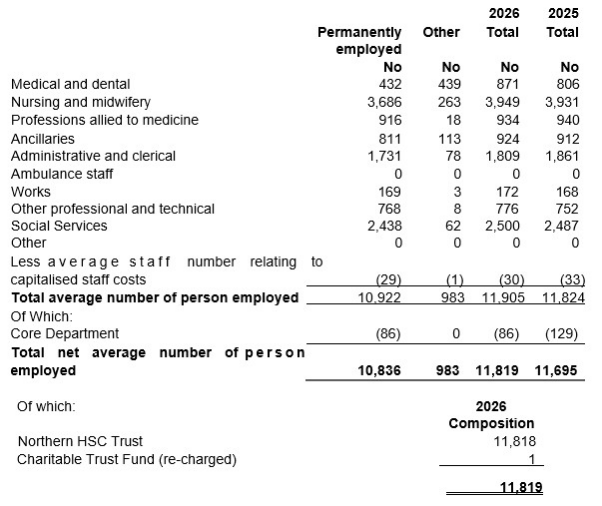
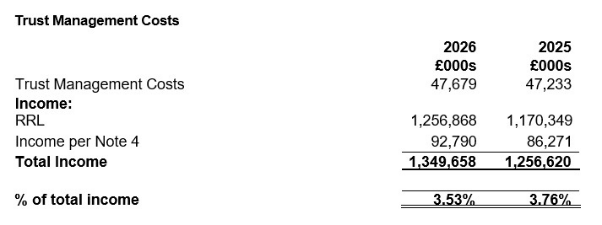
The management costs have been prepared on a consistent basis from previous years and have been based on the appropriate elements contained in the circular HSS (THR) 2/99.
Staff Redeployed
As with 2024/2025, there were no redeployment initiatives during 2025/2026.
Staff Turnover
The table below provides an analysis of staff turnover in the period, being defined as the number of leavers over the average number of staff in the period:
Staff Turnover
| Contract Type | 2025/26 | 2024/25 | ||
|---|---|---|---|---|
| No of
Leavers |
% | No of
Leavers |
% | |
| Permanent | 840 | 6.67% | 904 | 7.3 |
| Temporary | 138 | 32.78% | 159 | 30.9 |
| 978 | 7.51% | 1,063 | 8.24 | |
Staff Engagement
The Trust holds Silver accreditation with Investors in People (IIP), which is subject to periodic review. During 2025–26, the Trust was successfully re-accredited at Silver level for a further three-year period. This independent assessment provided an opportunity to reflect on the Trust’s people and culture arrangements, including the impact of the People and Culture Plan, and to hear directly from staff about their experience of working within TeamNORTH.
Human Resources Policies
Information on key Human Resource policies can be found on page 52.
Retirements Due to Ill-Health
During 2025/26 there were 29 (2024/25: 54) early retirements from the Trust, agreed on the grounds of ill-health. The estimated additional pension liabilities of these ill-health retirements will be £264k (£531k in 2024/25). These costs are borne by the HSC Pension Scheme.
Reporting of Early retirement and Other Compensation Scheme – Exit Packages (Audited)
As with 2024/25, there were no early retirement exit packages.
Redundancy and other departure costs are paid in accordance with the provisions of the HSC Pension Scheme Regulations and the Compensation for Premature Retirement Regulations, statutory provisions made under the Superannuation (NI) Order 1972. Exit costs are accounted for in full in the year in which the exit package is approved and agreed and are included as operating expenses at Note 3. Where early retirements have been agreed, the additional costs are met by the Trust and not by the HSC pension scheme. Ill-health retirement costs are met by the pension scheme are not included in the table.
Compensation packages payable to a former senior manager – £nil (2024/25 £nil).
Amounts payable to third parties for the service of a senior manager – £nil (2024/25 £nil).
Staff Composition by Gender
The following table provides an analysis of the number of employed staff as at 31 March 2026 by gender:
Staff Composition by Gender
| NHSCT Staff Composition as at 31 March 2026 | ||||||||||
|---|---|---|---|---|---|---|---|---|---|---|
| Gender | Directors* | Non-Executive Directors | Senior Staff** | Other Staff | Trust Total | |||||
| H’count | As% | H’count | As% | H’count | As% | H’count | As% | H’count | As% | |
| Female | 10 | 63% | 4 | 50% | 30 | 65% | 11,088 | 85% | 11,132 | 85% |
| Male | 6 | 38% | 4 | 50% | 16 | 35% | 1,936 | 15% | 1,962 | 15% |
| Total | 16 | 8 | 46 | 13,024 | 13,094 | |||||
* Executive Team and Divisional Directors
** Senior staff are considered to be those operating at Assistant Director level
Staff Absence
The Trust was set a target of 7.25% by the DoH for staff absence. The Trust absence for 2025/26 was 8.37% excluding Homecare staff.
Off Payroll Engagements
The Trust did not have any off-payroll engagements in 2025/26 that were in excess of £245 per day and/or that lasted longer than six months.
Consultancy
Expenditure on Consultancy in 2025/26 was £nil (2024/25 £nil).
Contingent Labour
Expenditure on temporary (agency) staff in 2025/26 was £71m, £27k of which was capitalised (2024/25 £72m of which £51k of which was capitalised).
77% (2024/25 78%) of the costs incurred were in respect of nursing, midwifery medical and dental support staff. Agency staff are engaged to cover temporary placements that may arise due to staff vacancies, maternity or sick leave and to over issues of acuity or demand pressures, e.g. seasonal pressure.
Assembly Accountability and Audit Report
Financial Resources
The Trust managed revenue expenditure of £1,398m in 2025/26, £2.3m of which related to COVID-19.
The Trust employed an average of 11,819 staff serving a population of approximately 470,000 residents and manages a wide and geographically dispersed estate at a value of £475m.
The Trust continues to experience cost pressures particularly in relation to: unscheduled care, ED activity growth; children’s services; mental health and disability services; pay and price inflation as well as demographic growth linked to an increasing elderly population and inflationary pressures.
The Trust developed a Financial Plan during the year, submitting a draft for response to SPPG in February 2026 and a final submission on 30 April 2026. This response included a Savings Plan towards the Trust savings target of £31m. These savings were a mix of recurrent and one-off cost containment measures and non-recurrent slippage on new investments.
While the Trust achieved financial balance in 2025/26, this outcome was attributable in part to a significant level of non-recurrent measures within the Trust and also deficit funding from SPPG and DoH. The Trust, therefore, begins 2026/27 with a funding gap, potential new demand pressures and a requirement to achieve savings which it continues to review with Commissioners and DoH to formalise into a 2026/27 Financial Plan. Indications are that 2026/27 COVID-19 funding will continue to be restricted to key areas and is expected to be at worst, similar to 2025/26 levels and that costs that continue should only be in response to the most recent guidance.
Financial Targets
The Trust has continued to improve the safety and responsiveness of services for its patients and clients and was still able to achieve its statutory financial targets, as outlined below:
- Breakeven on income and expenditure; and
- Maintain capital expenditure within the agreed Capital Resource Limit
The above achievements have been delivered through a combination of sound financial governance, control and management and the ongoing efforts of staff.
Financial Governance
The Trust has continued to maintain sound systems of internal financial control which are designed to safeguard public funds and assets. The same high degree of security is maintained over the patients’ and residents’ monies and CTFs administered by the Trust.
The internal control framework relies on a combination of robust internal governance structures, policies and procedures, control checks and balances, self-assessments and independent reviews. The Chief Executive’s assurances in respect of this area are set out in the Governance Statement within this report.
In terms of financial management and control across the Trust, a detailed financial plan is prepared and approved by the Trust Board at the beginning of each financial year and budgets are allocated to Directorates. Financial performance is monitored and reviewed through detailed financial reporting to Directors and budget managers on a monthly basis. This is supported by a programme of regular Accountability meetings with Directorates and Divisions during which financial performance forms a significant part of the agenda. An aggregate summary of the financial position to date and forecast year end position is presented by the Director of Finance to Trust Board each month with supporting narrative to ensure a clear understanding of underlying issues and trends.
Income and Expenditure
The information below provides an analysis of Trust’s income and a breakdown of expenditure in 2025/26.
The largest cost incurred by the Trust is staff salaries, representing over 57% (£771m) of total expenditure covering a range of staff groups such as nursing, medical, diagnostic, social services and allied health professionals.
The chart below shows the percentage of payroll spend (£771m) for the professional staff groups with the largest spend residing in the nursing category.
Analysis of Staff by Function
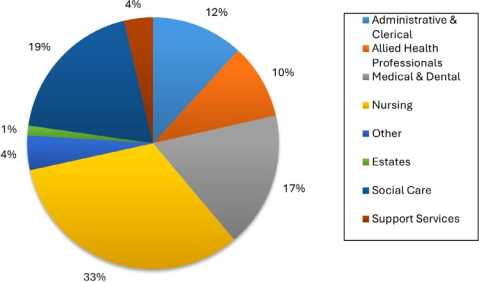
The Trust incurred £578m of non pay expenditure (operating expenses excluding staff costs) during 2025/26 and the chart below provides an analysis of this.
Analysis of Non Pay Expenditure
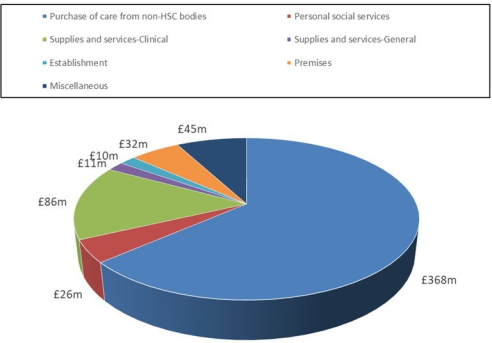
In 2025/26 the Trust provided services for a range of programmes of care as detailed in the graph below (most recent source Trust Financial Returns).
Expenditure by Programme of Care
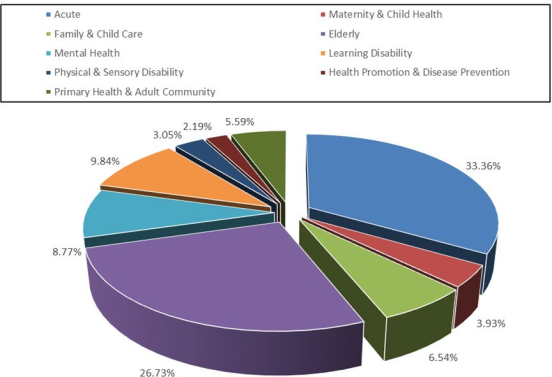
Income
The majority of income, 99%, comes from DoH, through SPPG and the Public Health Agency. The Trust also receives income for medical education from NI Medical and Dental Training Agency (NIMDTA).
The income received by the Trust is used to deliver health and social care services for the population of the Trust region which covers 1,733 square miles spanning four council areas (Antrim and Newtownabbey District, Causeway Coast and Glens District, Mid and East Antrim District and Mid Ulster District) making it the largest geographical Trust in NI.
Fees and Charges (Audited)
The Trust does not have material income generated from fees and charges.
Remote Contingent Liabilities (Audited)
The Trust has no remote contingent liabilities that I am aware of (2024/25 £nil).
Capital Development Programme
For the 2025/26 financial year the Trust managed gross capital expenditure to the value of £32.6m to deliver capital projects.
We are delighted to say that the following schemes progressed during 2025/26, with a minor surplus against the Capital Resource budget of £3k.
Capital Schemes
| Capital Scheme | Expenditure 2025/26 £m |
Total Value of Project £m |
|---|---|---|
| Mental Health Inpatient Facility | £0.4m | £88.21m |
| Alongside Midwifery Led Unit | £3.5m | £5.7m |
| Medical Devices | £4.3m | £4.3m |
| Implementation of Rapid Diagnosis Centres | £0.6m | £4.0m |
| ICT | £6.0m | £6.0m |
| Community Mental Health Team Accommodation at Carrickfergus Health Centre | £1.3m | £1.4m |
| Mid Ulster Hospital CT Scanner | £0.7m | £0.7m |
| Vehicle Replacement | £2.0m | £2.0m |
| Children’s Respite Facilities | £0.6m | £0.6m |
| Trustwide Asbestos Removals | £0.24m | £0.24m |
The above table sets out some of the capital schemes which happened during the financial year but the total capital expenditure of £32.3m is broken down as follows:
- £17.3m on general capital which included spend on capital estate’s schemes, medical devices and vehicles;
- £5.1m on backlog maintenance;
- £0.4m on Mental Health Inpatient Facility;
- £3.9m on Alongside Midwifery Led Unit; and
- £6.0m on Trust’s ICT infrastructure totalled
Charitable Trust Funds
CTF management and activity, including expenditure and income, is an integral part of the successful operation of the Trust. The Trustees (The Trust Board) work diligently to ensure that these funds are put to the most appropriate and effective use for the benefit of patients, residents and clients using Trust services as intended by the donors in the:
- provision of comforts;
- purchase of equipment and services; and
- research into any aspect of the work of the
During the year these funds supported initiatives as wide as the provision of a greenhouse to enable service users to participate in horticulture activity at a day centre to the purchase of diabetes products for children to ensure insulin pump devices do not become disconnected or fall off, reducing anxiety and concern, etc.
CTFs are managed under the same exacting governance arrangements and controls as public funds. In 2025/26, CTF income amounted to £1,057k and expenditure was £1,507k including £8k notional audit fee. Total fund balances as at 31 March 2026 amounted to £8,249k.
Investments showed an unrealised gain of £886k on their share valuation at 31 March 2026.
The annual accounts are prepared on a consolidated basis including both public and CTF transactions.
There is also a separate CTF Annual Trustees Report and Annual Accounts available for 2025/26. This is subject to audit.
Losses and Special Payments (Audited)
Losses and Special Payments require specific approvals with delegated limits for approval set by DoH. Losses over a particular threshold require approval by the DoH.
Losses and Special Payments
| Losses Statement | 2025/26 | 2024/25 |
|---|---|---|
| Total Number of Losses | 277 | 250 |
| Total Value of Losses (£000) | 350 | 485 |
| Individual Losses over £300,000 | 2025/26 | 2024/25 |
| £000 | £000 | |
| Cash Losses | 0 | 0 |
| Administrative Write Offs | 0 | 0 |
| Fruitless Payments | 0 | 0 |
| Store Losses | 0 | 0 |
Losses and Special Payments (continued)
| Special Payments | 2025/26 | 2024/25 |
|---|---|---|
| Total Number of Special Payments | 113 | 138 |
| Total Value of Special Payments (£000) | 4,545 | 13,178 |
Losses and Special Payments (continued)
| Individual Special Payments over £300,000 | 2025/26 | 2024/25 |
|---|---|---|
| £000 | £000 | |
| Compensation Payments: | ||
| – Clinical Negligence (2 cases*/2 payments) | 1,298 | 9,066 |
| – Public Liability | 0 | 0 |
| – Employers Liability | 0 | 350 |
| – Other | 0 | 375 |
| Ex-gratia payments | 0 | 0 |
| Extra contractual | 0 | 0 |
| Special severance payments | 0 | 0 |
| Total Special Payments | 1,298 | 9,791 |
* Details of these cases are not being disclosed as this would conflict with a legal obligation arising as a result of the Data Protection Act 2018
Other Payments
There were no other payments made during the year.
Regularity Statement (Audited)
The Trust’s financial and governance framework incorporates the Trust’s Management Statement and Financial Memorandum with DoH, DoH circulars, the Trust’s Standing Orders and Scheme of Reservation and Delegation, Standing Financial Instructions and financial procedures, processes and controls. These are designed to ensure that the expenditure and income, reported for the year ended 31 March 2026, has been applied to the purposes intended by the NI Assembly and that transactions conform to the authorities which govern them.
The Trust maintains a Register of Interests and a Gifts and Hospitality Register, against which decisions on acceptance are made in line with Policy.
Further details on expenditure trends, risks and long-term expenditure plans are set out within the Governance Statement and Performance Report.
- Suzanne Pullins, Interim Chief Executive/Accounting Officer, 25 June 2026
Northern Health and Social Care Trust – Public Funds
The certificate and report of the Comptroller and Auditor General to the Northern Ireland Assembly
Opinion on financial statements
I certify that I have audited the financial statements of the Northern Health and Social Care Trust (NHSCT) for the year ended 31 March 202 under the Health and Personal Social Services (Northern Ireland) Order 1972, as amended. The financial statements comprise: the Group and Parent Statements of Comprehensive Net Expenditure, Financial Position, Cash Flows, Changes in Taxpayers’ Equity; and the related notes including significant accounting policies.
The financial reporting framework that has been applied in their preparation is applicable law and UK adopted international accounting standards as interpreted and adapted by the Government Financial Reporting Manual.
I have also audited the information in the Accountability Report that is described in that report as having been audited.
In my opinion the financial statements:
- give a true and fair view of the state of the group’s and the NHSCT’s affairs as at 31 March 2026 and of the group’s and the NHSCT’s net expenditure for the year then ended; and
- have been properly prepared in accordance with the Health and Personal Social Services (Northern Ireland) Order 1972, as amended and Department of Health directions issued
Opinion on regularity
In my opinion, in all material respects the expenditure and income recorded in the financial statements have been applied to the purposes intended by the Assembly and the financial transactions recorded in the financial statements conform to the authorities which govern them.
Basis for opinions
I conducted my audit in accordance with International Standards on Auditing (ISAs) (UK), applicable law and Practice Note 10 ‘Audit of Financial Statements and Regularity of Public Sector Bodies in the United Kingdom’. My responsibilities under those standards are further described in the Auditor’s responsibilities for the audit of the financial statements section of my certificate.
My staff and I are independent of NHSCT in accordance with the ethical requirements that are relevant to my audit of the financial statements in the UK, including the Financial Reporting Council’s Ethical Standard, and have fulfilled our other ethical responsibilities in accordance with these requirements. I believe that the audit evidence obtained is sufficient and appropriate to provide a basis for my opinions.
Conclusions relating to going concern
In auditing the financial statements, I have concluded that NHSCT’s use of the going concern basis of accounting in the preparation of the financial statements is appropriate.
Based on the work I have performed, I have not identified any material uncertainties relating to events or conditions that, individually or collectively, may cast significant doubt on NHSCT’s ability to continue as a going concern for a period of at least twelve months from when the financial statements are authorised for issue.
The going concern basis of accounting for NHSCT is adopted in consideration of the requirements set out in the Government Financial Reporting Manual, which require entities to adopt the going concern basis of accounting in the preparation of the financial statements where it anticipated that the services which they provide will continue into the future.
My responsibilities and the responsibilities of the Board and the Accounting Officer with respect to going concern are described in the relevant sections of this certificate.
Other Information
The other information comprises the information included in the annual report other than the financial statements, the parts of the Accountability Report described in that report as having been audited, and my audit certificate and report. The Board and the Accounting Officer are responsible for the other information included in the annual report. My opinion on the financial statements does not cover the other information and except to the extent otherwise explicitly stated in my report, I do not express any form of assurance conclusion thereon.
My responsibility is to read the other information and, in doing so, consider whether the other information is materially inconsistent with the financial statements or my knowledge obtained in the audit, or otherwise appears to be materially misstated. If I identify such material inconsistencies or apparent material misstatements, I am required to determine whether this gives rise to a material misstatement in the financial statements themselves. If, based on the work I have performed, I conclude that there is a material misstatement of this other information, I am required to report that fact.
I have nothing to report in this regard.
Opinion on other matters
In my opinion the part of the Remuneration and Staff Report to be audited has been properly prepared in accordance with Department of Finance directions issued under the Health and Personal Social Services (Northern Ireland) Order 1972.
In my opinion, based on the work undertaken in the course of the audit:
- the parts of the Accountability Report to be audited have been properly prepared in accordance with Department of Health directions made under the Health and Personal Social Services (Northern Ireland) Order 1972, as amended; and
- the information given in the Performance Report and Accountability Report for the financial year for which the financial statements are prepared is consistent with the financial statements
Matters on which I report by exception
In the light of the knowledge and understanding of NHSCT and its environment obtained in the course of the audit, I have not identified material misstatements in the Performance Report and Accountability Report. I have nothing to report in respect of the following matters which I report to you if, in my opinion:
- adequate accounting records have not been kept; or
- the financial statements and the parts of the Accountability Report to be audited are not in agreement with the accounting records; or
- certain disclosures of remuneration specified by the Government Financial Reporting Manual are not made or parts of the Remuneration and Staff Report to be audited is not in agreement with the accounting records and returns; or
- I have not received all of the information and explanations I require for my audit; or
- the Governance Statement does not reflect compliance with the Department of Finance’s guideance
Responsibilities of the Board and Accounting Officer for the financial statements
As explained more fully in the Statement of Accounting Officer Responsibilities, the Board and the Accounting Officer are responsible for:
- maintaining proper accounting records;
- the preparation of the financial statements in accordance with the applicable financial reporting framework and for being satisfied that they give a true and fair view;
- ensuring such internal controls are in place as deemed necessary to enable the preparation of financial statements to be free from material misstatement, whether due to fraud or error;
- ensuring the annual report, which includes the Remuneration and Staff Report is prepared in accordance with the applicable financial reporting framework; and
- assessing the Northern Health and Social Care Trust’s ability to continue as a going concern, disclosing, as applicable, matters related to going concern and using the going concern basis of accounting unless the Accounting Officer anticipates that the services provided by the Northern Health and Social Care Trust will not continue to be provided in the future
Auditor’s responsibilities for the audit of the financial statements
My responsibility is to examine, certify and report on the financial statements in accordance with the Health and Personal Social Services (Northern Ireland) Order 1972, as amended.
My objectives are to obtain reasonable assurance about whether the financial statements as a whole are free from material misstatement, whether due to fraud or error and to issue a certificate that includes my opinion. Reasonable assurance is a high level of assurance, but is not a guarantee that an audit conducted in accordance with ISAs (UK) will always detect a material misstatement when it exists. Misstatements can arise from fraud or error and are considered material if, individually or in the aggregate, they could reasonably be expected to influence the economic decisions of users taken on the basis of these financial statements.
I design procedures in line with my responsibilities, outlined above, to detect material misstatements in respect of non-compliance with laws and regulation, including fraud.
My procedures included:
- obtaining an understanding of the legal and regulatory framework applicable to the Northern Health and Social Care Trust through discussion with management and application of extensive public sector accountability The key laws and regulations I considered included the Health and Personal Social Services (Northern Ireland) Order 1972, as amended;
- making enquires of management and those charged with governance on the Northern Health and Social Care Trust’s compliance with laws and regulations;
- making enquiries of internal audit, management and those charged with governance as to susceptibility to irregularity and fraud, their assessment of the risk of material misstatement due to fraud and irregularity, and their knowledge of actual, suspected and alleged fraud and irregularity;
- completing risk assessment procedures to assess the susceptibility of Northern Health and Social Care Trust’s financial statements to material misstatement, including how fraud might This included, but was not limited to, an engagement director led engagement team discussion on fraud to identify particular areas, transaction streams and business practices that may be susceptible to material misstatement due to fraud. As part of this discussion, I identified potential for fraud in the following areas: expenditure recognition and posting of unusual journals;
- engagement director oversight to ensure the engagement team collectively had the appropriate competence, capabilities and skills to identify or recognise non-compliance with the applicable legal and regulatory framework throughout the audit;
- documenting and evaluating the design and implementation of internal controls in place to mitigate risk of material misstatement due to fraud and non-compliance with laws and regulations;
- designing audit procedures to address specific laws and regulations which the engagement team considered to have a direct material effect on the financial statements in terms of misstatement and irregularity, including These audit procedures included, but were not limited to, reading Commission and committee minutes, and agreeing financial statement disclosures to underlying supporting documentation and approvals as appropriate; and
- addressing the risk of fraud as a result of management override of controls by:
- » performing analytical procedures to identify unusual or unexpected relationships or movements;
- » testing journal entries to identify potential anomalies, and inappropriate or unauthorised adjustments;
- » assessing whether judgements and other assumptions made in determining accounting estimates were indicative of potential bias; and
- » investigating significant or unusual transactions made outside of the normal course of business.
A further description of my responsibilities for the audit of the financial statements is located on the Financial Reporting Council’s website www.frc.org.uk/auditorsresponsibilities. This description forms part of my certificate.
In addition, I am required to obtain evidence sufficient to give reasonable assurance that the income and expenditure recorded in the financial statements have been applied to the purposes intended by the Assembly and the financial transactions recorded in the financial statements conform to the authorities which govern them.
Report
I have no observations to make on these financial statements.
- Dorinnia Carville, Comptroller and Auditor General, Northern Ireland Audit Office 106 University Street BELFAST, BT7 1EU, 30 June 2026