
Contents
- Introduction
- Consolidated Accounts
- Notes to the Accounts
- Accounts of monies held on behalf of patients and residents
- Glossary
The report is also available to download as a PDF: Annual Report and Accounts 2025/2026 (PDF, 16MB)
Introduction
The financial statements and notes to the accounts of the Trust for 2025/26 are included on pages 120 to 163.
The Patients and Residents Monies Accounts for 2025/26 are included on pages 168 to 169.
Charitable Trust Fund Accounts for 2025/26 are issued separately however they are consolidated within the public fund accounts to meet the requirements of the relevant consolidation accounting policy.
Northern HSC Trust Accounts for the year ended 31 March 2026
Foreword
Consolidated Statement of Comprehensive Net Expenditure for the year ended 31 March 2026
This account summarises the expenditure and income generated and consumed on an accruals basis. It also includes other comprehensive income and expenditure, which includes changes to the values of non-current assets and other financial instruments that cannot yet be recognised as income or expenditure.
These accounts for the year ended 31 March 2026 have been prepared in accordance with Article 90(2) (a) of the Health and Personal Social Services (Northern Ireland) Order 1972, as amended by Article 6 of the Audit and Accountability (Northern Ireland) Order 2003, in a form directed by DoH.
Certificates of the Director of Finance, Chairman and Chief Executive
I certify that the annual accounts set out in the financial statements and notes to the accounts (pages 120 to 163) which I am required to prepare on behalf of the Northern HSC Trust have been compiled from and are in accordance with the accounts and financial records maintained by the Northern
HSC Trust and with the accounting standards and policies for HSC bodies approved by the DoH.
- Stephen Lennon, Interim Director of Finance, 25 June 2026
I certify that the annual accounts set out in the financial statements and notes to the accounts (pages 120 to 163) as prepared in accordance with the above requirements have been submitted to and duly approved by the Board.
- Anne O’Reilly, Chair, 25 June 2026
- Suzanne Pullins, Interim Chief Executive, 25 June 2026
Consolidated Statement of Comprehensive Net Expenditure for the year ended 31 March 2026
This account summarises the expenditure and income generated and consumed on an accruals basis. It also includes other comprehensive income and expenditure, which includes changes to the values of non-current assets and other financial instruments that cannot yet be recognised as income or expenditure.
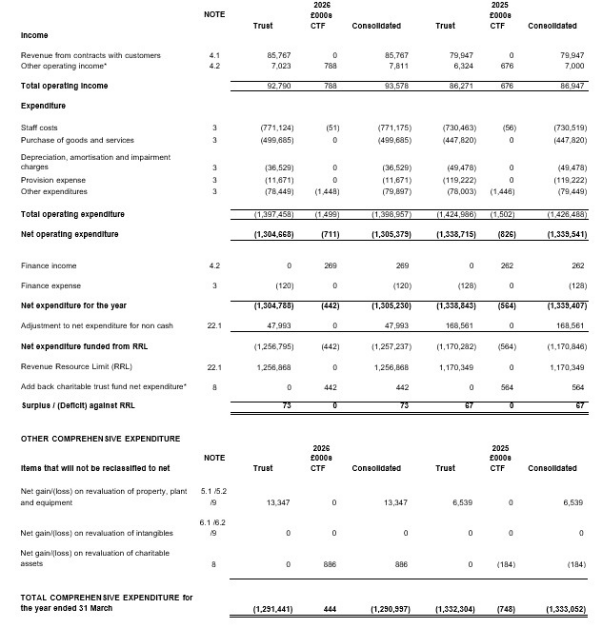
The notes on pages 125 to 163 form part of these accounts.
* All donated funds have been used by Northern Health and Social Care Trust as intended by the benefactor. It is for the Charitable Trust Fund Committee within the Trust to manage the internal disbursements. The committee ensures that charitable donations received by the Trust are appropriately managed, invested, expended and controlled, in a manner that is consistent with the purposes for which they were given and with the Trust’s Standing Financial Instructions, Departmental guidance and legislation.
All such funds are allocated to the area specified by the benefactor and are not used for any other purpose than that intended by the benefactor.
Consolidated Statement of Financial Position as at 31 March 2026
This statement presents the financial position of Northern HSC Trust. It comprises three main components: assets owned or controlled; liabilities owed to other bodies; and equity, the remaining value of the entity.
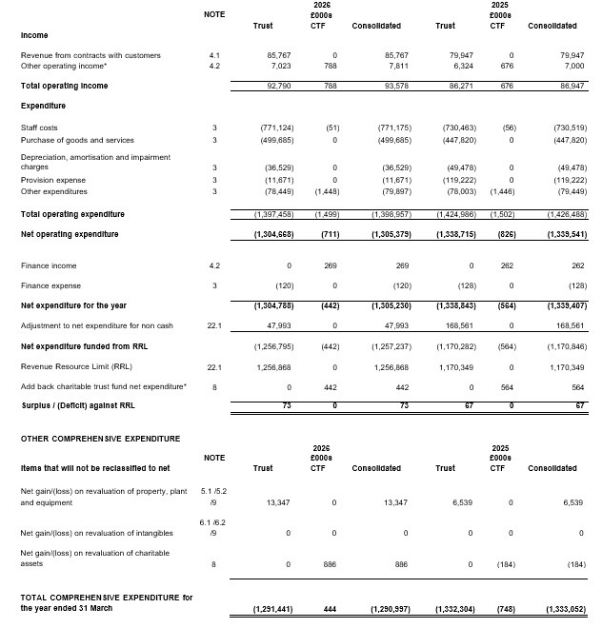
The financial statements on pages 120 to 124 were approved by the Board on 25 June 2026 and were signed on its behalf by;
The notes on pages 125 to 163 form part of these accounts.
- Anne O’Reilly, Chair, 25 June 2026
- Suzanne Pullins, Interim Chief Executive, 25 June 2026
Consolidated Statement of Changes in Taxpayers’ Equity for the year ended 31 March 2026
This statement shows the movement in the year on the different reserves held by Northern HSC Trust, analysed into the SoCNE Reserve (i.e. that reserve that reflects a contribution from the Department of Health). The Revaluation Reserve reflects the change in asset values that have not been recognised as income or expenditure. The SoCNE Reserve represents the total assets less liabilities of the Northern HSC Trust, to the extent that the total is not represented by other reserves and financing items.
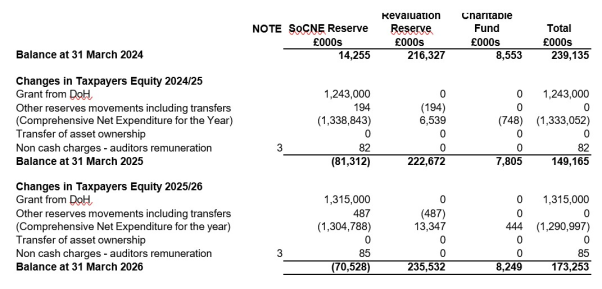
The notes on pages 125 to 163 form part of these accounts.
Statement of accounting policies
1.0 Authority
These financial statements have been prepared in a form determined by DoH based on guidance from the Department of Finance’s Financial Reporting Manual (FReM) and in accordance with the requirements of Article 90(2) (a) of the Health and Personal Social Services (Northern Ireland) Order 1972 No 1265 (NI 14) as amended by Article 6 of the Audit and Accountability (Northern Ireland) Order 2003.
The accounting policies contained in the FReM apply International Financial Reporting Standards (IFRS) as adapted or interpreted for the public sector context. Where the FReM permits a choice of accounting policy, the accounting policy which has been judged to be most appropriate to the particular circumstances of the Trust for the purpose of giving a true and fair view has been selected. The particular policies adopted by the Trust are described below. They have been applied consistently in dealing with items considered material in relation to the accounts.
1.1 Accounting Convention
These accounts have been prepared under the historical cost convention modified to account for the revaluation of property, plant and equipment and certain financial assets and liabilities.
1.2 Property, Plant and Equipment
Property, plant and equipment assets comprise Land, Buildings, Dwellings, Transport Equipment, Plant and Machinery, Information Technology, Furniture and Fittings and Assets under Construction. This includes assets donated to the Trust.
Recognition
Property, plant and equipment must be capitalised if:
- it is held for use in delivering services or for administrative purposes;
- it is probable that future economic benefits will flow to, or service potential will be supplied to, the entity;
- it is expected to be used for more than one financial year;
- the cost of the item can be measured reliably; and
- the item has a cost of at least £5,000 (or less if so desired); or
- collectively, a number of items have a cost of at least £5,000 (or less if so desired) and individually have a cost of more than £1,000 (or less if so desired), where the assets are functionally interdependent, they had broadly simultaneous purchase dates, are anticipated to have simultaneous disposal dates and are under single managerial control; or
- items form part of the initial equipping and setting-up cost of a new building, ward or unit, irrespective of their individual or collective cost
On initial recognition property, plant and equipment are measured at cost including any expenditure such as installation, directly attributable to bringing them into working condition. Items classified as “under construction” are recognised in the Statement of Financial Position to the extent that money has been paid or a liability has been incurred.
Valuation
All Property, Plant and Equipment are carried at fair value.
Fair value of Property is estimated as the latest professional valuation revised annually by reference to indices supplied by Land and Property Services.
Fair value for Plant and Equipment is estimated by restating the value annually by reference to indices compiled by the Office of National Statistics (ONS), except for assets under construction, which are carried at cost, less any impairment loss.
RICS, IFRS, IVS and HM Treasury compliant asset revaluation of land and buildings for financial reporting purposes are undertaken by Land and Property Services (LPS) at least once in every five year period. Figures are then restated annually, between revaluations, using indices provided by LPS.
The last asset revaluation was carried out on 31 January 2025 by Land and Property Services (LPS).
Fair values are determined as follows:
- Land and non-specialised buildings – open market value for existing use;
- Specialised buildings – depreciated replacement cost; and
- Properties surplus to requirements – the lower of open market value less any material directly attributable selling costs, or book value at date of moving to non-current assets
Modern Equivalent Asset
DoF has adopted a standard approach to depreciated replacement cost valuations based on modern equivalent assets and, where it would meet the location requirements of the service being provided, an alternative site can be valued. Land and Property Services (LPS) have included this requirement within the latest valuation.
Assets Under Construction (AUC)
Assets classified as “under construction” are recognised in the Statement of Financial Position to the extent that money has been paid or a liability has been incurred. They are carried at cost, less any impairment loss. Assets under construction are revalued and depreciation commences when they are brought into use.
Short Life Assets
Short life assets are not indexed. Short life is defined as a useful life of up to and including 5 years. Short life assets are carried at depreciated historic cost as this is not considered to be materially different from fair value and are depreciated over their useful life.
Where estimated life of fixtures and equipment exceed 5 years, suitable indices will be applied each year and depreciation will be based on the indexed amount.
Revaluation Reserve
An increase arising on revaluation is taken to the revaluation reserve except when it reverses an impairment for the same asset previously recognised in expenditure, in which case it is credited to expenditure to the extent of the decrease previously charged there. A revaluation decrease is recognised as an impairment charged to the revaluation reserve to the extent that there is a balance on the reserve for the asset and, thereafter, to expenditure.
1.3 Depreciation
No depreciation is provided on freehold land since land has unlimited or a very long established useful life. Items under construction are not depreciated until they are commissioned. Properties that are surplus to requirements and which meet the definition of “non-current assets held for sale” are also not depreciated.
Otherwise, depreciation is charged to write off the costs or valuation of property, plant and equipment and similarly, amortisation is applied to intangible non-current assets, less any residual value, over their estimated useful lives, in a manner that reflects the consumption of economic benefits or service potential of the assets. Assets held under finance leases are also depreciated over the lower of their estimated useful lives and the terms of the lease. The estimated useful life of an asset is the period over which the Trust expects to obtain economic benefits or service potential from the asset.
Estimated useful lives and residual values are reviewed each year end, with the effect of any changes recognised on a prospective basis. The following asset lives have been used:
| Asset Type | Asset Life |
|---|---|
| Freehold Buildings | 25 – 80 years |
| Leasehold property | Remaining period of lease |
| IT assets | 4 – 5 years |
| Intangible assets | 4 – 5 years |
| Other Equipment | 3 – 15 years |
Impairment Loss
If there has been an impairment loss due to a general change in prices, the asset is written down to its recoverable amount, with the loss charged to the revaluation reserve to the extent that there is a balance on the reserve for the asset and, thereafter, to expenditure within the Statement of Comprehensive Net Expenditure. If the impairment is due to the consumption of economic benefits the full amount of the impairment is charged to the Statement of Comprehensive Net Expenditure and an amount up to the value of the impairment in the revaluation reserve is transferred to the Statement of Comprehensive Net Expenditure Reserve. Where an impairment loss subsequently reverses, the carrying amount of the asset is increased to the revised estimate of the recoverable amount but capped at the amount that would have been determined had there been no initial impairment loss. The reversal of the impairment loss is credited firstly to the Statement of Comprehensive Net Expenditure to
the extent of the decrease previously charged there and, thereafter, to the revaluation reserve.
1.5 Subsequent Expenditure
Where subsequent expenditure enhances an asset beyond its original specification, the directly attributable cost is capitalised. Where subsequent expenditure, which meets the definition of capital, restores the asset to its original specification, the expenditure is capitalised and any existing carrying value of the item replaced is written off and charged to operating expenses.
The overall useful life of the Trust’s buildings takes account of the fact that different components of those buildings have different useful lives. This ensures that depreciation is charged on those assets at the same rate as if separate components had been identified and depreciated at different rates.
1.6 Intangible Assets
Intangible assets includes any of the following held – software, licences, trademarks, websites, development expenditure, patents, goodwill and intangible Assets under Construction. Software that is integral to the operating of hardware, for example an operating system is capitalised as part of the relevant item of property, plant and equipment. Software that is not integral to the operation of hardware, for example, application software is capitalised as an intangible non-current asset. Internally-generated assets are recognised if, and only if, all of the following have been demonstrated:
- the technical feasibility of completing the intangible asset so that it will be available for use;
- the intention to complete the intangible asset and use it;
- the ability to sell or use the intangible asset;
- how the intangible asset will generate probable future economic benefits or service potential;
- the availability of adequate technical, financial and other resources to complete the intangible asset and sell or use it; and
- the ability to measure reliably the expenditure attributable to the intangible asset during its development
Recognition
Intangible assets are non-monetary assets without physical substance, which are capable
of sale separately from the rest of the Trust’s business or which arise from contractual or other legal rights. Intangible assets are considered to have a finite life. They are recognised only when it is probable that future economic benefits will flow to, or service potential be provided to, the Trust where the cost of the asset can be measured reliably. All single items over £5,000,
(or less if so desired) in value must be capitalised while intangible assets which fall within the grouped asset definition must be capitalised if their individual value is at least £1,000 (or less if so desired) each and the group is at least £5,000 in value.
The amount recognised for internally-generated intangible assets is the sum of the expenditure incurred from the date of commencement of the intangible asset, until it is complete and ready for use.
Intangible assets acquired separately are initially recognised at fair value.
Following initial recognition, intangible assets are carried at fair value by reference to an active market, and as no active market currently exists depreciated replacement cost has been used as fair value.
1.7 Non-current Assets Held for Sale
Non-current assets are classified as held for sale if their carrying amount will be recovered principally through a sale transaction rather than through continuing use. In order to meet this definition IFRS 5 requires that the asset must be immediately available for sale in its current condition and that the sale is highly probable. A sale is regarded as highly probable where an active plan is in place to find a buyer for the asset through appropriate marketing at a reasonable price and the sale is considered likely to be concluded within one year. Non-current assets held for sale are measured at the lower of their previous carrying amount and fair value, less any material directly attributable selling costs. Fair value is open market value, where one is available, including alternative uses.
Assets classified as held for sale are not depreciated.
The profit or loss arising on disposal of an asset is the difference between the sale proceeds and the carrying amount. The profit from sale of land which is a non-depreciating asset is recognised within income. The profit from sale of a depreciating asset is shown as a reduced expense. The loss from sale of land or from any depreciating assets is shown within operating expenses. On disposal, the balance for the asset on the revaluation reserve is transferred to the Statement of Comprehensive Net Expenditure reserve.
Property, plant or equipment that is to be scrapped or demolished does not qualify for recognition as held for sale. Instead, it is retained as an operational asset and its economic life is adjusted. The asset is de-recognised when it is scrapped or demolished.
1.8 Inventories
Inventories are valued at the lower of cost and net realisable value and are included exclusive of VAT. This is considered to be a reasonable approximation to fair value due to the high turnover of stocks.
1.9 Income
Income is classified between Revenue from Contracts and Other Operating Income as assessed necessary in line with Trust activity, under the requirements of IFRS 15 and as applicable to the public sector. Judgement is exercised in order to determine whether the five essential criteria within the scope of IFRS 15 are met in order to define income as a contract.
Income relates directly to the activities of the Trust and is recognised on an accruals basis when, and to the extent that a performance obligation is satisfied in a manner that depicts the transfer to the customer of the goods or services promised.
Where the criteria to determine whether a contract is in existence is not met, income is classified as Other Operating Income within the Statement of Comprehensive Net Expenditure and is recognised when the right to receive payment is established.
Income is stated net of VAT.
1.10 Grant in Aid
Funding received from other entities, including DoH and SPPG, are accounted for as grant in aid and are reflected through the Statement of Comprehensive Net Expenditure Reserve.
1.11 Investments
The Trust does not have any investments.
CTF investments have been consolidated. These Investment Fixed Assets are shown at market value as at the Statement of Financial Position date. The Statement of Financial Activities includes the net gains and losses arising on revaluation and disposals throughout the year.
Quoted stocks and shares are included in the Statement of Financial Position at mid-market price excluding dividend.
Other investment fixed assets are included at the Trustees’ best estimate of market value.
1.12 Cash and Cash Equivalents
Cash is cash in hand and deposits with any financial institution repayable without penalty on notice of not more than 24 hours. Cash equivalents are investments that mature in 3 months or less from the date of acquisition and that are readily convertible to known amounts of cash with insignificant risk of change in value.
1.13 Leases
Under IFRS16 leased assets which the Trust has use/control over and which it does not necessarily legally own are to be recognised as a ‘Right Of Use’ (ROU) asset. There are only two exceptions:
- short term assets – with a life of up to one year; and
- low value assets – with a value equal to or below DoH’s threshold limit which is currently £5,000.
Short Term Leases
Short term leases are defined as having a lease term of 12 months or less. Any lease with a purchase option cannot qualify as a short term lease. The lessee must not exercise an option to extend the lease beyond 12 months. No liability should be recognised in respect of short term leases and neither should the underlying asset be capitalised. Lease agreements which contain a purchase option cannot quality as short term. Examples of short term leases are software leases, specialised equipment, hire cars and some property leases.
Low Value Assets
An asset is considered ‘low value’ if its value, when new, is less than the capitalisation threshold. The application of the exemption is dependent on considerations of materiality. The low value assessment is performed on the underlying asset, which is the value of that underlying asset when new. Examples of low value assets are tablet and personal computers, small items of office furniture and telephones.
Separating Lease and Service Components
Some contracts may contain both a lease element and a service element. DoH bodies can, at their own discretion, choose to combine lease and non-lease components of contracts, and account for the entire contract as a lease. If a contract contains both lease and service components IFRS 16 provides guidance on how to separate those components. If a lessee separates lease and service components, it should capitalise amounts related to the lease components and expense elements relating to the service elements. However, IFRS 16 also provides an option for lessees to combine lease and service components and account for them as a single lease. This option should help DoH bodies where it is time consuming or difficult to separate these components.
The Trust as Lessee
The ROU asset lease liability will initially be measured at the present value of the unavoidable future lease payments. The future lease payments should include any amounts for:
- indexation;
- amounts payable for residual value;
- purchase price options;
- payment of penalties for terminating the lease;
- any initial direct costs; and
- costs relating to restoration of the asset at the end of the The lease liability is discounted using the rate implicit in the lease.
Lease payments are apportioned between finance charges and reduction of the lease obligation so as to achieve a constant rate of interest on the remaining balance of the liability. Finance charges are recognised in calculating the Arm’s Length Body (ALB) surplus/deficit.
The difference between the carrying amount and the lease liability on transition is recognised as an adjustment to taxpayers equity. After transition the difference is recognised as income in accordance with IAS 20.
Subsequent Measurement
After the commencement date (the date that the lessor makes the underlying asset available for use by the lessee) a lessee shall measure the liability by;
- increasing the carrying amount to reflect interest;
- reducing the carrying amount to reflect lease payments made; and
- re-measuring the carrying amount to reflect any reassessments or lease modifications, or to reflect revised in substance fixed lease payments
There is a need to reassess the lease liability in the future if there is:
- a change in lease term;
- change in assessment of purchase option;
- change in amounts expected to be payable under a residual value guarantee; or
- change in future payments resulting from change in index or rate
Subsequent measurement of the ROU asset is measured in same way as other property, plant and equipment. Asset valuations should be measured at either ‘fair value’ or ‘current value in existing use’.
Depreciation
Assets under a finance lease or ROU lease are depreciated over the shorter of the lease term and its useful life, unless there is a reasonable certainty the lessee will obtain ownership of the asset by the end of the lease term in which case it should be depreciated over its useful life.
The depreciation policy is as for other depreciable assets that are owned by the entity. Leased assets under construction must also be depreciated.
The Trust as Lessor
Amounts due from lessees under finance leases are recorded as receivables at the amount of the Trust’s net investment in the leases. Finance lease income is allocated to accounting periods so as to reflect a constant periodic rate of return on the Trust’s net investment outstanding in respect of the leases.
Rental income from operating leases is recognised on a straight-line basis over the term of the lease. Initial direct costs incurred in negotiating and arranging an operating lease are added to the carrying amount of the leased asset and recognised on a straight-line basis over the lease term
The Trust will classify subleases as follows:
- If the head lease is short term (up to 1 year), the sublease is classified as an operating lease;
- otherwise, the sublease is classified with reference to the ROU asset arising from the head lease, rather than with reference to the underlying asset.
Private Finance Initiative (PFI) Transactions
The Trust has had no PFI transactions during the year.
1.14 Financial Instruments
A financial instrument is defined as any contract that gives rise to a financial asset of one entity and a financial liability or equity instrument of another entity.
The Trust has financial instruments in the form of trade receivables and payables and cash and cash equivalents.
1.15 Financial Assets
Financial assets are recognised on the Statement of Financial Position when the Trust becomes party to the financial instrument contract or, in the case of trade receivables, when the goods or services have been delivered. Financial assets are de-recognised when the contractual rights have expired or the asset has been transferred.
Financial assets are initially recognised at fair value. IFRS 9 introduces the requirement to consider the expected credit loss model on financial assets. The measure of the loss allowance depends on the HSC Body’s assessment at the end of each reporting period as to whether the financial instrument’s credit risk has increased significantly since initial recognition, based on reasonable and supportable information that is available, without undue cost or effort
to obtain. The amount of expected credit loss recognised is measured on the basis of the probability weighted present value of anticipated cash shortfalls over the life of the instrument, where judged necessary.
Financial assets are classified into the following categories:
- financial assets at fair value through the Statement of Comprehensive Net Expenditure;
- held to maturity investments;
- available for sale financial assets;
- loans and
The classification depends on the nature and purpose of the financial assets and is determined at the time of initial recognition.
Financial Liabilities
Financial liabilities are recognised on the Statement of Financial Position when the Trust becomes party to the contractual provisions of the financial instrument or, in the case of trade payables, when the goods or services have been received. Financial liabilities are de-recognised when the liability has been discharged, that is, the liability has been paid or has expired.
Financial liabilities are initially recognised at fair value.
Financial Risk Management
IFRS 7 requires disclosure of the role that financial instruments have had during the period in creating or changing the risks a body faces in undertaking its activities. Because of the relationships with HSC Commissioners, and the manner in which they are funded, financial instruments play a more limited role in creating risk than would apply to a non-public sector body of a similar size, therefore the Trust is not exposed to the degree of financial risk faced by business entities.
The Trust has limited powers to borrow or invest surplus funds and financial assets and liabilities are generated by day to day operational activities rather than being held to change the risks facing the Trust in undertaking activities. Therefore the HSC is exposed to little credit, liquidity or market risk.
Currency Risk
The Trust is principally a domestic organisation with the great majority of transactions, assets and liabilities being in the UK and Sterling based. There is, therefore, low exposure to currency rate fluctuations.
Interest Rate Risk
The Trust has limited powers to borrow or invest and therefore has low exposure to interest rate fluctuations.
Credit Risk
Because the majority of the Trust’s income comes from contracts with other public sector bodies, the Trust has low exposure to credit risk.
Liquidity Risk
Since the Trust receives the majority of its funding through its principal Commissioner which is voted through the Assembly, there is low exposure to significant liquidity risks.
1.16 Provisions
In accordance with IAS 37, provisions are recognised when the Trust has a present legal or constructive obligation as a result of a past event, it is probable that the Trust will be required to settle the obligation, and a reliable estimate can be made of the amount of the obligation. The amount recognised as a provision is the best estimate of the expenditure required to settle the obligation at the end of the reporting period, taking into account the risks and uncertainties.
Where a provision is measured using the cash flows estimated to settle the obligation, its carrying amount is the present value of those cash flows using the relevant rates provided by HM Treasury.
When some or all of the economic benefits required to settle a provision are expected to be recovered from a third party, the receivable is recognised as an asset if it is virtually certain that reimbursements will be received and the amount of the receivable can be measured reliably.
1.17 Contingent liabilities/assets
In addition to contingent liabilities disclosed in accordance with IAS 37, HSC Trusts disclose for Assembly reporting and accountability purposes certain statutory and non-statutory
contingent liabilities where the likelihood of a transfer of economic benefit is remote, but which have been reported to the Assembly in accordance with the requirements of Managing Public Money Northern Ireland.
Where the time value of money is material, contingent liabilities which are required to be disclosed under IAS 37 are stated at discounted amounts and the amount reported to the Assembly separately noted. Contingent liabilities that are not required to be disclosed by IAS 37 are stated at the amounts reported to the Assembly.
Under IAS 37, the Trust discloses contingent liabilities where there is a possible obligation that arises from past events and whose existence will be confirmed only by the occurrence or non-occurrence of one or more uncertain future events not wholly within the control of the Trust, or a present obligation that is not recognised because it is not probable that a payment will be required to settle the obligation or the amount of the obligation cannot be measured sufficiently reliably. A contingent liability is disclosed unless the possibility of a payment is remote.
A contingent asset is a possible asset that arises from past events and whose existence will be confirmed by the occurrence or non-occurrence of one or more uncertain future events not wholly within the control of the Trust. A contingent asset is disclosed where an inflow of economic benefits is probable.
Employee Benefits
1.18 Short-term Employee Benefits
Under the requirements of IAS 19: Employee Benefits, staff costs must be recorded as an expense as soon as the organisation is obligated to pay them. This includes the cost of any untaken leave that has been earned at the year end. This cost has been estimated using the Trust’s current WTE staff numbers and actual costs applied to the assessed average untaken leave balance determined from the results of a full analytical review and survey to ascertain leave balances as at 31 March 2025.
Retirement Benefit Costs
The Trust participates in the HSC Pension Scheme. Under this multi-employer defined benefit scheme both the Trust and employees pay specified percentages of pay into the scheme and the liability to pay benefit falls to DoH. The Trust is unable to identify its share of the underlying assets and liabilities in the scheme on a consistent and reliable basis.
The costs of early retirements are met by the Trust and charged to the Statement of Comprehensive Net Expenditure at the time the Trust commits itself to the retirement.
As per the requirements of IAS 19, full actuarial valuations by a professionally qualified actuary are required with sufficient regularity that the amounts recognised in the financial statements do not differ materially from those determined at the reporting period date. This has been interpreted in the FReM to mean that the period between formal actuarial valuations shall be four years. The actuary reviews the most recent actuarial valuation at the statement of financial position date and updates it to reflect current conditions.
The scheme valuation data provided for the 2020 actuarial valuation will be used in the 2025-26 accounts. The 2020 valuation assumptions will be retained for most demographic
assumptions apart from the assumption for future longevity improvements, which are assumed to be in line with the 2022-based population projections for the United Kingdom published by the Office for National Statistics (ONS) on 28 January 2025. Financial assumptions are updated to reflect recent financial conditions. The 2024 valuation is underway but not sufficiently progressed to be used in the 2025-26 accounts.
1.19 Reserves
Statement of Comprehensive Net Expenditure Reserve
Accumulated surpluses are accounted for in the Statement of Comprehensive Net Expenditure Reserve.
Whilst the balance at 31 March 2026 is currently in negative as a result of Provisions, this does not affect Going Concern.
1.19 Revaluation Reserve
The Revaluation Reserve reflects the unrealised balance of cumulative indexation and revaluation adjustments to assets other than donated assets
1.20 Value Added Tax
Where output VAT is charged or input VAT is recoverable, the amounts are stated net of VAT. Irrecoverable VAT is charged to the relevant expenditure category or included in the capitalised purchase cost of fixed assets.
The Revaluation Reserve reflects the unrealised balance of cumulative indexation and revaluation adjustments to assets other than donated assets
1.21 Third Party Assets
Assets belonging to third parties (such as money held on behalf of patients) are not recognised in the accounts since the Trust has no beneficial interest in them. Details of third party assets are given in Note 21 to the accounts.
1.22 Government Grants
The Trust had no Government Grants.
1.23 Losses and Special Payments
Losses and special payments are items that the Assembly would not have contemplated when it agreed funds for the health service or passed legislation. By their nature they are items that ideally should not arise. They are therefore subject to special control procedures compared with the generality of payments.
They are divided into different categories, which govern the way that individual cases are handled.
Losses and special payments are charged to the relevant functional headings in expenditure on an accruals basis, including losses which would have been made good through insurance cover had the Trust not been bearing their own risks (with insurance premiums then being included as normal revenue expenditure). The note on losses and special payments is compiled directly from the losses and compensations register which reports amounts on an accruals basis with the exception of provisions for future losses.
1.24 Charitable Trust Account Consolidation
HSC Trusts are required to consolidate the accounts of controlled charitable organisations and funds held on trust into their financial statements. As a result the financial performance and funds have been consolidated. The Trust has accounted for these transfers using merger accounting as required by the FReM.
It is important to note however the distinction between public funding and the other monies donated by private individuals still exists.
All funds have been used by the Trust as intended by the benefactor. It is for the Charitable Trust Fund Advisory Committee within the Trust to manage the internal disbursements.
The Committee ensures that charitable donations received by the Trust are appropriately managed, invested, expended and controlled, in a manner that is consistent with the purposes for which they were given and with the Trust’s Standing Financial Instructions, Departmental guidance and legislation.
All such funds are allocated to the area specified by the benefactor and are not used for any other purpose than that intended by the benefactor.
1.25 Accounting Standards that have been Issued but have not yet been adopted
IFRS 18 Presentation and Disclosure in Financial Statements
IFRS 18 will replace IAS 1 Presentation of Financial Statements and is effective for annual reporting periods beginning on or after the 1 January 2027 in the private sector. The impact of IFRS 18 on the Public Sector is still being assessed, and a decision has not yet been taken on an implementation date.
IFRS 19 Subsidiaries without Public Accountability: Disclosures
IFRS 19 allows eligible subsidiaries to apply IFRS Accounting Standards with reduced disclosure requirements and is effective for annual reporting periods beginning on or after the 1 January 2027 in the private sector. The impact of IFRS 19 on the Public Sector is still being assessed, and a decision has not yet been taken on an implementation date.
Management currently assesses that there will be minimal impact on application to the Trust’s consolidated financial statements.
Analysis of net expenditure by segment
Note 2
The Trust is managed by way of a directorate structure, each led by a Director, providing an integrated
healthcare service for the resident population. The Directors along with Non Executive Directors, Chairman and Chief Executive form the Trust Board which coordinates the activities of the Trust and is considered to be the Chief Operating Decision Maker. The information disclosed in this statement does not reflect budgetary performance and is based solely on expenditure information provided from the accounting system used to prepare the accounts.
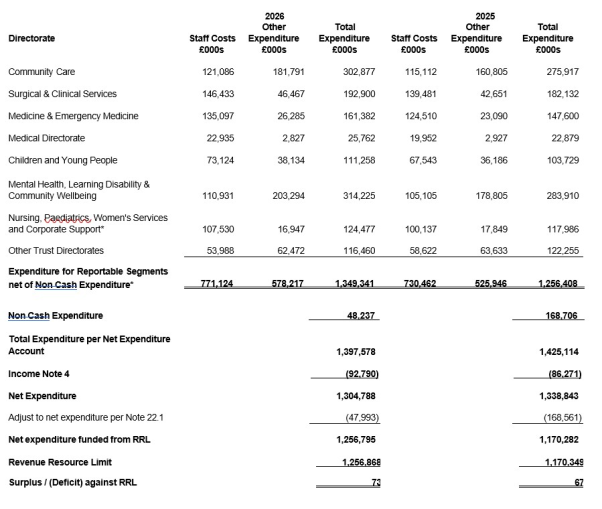
Costs are allocated to each of the individual Directorates based on similarity of the nature of service provided. Management accounts are also prepared by Directorates to aid decision making by the Board, which include key performance indicators such as:
- RRL budget forecast and breakeven targets;
- deliverables within funding programmes such as demography, Transformation and new service development;
- funded staffing levels;
- agency, bank and overtime staff costs;
- R&D targets; and
- SLAs for independent sector domiciliary care and private homes.
Community Care
- Community Teams including Eldercare and Physical Disability Social Work, District Nursing, Occupational Therapy and Treatment Rooms to GP Practices;
- Eldercare and Physical Disability Nursing Home, Residential Homes, Supported Living, Domiciliary, Respite and Day Care Services;
- Specialist and Community Palliative Care services;
- Community Beds including rehabilitation and step up/down; and
- AHP and Specialist Services including Podiatry, Specialist OT, Acute OT.
Surgical and Clinical Services
- General and Breast Surgery (including in-patient, days and endoscopy);
- Theatre and Anaesthetics;
- Gastroenterology, ENT and Audiology;
- Cancer and OPD Services;
- Dental services (including Community);
- Diagnostics and AHPs (including Pathology, Radiology and Physiotherapy); and
- Administrative support to all Acute Divisions.
Medicine and Emergency Medicine
- Emergency and Urgent Assessment pathways of care;
- Acute Medicine (including Hospital Social Work);
- Alternatives to admission and Ambulatory pathways (including Care of Elderly Stroke and Rehabilitation); and
- In Hospital Specialist Medical pathways (including Rheumatology, Cardiology, Renal, Endocrine, Neurology, Cardiology, Frail Elderly, Diabetes and Dietetics).
Medical Directorate
- Medical Management and Education;
- Decontamination Services;
- Pharmacy Clinical, Dispensing and Procurement Services;
- Regional Medicines Optimisation and Innovation Centre; and
- Governance including Clinical Audit, Complaints, Health and Safety and Risk Management.
Children and Young People
- Corporate Parenting including Adoption, Fostering, Family Support and Residential Services;
- Safeguarding and Family Support, Early Years Services and Disability Services including Respite;
- Early Intervention and CAMHS;
- Speech and Language Services to both Adults and Children;
- Other Services include Autism and Attention Deficit Hyperactivity Disorder (ADHD), Paediatric Occupational Therapy;
- Regional Sexual Assault and Referral Centre;
- Social Services and Training and Governance Unit; and
- Business and Governance support to Divisions.
Mental Health, Learning Disability and Psychological Services
- Acute Mental Health including Acute Learning Disability, Dementia and Addictions, Crisis Response Home Treatment and Mental Health Liaison to Antrim and Causeway Hospitals;
- Community Teams for Learning Disability, Adult Mental Health and Older People Mental Health including dementia service users;
- Specialist Services including Condition Management, Recovery College, Wellness, Wellbeing Hubs, OT, Forensic, Promote, Brain Injury, Personality Disorders and Eating Disorders services;
- Psychology Services including Learning Disability and Acute Health psychology;
- Community Health, Wellbeing and Planning; and
- Mental Health including Dementia and Learning Disability Nursing Homes, Residential Homes, Supported Living, Domiciliary Care, Respite, Adult Centre and Day Opportunity Services.
Nursing, Paediatrics, Women’s Services and Corporate Support
- Includes all Corporate Support Services to Hospitals and Community facilities (Catering, Domestic Services, Laundry, Portering and Transport);
- Includes all Acute and Community Health Services to children and adolescents including Paediatric Wards, Neo Natal unit, provision of complex health care support to children in the community;
- Corporate Nursing Services including Infection Control, Tissue Viability, Patient Pathways, Workforce and Practice Development;
- Maternity and Women’s Health including Community Midwifery Services;
- Specialist Services such as Family Planning and Sexual Health Services; and
- Health Visiting and School Nursing.
Other Trust Directorates
- Chief Executive’s Office;
- Infrastructure, Finance Directorate and Human Resources;
- Strategic Planning, Performance and ICT;
- Operations Directorate;
- Intermediate Care and Integrated Discharge; and
- Research and Development.
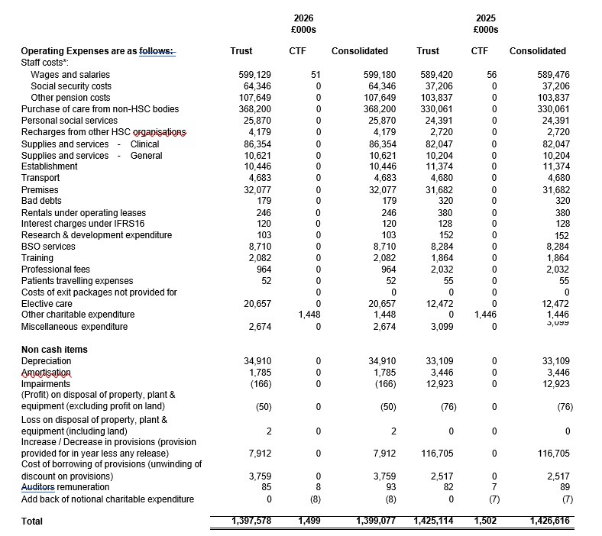
Note 3 Expenditure
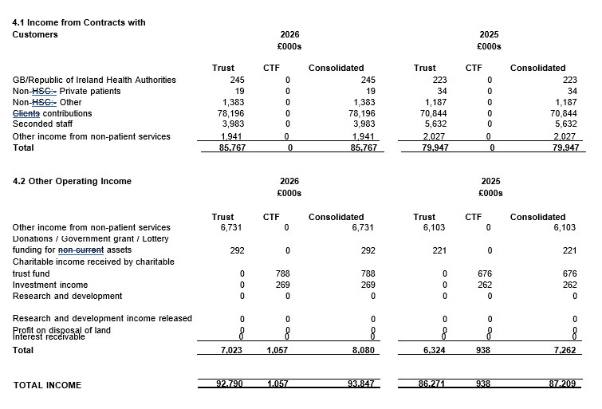
Note 4 Income
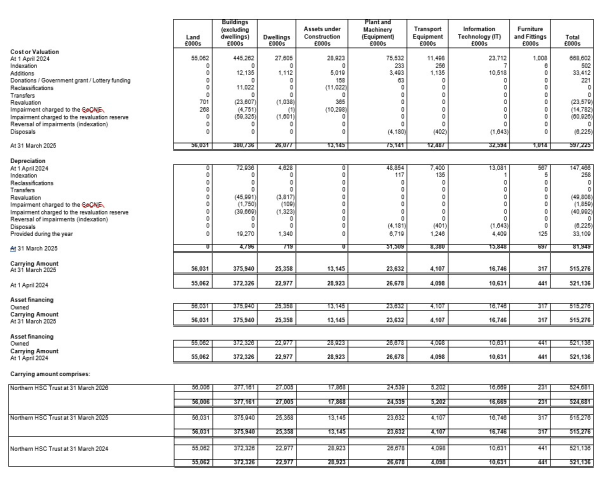
Note 5.2 Trust and Consolidated Property, plant & equipment – year ended 31 March 2025
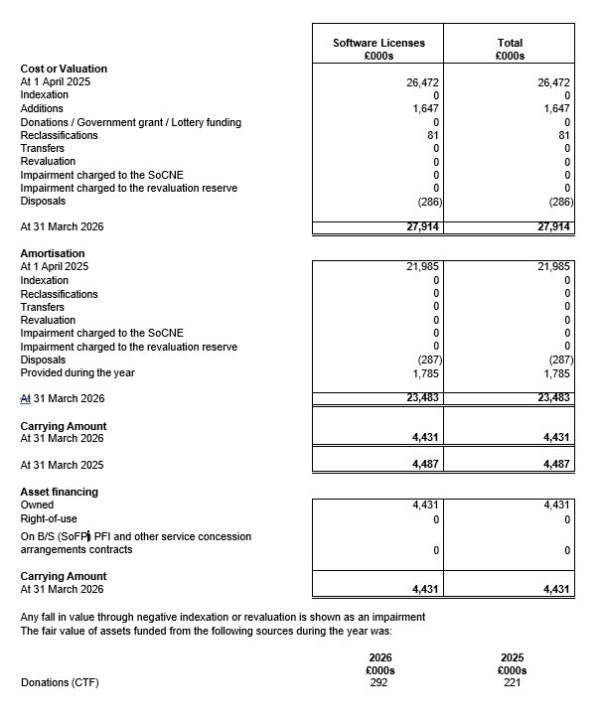
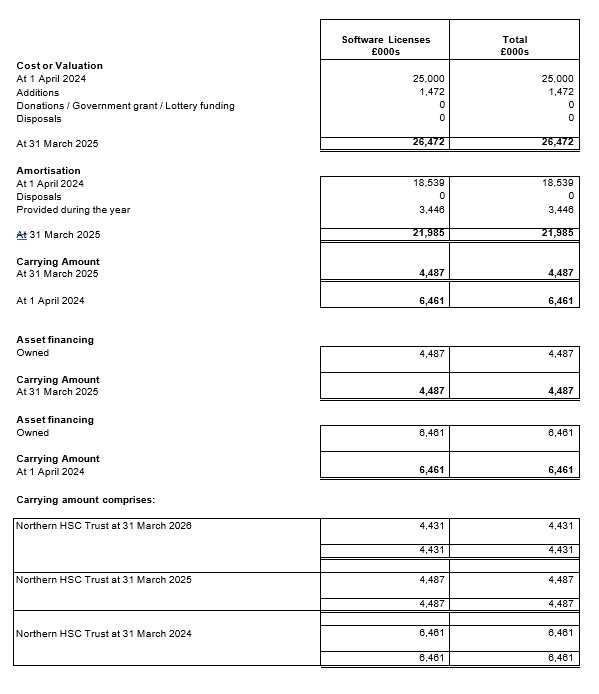
Note 6.1 Trust and Consolidated Intangible assets – year ended 31 March 2026
Note 6.2 Trust and Consolidated Intangible assets – year ended 31 March 2025
Note 7 Financial instruments
As the cash requirements of NHSCT are met through Grant-in-Aid provided by the Department of Health, financial instruments play a more limited role in creating and managing risk than would apply to a non-public sector body. The majority of financial instruments relate to contracts to buy non-financial items in line with the Northern Health and Social Care Trust’s expected purchase and usage requirements and the Trust is therefore exposed to little credit, liquidity or market risk.
Please note that the investments shown below relate to Charitable Trust Funds.
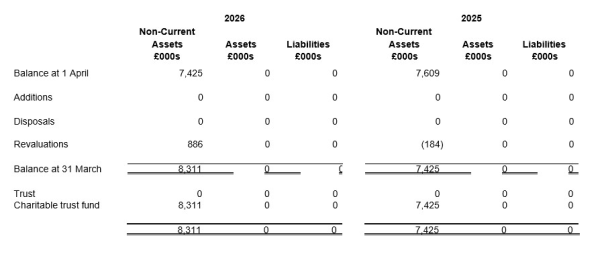
The only other financial instruments held by the Trust as at 31 March 2026 are trade receivables, cash and trade payables. Details of these can be seen in Notes 12 – 14 respectively. The situation also applied in 2024/25.
Note 8 Investments and loans
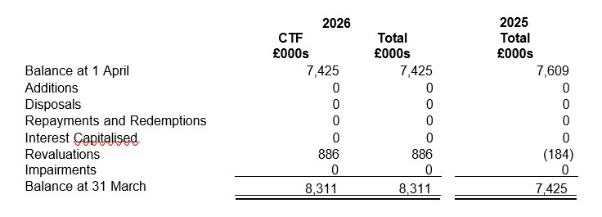
The balance is represented by Non Current Assets of £8,311 (2025/25: £7,425) and Current Assets of £nil (2024/25: £nil)
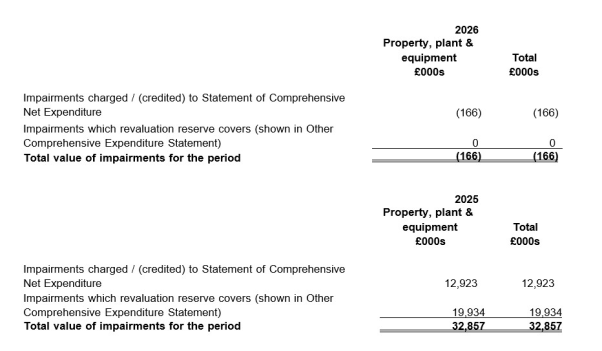
Note 9 Impairments
Note 10 Assets classified as held for sale
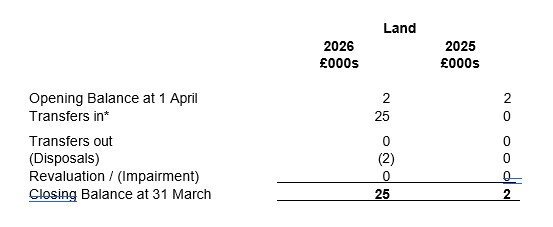
Non current assets held for sale comprise non current assets that are held for resale rather than for continuing use within the business.
* The amount disclosed in 2025/26 refers to one land asset at the following site: Holywell Reservoir. The MUH Laneway was disposed of in year.
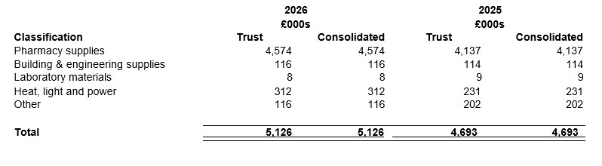
Note 11 Inventories
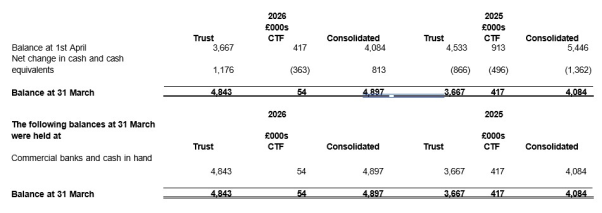
Note 12 Cash and cash equivalents
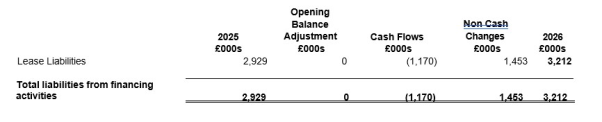
Note 12.1 Reconciliation of liabilities arising from financial activities
Note 13 Trade receivables, financial and other assets
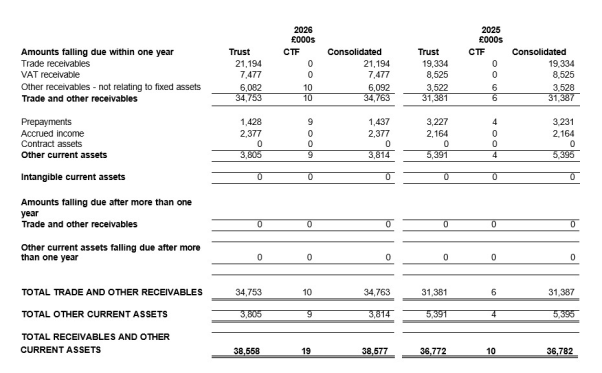
The balances are net of a provision for bad debts of £3,624k (2024/25 £3,038k)
Note 14 trade payables, financial and other liabilities
14.1 Trade payables and other current liabilities
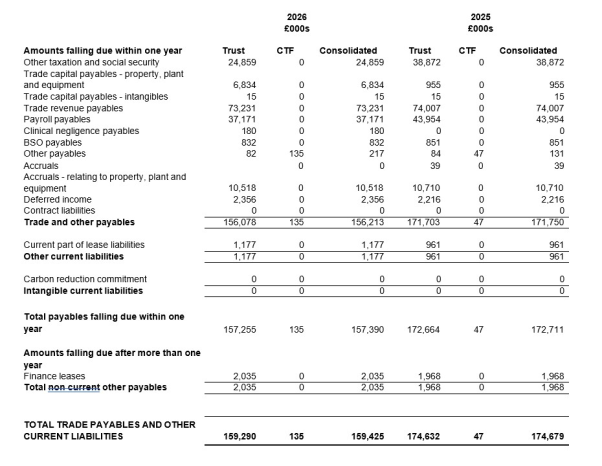
The Trust did not have any loans payable at either 31 March 2026 or 31 March 2025.
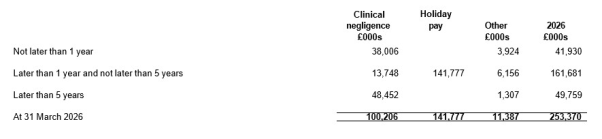
Note 15 provisions for liabilities and charges – 2026
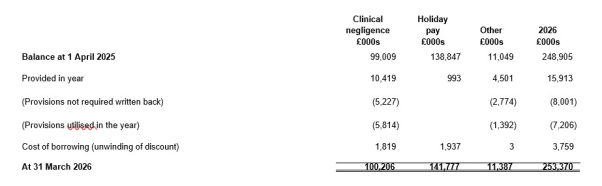
Provisions have been made for 7 types of potential liability: Clinical Negligence, Employer’s and Occupier’s Liability, Injury Benefit, Employment Law, Holiday Pay, Pay Modernisation and Senior Executive’s pay.
The provision for Injury Benefit relates to the future liabilities for the Trust based on information provided by the HSC Pension Branch. For Clinical Negligence, Employer’s and Occupier’s claims and Employment Law the Trust has estimated an appropriate level of provision, for each individual case, based on professional legal advice with Periodic Payment Order (PPO) calculations based on estimated life expectancy data provided by professional legal advisors.
For Holiday Pay the Trust has estimated an appropriate level of provision on the basis of the duration of the claims and the application of a regionally agreed estimated payment percentage of the total expenditure incurred on affected allowances. The total liability to be provided isestimated as £142m for NHSCT.
Clinical Negligence
Where a finding of clinical negligence has been made, the Trust has relied on professional legal advice to estimate an appropriate level of provision, for each individual case, with Periodic Payment Order (PPO) calculations based on estimated life expectancy data.
A discount rate is applied by courts to a lump-sum award of damages for future financial loss in a personal injury case, to take account of the return that can be earned from investment. In accordance with the provisions of Schedule C1 to the Damages Act 1996, the Government Actuary has reviewed the discount rate for Northern Ireland and determined that the rate should be +0.5% with effect from 27 September 2024, having previously been set at -1.5% from 22 March 2022. The next planned review of the rate will commence in July 2029. Estimated settlement values provided by DLS as at 31 March 2026 wholly reflect the updated rate where applicable.
Holiday Pay Liability
On 4 October 2023, the Supreme Court handed down the decision in the case of the Chief Constable of the PSNI v Agnew and others. The judgment confirmed that the claimants are able to bring their claims under the ‘unlawful deductions’ provisions of the Employment Rights (Northern Ireland) Order 1996 and can thus claim in respect of a series of deductions potentially going back to the beginning of their employment or the implementation of the Working Time Regulations in 1998.
At the point that the Supreme Court judgment was provided, the PSNI had accepted the principle, established by a number of cases in both the European and domestic courts, that the claimants were entitled to be paid their normal pay during periods of annual leave, and that “normal pay” is not limited to basic pay but could include elements such as overtime, commission and allowances.
The outcome of this case has widespread implications for all public sector bodies in Northern Ireland in respect of both the pay elements that must be included in holiday pay calculations and the period of retrospection which means that some employees may be able to bring claims to be rectified as far back as 1998 in respect of holiday pay. Under Agenda for Change, the contractual provisions for Sick Pay mirror those for Holiday Pay i.e. payment includes what would have been paid had the employee been in work.
With effect from 1 April 2025, HSC employers have implemented an interim arrangement for the calculation of holiday pay to ensure employees are paid appropriately for periods of annual leave. This interim solution also covers periods of sick leave. This interim arrangement has been agreed with trade unions pending the introduction of the new HR and payroll system in 2026/27. However a provision in respect of the retrospective payment for holiday pay is still required for the period 1998/99 to 2024/25. The Trust provision at 31 March 2026 reflects this retrospective time frame.
In calculating the provision, the Trust has used payroll data available, for all eligible staff, within the current HRPTS system back to 2014 with averaging applied for the prior years and changes in staffing numbers. Actual staffing numbers are available for 2012/13. Staffing numbers prior to this have been estimated based on an assumed 1% increase per annum.
Revised Working Time Directive (14.5%) and Employer costs rates have been factored in, and compound interest applied. A settlement year of2028/29 has been used and as such the overall value of the provision has been discounted to determine the net present value
The key areas of uncertainty include:
- The reliability of the data used;
- The terms of the settlement which is subject to a number of factors including:
- the determination of a very significant number of cases currently progressing through the Industrial Tribunal;
- the number of further Industrial Tribunal claims lodged by employees;
- any settlement of these claims agreed with the claimants or their legal representatives;
- the number of grievances already lodged by employees in respect of the underpayment/incorrect payment of holiday pay and sick pay which requires to be resolved and any settlement negotiations with trade unions;
- the number of further grievances received; and
- any potential requirements to include additional numbers of employees within any settlement;
- The uptake rate for current or past employees;
- The extent of attrition in the workforce
- Delays in the time it will take to administer the payments, once agreed; and
- The extent to which interest will apply.
A sensitivity analysis has been undertaken to determine how sensitive the total provision is to changes in a number of the assumptions. This analysis will support management in making informed decision in respect of any final settlement.
The sensitivity analysis in respect of likely uptake rate has been applied based on the frequency of staff claims in prior years; applying a threshold of 6 claims per year to reflect a regular pattern of occurrence, and 4 claims per year reflecting a lower frequency of occurrence.
The calculation of the holiday pay and sick pay provision is sensitive to the rates applied in respect of Working Time Directive, Employers National Insurance and compound interest, as well as the potential uptake in claimants. The table below shows the potential impact of varying applicable rates.
| Analysis | Impact | |
|---|---|---|
| £’m | % | |
| WTD rate – increase 1% | 10.04 | 6.90% |
| WTD rate – decrease 1% | -10.04 | -6.90% |
| NIC rate – increase 1% | 1.25 | 0.86% |
| NIC rate – decrease 1% | -1.25 | -0.86% |
| Compound Interest rate – increase 1% | 24.38 | 16.74% |
| Compound Interest rate – decrease 1% | -20.39 | -14% |
| Uptake based on minimum 6 Claims per annum | -36.56 | -25% |
| Uptake based on minimum 4 Claims per annum | -18.94 | -13% |
Pay Modernisation and Senior Executive Pay
A number of staff have challenged the banding of their job and the Trust has reflected any anticipated liability as a mix of accruals and provisions on the basis of actions and outcomes in-year in individual cases and their consequential impacts.
Senior HSC Executives raised a legal challenge to their pay arrangements. The DoH introduced a Senior Executive Pay Structure Reform during 2024-25 which impacted all senior executives in post as at 1 April 2023. A provision remains for non-current Senior Executives due to the ongoing legal challenge. The value of this provision remains at £228k in 2025/26.
Comprehensive Net Expenditure Account charges
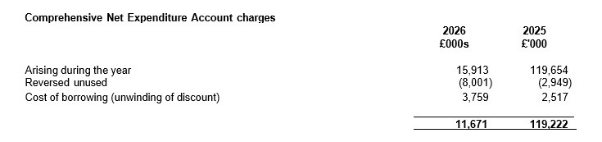
Analysis of expected timing of discounted flows
Note 15 provisions for liabilities and charges – 2025
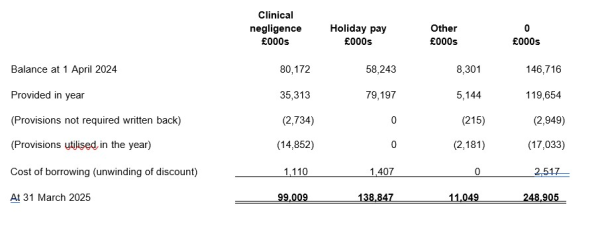
Provisions have been made for 4 types of potential liability: Clinical Negligence, Employer’s and Occupier’s Liability, Injury Benefit and Employment Law. The provision for Injury Benefit relates to the future liabilities for the Trust based on information provided by the HSC Pension Branch. For Clinical Negligence, Employer’s and Occupier’s claims and Employment Law the Trust has estimated an appropriate level of provision, for each individual case, based on professional legal advice with
PPO calculations based on estimated life expectancy data provided by professional legal advisors.
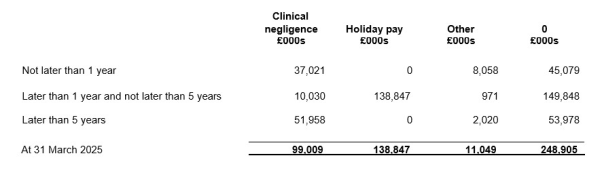
Analysis of expected timing of discounted flows
Note 16 capital and other commitments
Note 16.1 Capital Commitments
Contracted capital commitments at 31 March 2026 not otherwise included in these financial statements are:

Note 16.2 other financial commitments
The Trust did not have any other financial commitments at either 31 March 2026 or 31 March 2025
Note 17 Leases
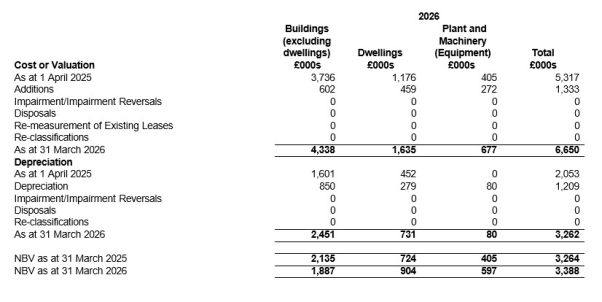
17.1 Quantitative disclosures around right of use assets
17.2 Quantitative disclosures around lease liabilities
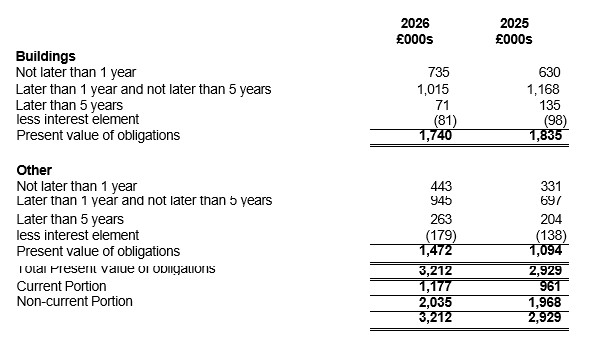
17.3 Quantitative disclosures around elements in the Statement of Comprehensive Net Expenditure
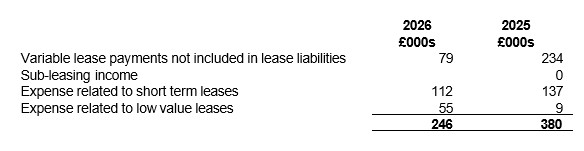
17.4 Quantitative disclosures around cash outflow for leases

Note 18 commitments under PFI contracts and other service concession arrangements
18.1 Off balance sheet PFI contracts and other service concession arrangements
The Trust had no off balance sheet (SoFP) PFI and other service concession arrangements schemes in 2025/26 and 2024/25.
18.2 On balance sheet (SoFP) PFI Schemes
The Trust had no on balance sheet (SoFP) PFI contracts and other service concession arrangements in 2025/26 and 2024/25.
Note 19 Contingent Liabilities
Material contingent liabilities are noted in the table below, where there is a 50% or less probability that a payment will be required to settle any possible obligations. The amounts or timing of any outflow will depend on the merits of each case.
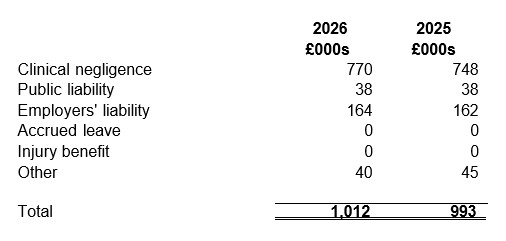
Unquantifiable Contingent Liabilities Clinical Excellence Awards
The Clinical Excellence scheme recognised the contribution of consultants who show commitment to achieving the delivery of high quality care to patients and to the continuous improvement of Health
and Social Care. There were 12 levels of award; lower awards (steps 1-8 were made by local (employer) committees, and higher awards were recommended by the Northern Ireland Clinical Excellence Awards Committee (NICEAC). Self-nomination was, however, the only method of application within the scheme. After consultations, the Department of Health (DoH) decided that from the 2013/14 awards round and onwards, no new clinical excellence awards (higher or lower) would be made to medical and dental consultants. This decision has been subject to legal challenge. An agreement
was reached through mediation for the design and implementation of a future scheme. A public consultation was carried and DoH are currently considering the response. Any scheme will require Ministerial approval. Whilst the current litigation has been paused, it has not been withdrawn, and therefore the legal case has continued to be treated as a contingent liability at 31 March 2026.
At this stage, it is not possible to determine the amount and timing of the financial impact, if any.
Employment Tribunals
HSC Trusts may have open Tribunal Cases where a liability has not yet been established and cannot be quantified at this stage.
Holiday Pay Liability
The Trust has made provision of the potential liability, back to 1998, for claims for shortfalls to staff in holiday pay, and for breach of contract in relation to sick pay. However, the extent to which the liability may exceed this amount remains uncertain as the calculation will rely on the outworkings of the Supreme Court judgment, and will be agreed as part of any negotiated settlement with Trade Unions.
Public Sector Pensions – Injury to Feelings Claims
The Department of Finance (DoF) is a named Respondent in a class action affecting employers across the public sector and is managing claims on behalf of the Northern Ireland Civil Service (NICS) Departments. This is an extremely complex case with potential implications for the NICS and wider public sector. However, given the complexities, the cases are still at an early stage of proceedings and until there is further clarity on potential scope and impact, a reliable estimate of liability cannot be provided.
Note 19.1 Financial Guarantees, Indemnities and Letters of Comfort
The Trust has not entered into any quantifiable guarantees, indemnities or provided any letters of comfort.
Note 20 related party transactions
The Trust is required to disclose details of transactions with individuals who are regarded as related parties, consistent with the requirements of IAS 24 – Related Party Transactions. A Trust Board Register of Interests is maintained by the Office of the Chief Executive and is available for inspection online by members of the public at the following link: https://www.northerntrust.hscni.net/ registerofinterests
During the year, the Trust entered into the following material transactions with the following related parties.
HSC Bodies
The Trust is an ALB of DoH, and as such the DoH is a related party and the ultimate controlling parent, with which the Trust has had various material transactions during the year. During 2025/26, the Trust has also had a number of material transactions with other entities for which the DoH is regarded as the ultimate controlling parent. These entities include the five HSCTs, BSO, SPPG, PHA, RQIA and NIAS.
Non-Executive Directors
Some of the Trust’s Non-Executive Directors have disclosed interests with organisations which the Trust purchased services from or supplied services to during 2025/26. Set out below are details of the amount paid to these organisations during 2025/26. In none of these cases listed did the Non-Executive Director have any involvement in the decisions to procure the services from the organisation concerned.
| 2025/26 | Service Provided by Organisation | Payments to Related Party
£000s |
Income from Related Party
£000s |
Amounts owed to Related Party
£000s |
Amounts due from Related Party
£000s |
|---|---|---|---|---|---|
| NISCC | Northern Ireland Social Care Council | 1 | 0 | 0 | 0 |
Interests in the above organisations were declared by the following Board members:
Carol Diffin (Non-Executive Director since 18 December 2023) has been appointed as a Non-Executive Director to NISCC since May 2025.
| 2024/25 | Service Provided by Organisation | Payments to Related Party
£000s |
Income from Related Party
£000s |
Amounts owed to Related Party
£000s |
Amounts due from Related Party
£000s |
|---|---|---|---|---|---|
| Action Mental Health | Mental Health Charity | 330 | 0 | 0 | 0 |
Carol Diffin (Non-Executive Director since 18 December 2023) has a family member who was a Board Member of Action Mental Health until June 2024.
Transactions with these related parties are conducted on an arm’s length basis. The purchase of goods and services are subject to the normal tendering processes under Northern Ireland Public Procurement Policy, Trust Standing Orders and Trust Standing Financial Instructions. There are no provisions for doubtful debts against the related party balances owed. In addition, the Trust has not provided or received financial guarantees in respect of related parties identified.
Other Board Members and Senior Managers
In a similar way, some other Trust Board members and Senior Managers have disclosed interests in organisations from which the Trust purchase services, in 2025/26. The details are set out below.
Again, the officers listed had no involvement in the decisions to procure the services from the organisations concerned.
| 2025/26 | Service Provided by Organisation | Payments to Related Party
£000s |
Income from Related Party
£000s |
Amounts owed to Related Party
£000s |
Amounts due from Related Party
£000s |
|---|---|---|---|---|---|
| Healthcare Financial Management Association | Healthcare Financial Management and Governance Representative Group | 1 | 0 | 0 | 0 |
| Healthcare People Management Association | Healthcare People Management Association Group | 3 | 0 | 0 | 0 |
Interests in the above organisations were declared by the following Board members:
Owen Harkin (Executive Director of Finance and Deputy Chief Executive) is a member of the Board of Trustees of Healthcare Financial Management Association.
Jacqui Reid (Director of Human Resources, Organisation Development and Corporate Communications) is Chair of the Healthcare People Management Association Group.
| 2024/25 | Service Provided by Organisation | Payments to Related Party
£000s |
Income from Related Party
£000s |
Amounts owed to Related Party
£000s |
Amounts due from Related Party
£000s |
|---|---|---|---|---|---|
| Healthcare Financial Management Association | Healthcare Financial Management and Governance Representative Group | 14 | 0 | 0 | 0 |
| Healthcare People Management Association | Healthcare People Management Association Group | 3 | 0 | 0 | 0 |
Note 21 third party assets
The Trust held £9,234k investments and cash at bank and in hand at 31 March 2026, which relate to monies held by the Trust on behalf of patients. This has been excluded from the cash at bank and in hand amounts reported in the accounts. A separate audited account of these monies is maintained by the Trust (presented on page 168).
Note 22 financial performance targets
Organisations are allocated a Revenue Resource Limit (RRL) and a Capital Resource Limit (CRL) and must contain spending within these limits.
The resource limits for a body may be a combination of agreed funding allocated by commissioners, the Department of Health, other Departmental bodies or other departments.
Bodies are required to report on any variance from the limit as set which is a financial target to be achieved and not part of the accounting system.
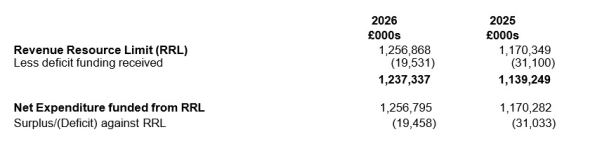
22.1 Revenue Resource Limit (RRL)
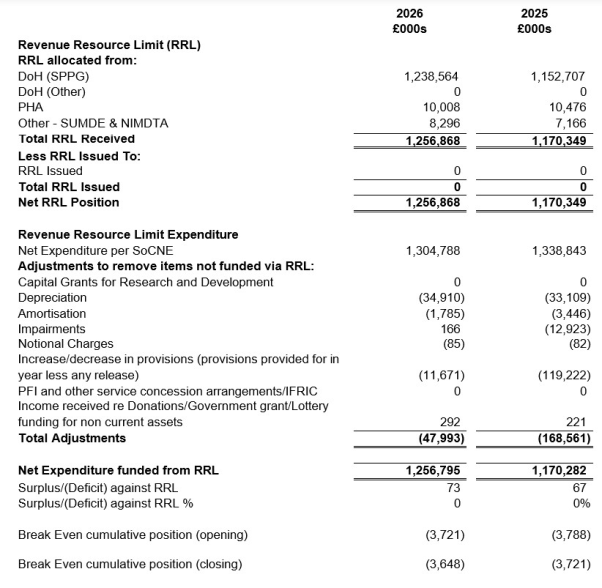
Materiality Test:
The Trust is required to ensure that is breaks even on an annual basis by containing its net expenditure to within 0.25% of RRL limits

The Trust has remained within the budget control limits it was issued.
Financial Performance Targets less Deficit Funding
For the year ended 31 March 2026 the Trust received non recurrent funding from the Department of Health to address the deficit held by the Trust
22.2 Capital Resource Limit
The Trust is given a Capital Resources Limit (CRL) which it is not permitted to overspend.
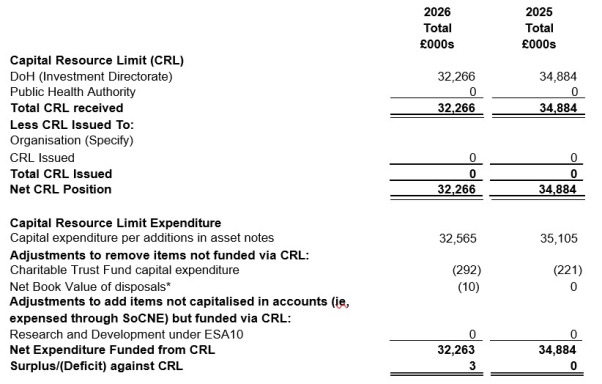
* Receipts from sales will be the lower of the NBV of the asset and the net sale proceeds.
Note 23 events after the reporting period
There are no events after the reporting period having a material effect on the accounts. Date of authorisation for issue
The Accounting Officer authorised these financial statements for issue on 30 June 2026.
Northern Health and Social Care Trust – Patients’ and Residents’ Monies
The certificate and report of the Comptroller and Auditor General to the Northern Ireland Assembly
Opinion on account
I certify that I have audited Northern Health and Social Care Trust’s (NHSCT) account of monies held on behalf of patients and residents for the year ended 31 March 2026 under the Health and Personal Social Services (Northern Ireland) Order 1972, as amended.
In my opinion the account:
- properly presents the receipts and payments of the monies held on behalf of the patients and residents of NHSCT for the year ended 31 March 2026 and balances held at that date; and
- the account has been properly prepared in accordance with the Health and Personal Social Services (Northern Ireland) Order 1972, as amended and Department of Health directions issued thereafter.
Opinion on regularity
In my opinion, in all material respects the financial transactions recorded in the account statements conform to the authorities which govern them.
Basis for opinions
I conducted my audit in accordance with International Standards on Auditing (ISAs) (UK), applicable law and Practice Note 10 ‘Audit of Financial Statements and Regularity of Public Sector Bodies in the United Kingdom’. My responsibilities under those standards are further described in the Auditor’s responsibilities for the audit of the account section of my certificate.
My staff and I are independent of NHSCT in accordance with the ethical requirements that are relevant to my audit of the financial statements in the UK, including the Financial Reporting Council’s Revised Standard, and have fulfilled our other ethical responsibilities in accordance with these requirements.
I believe that the audit evidence obtained is sufficient and appropriate to provide a basis for my opinions.
Conclusions relating to going concern
In auditing the financial statements, I have concluded that NHSCT’s use of the going concern basis of accounting in the preparation of the financial statements for the monies held on behalf of the patients and residents is appropriate.
Based on the work I have performed, I have not identified any material uncertainties relating to events or conditions that, individually or collectively, may cast significant doubt on NHSCT’s ability to continue as a going concern for a period of at least twelve months from when the financial statements are authorised for issue.
My responsibilities and the responsibilities of the Accounting Officer with respect to going concern are described in the relevant sections of this certificate.
Matters on which I report by exception
I have nothing to report in respect of the following matters which I report to you if, in my opinion:
- properly presents the receipts and payments of the monies held on behalf of the patients and residents of NHSCT for the year ended 31 March 2026 and balances held at that date; and
- the account has been properly prepared in accordance with the Health and Personal Social Services (Northern Ireland) Order 1972, as amended and Department of Health directions issued thereafter.
Responsibilities of the Trust for the account
As explained more fully in the Statement of Trust’s Responsibilities in relation to patients’/residents’ monies, NHSCT is responsible for:
- maintaining proper accounting records;
- the preparation of the account in accordance with the applicable financial reporting framework and for being satisfied that they properly present the receipts and payments of the monies held on behalf of the patients and residents;
- ensuring such internal controls are in place as deemed necessary to enable the preparation of financial statements to be free from material misstatement, whether due to fraud or error; and
- assessing NHSCT’s ability to continue as a going concern, disclosing, as applicable, matters related to going concern and using the going concern basis of accounting unless the Trust anticipates that the services provided by the Northern Health and Social Care Trust for the monies held on behalf of the patients and residents will not continue to be provided in the future.
Auditor’s responsibilities for the audit of the account
My responsibility is to examine, certify and report on the financial statements in accordance with the Health and Personal Social Services (Northern Ireland) Order 1972, as amended.
My objectives are to obtain reasonable assurance about whether the financial statements as a whole are free from material misstatement, whether due to fraud or error and to issue a certificate that includes my opinion. Reasonable assurance is a high level of assurance but is not a guarantee that
an audit conducted in accordance with ISAs (UK) will always detect a material misstatement when it exists. Misstatements can arise from fraud or error and are considered material if, individually or in the aggregate, they could reasonably be expected to influence the economic decisions of users taken on the basis of these financial statements.
I design procedures in line with my responsibilities, outlined above, to detect material misstatements in respect of non-compliance with laws and regulation, including fraud.
My procedures included:
- obtaining an understanding of the legal and regulatory framework applicable to NHSCT for the monies held on behalf of the patients and residents through discussion with management and application of extensive public sector accountability The key laws and regulations I considered included the Health and Personal Social Services (Northern Ireland) Order 1972, as amended;
- making enquires of management and those charged with governance on NHSCT’s compliance with laws and regulations;
- making enquiries of internal audit, management and those charged with governance as to susceptibility to irregularity and fraud, their assessment of the risk of material misstatement due to fraud and irregularity, and their knowledge of actual, suspected and alleged fraud and irregularity;
- completing risk assessment procedures to assess the susceptibility of NHSCT’s Patients’ and Residents’ Monies’ financial statements to material misstatement, including how fraud might This included, but was not limited to, an engagement director led engagement team discussion on fraud to identify particular areas, transaction streams and business practices that may be susceptible to material misstatement due to fraud.
- engagement director oversight to ensure the engagement team collectively had the appropriate competence, capabilities and skills to identify or recognise non-compliance with the applicable legal and regulatory framework throughout the audit;
- designing audit procedures to address specific laws and regulations which the engagement team considered to have a direct material effect on the financial statements in terms of misstatement and irregularity, including These audit procedures included, but were not limited to, reading board and committee minutes, and agreeing financial statement disclosures to underlying supporting documentation and approvals as appropriate; and
- addressing the risk of fraud as a result of management override of controls by:
- performing analytical procedures to identify unusual or unexpected relationships or movements;
- testing journal entries to identify potential anomalies, and inappropriate or unauthorised adjustments;
- assessing whether judgements and other assumptions made in determining accounting estimates were indicative of potential bias; and
- investigating significant or unusual transactions made outside of the normal course of business.
A further description of my responsibilities for the audit of the financial statements is located on the Financial Reporting Council’s website www.frc.org.uk/auditorsresponsibilities. This description forms part of my certificate.
In addition, I am required to obtain evidence sufficient to give reasonable assurance that the income and expenditure recorded in the financial statements have been applied to the purposes intended by the Assembly and the financial transactions recorded in the financial statements conform to the authorities which govern them.
Report
I have no observations to make on these financial statements.
- Dorinnia Carville, Comptroller and Auditor General, Northern Ireland Audit Office,, Northern Ireland Audit Office 106 University Stree, Belfast, BT7 1EU, 30 June 2026
Statement of Trust’s responsibilities in relation to patients’ / residents’ monies
Under the Health and Personal Social Services (Northern Ireland) order 1972 (as amended by Article 6 of the Audit and Accountability (Northern Ireland) order 2003, the Trust is required to prepare and submit accounts in such form as the Department of Health may direct.
The Trust is also required to maintain proper and distinct accounting records and is responsible for safeguarding the monies held on behalf of patients / residents and for taking reasonable steps to prevent and detect fraud and other irregularities.
Year Ended 31 March 2026
Account of monies held on behalf of patients / residents
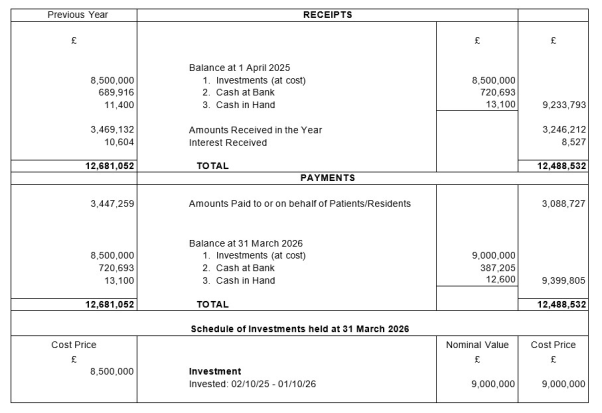
I certify that the above account has been compiled from and is in accordance with the accounts and financial records maintained by the Trust.
- Stephen Lennon, Interim Director of Finance, 25 June 2026
I certify that the above account has been submitted to and duly approved by the Board.
- Suzzane Pullins, Interim Chief Executive, 25 June 2026
Glossary
| Acronym | Meaning |
|---|---|
| AAH | Antrim Area Hospital |
| ACOMHS | Accreditation for Community Mental Health Services |
| ACP | Anticipatory Care Planning |
| ADHD | Attention Deficit Hyperactivity Disorder |
| ADOS | Autism Diagnostic Observation |
| AFC | Agenda For Change |
| AHPs | Allied Health Professionals |
| AIAO | Assistant Information Asset Owner |
| ALB | Arm’s Length Body |
| APP | (Software) Application |
| APPT | Accreditation Programme for Psychological Therapies |
| ARK | Antibiotic Review Kit |
| ASD | Autistic Spectrum Disorder
|
| ASSIST | Advice Support Services and Initial Screening Team Belfast Health and Social Care Trust |
| BHSCT | Belfast Health and Social Care Trust
|
| BPAS | British Pregnancy Advisory Service |
| BSO | Business Services Organisation |
| CAF | Cyber Assessment Framework |
| CAMHS | Child and Adolescent Mental Health Services |
| CARE | Career Average Revalued Earnings |
| CARF | Commission on Accreditation of Rehabilitation Facilities |
| CAS | Controls Assurance Standard |
| CCG | Clinical Communication Gateway
|
| CDF | Cancer Drugs Fund |
| CDI | Clostridium Difficile |
| CETV | Cash Equivalent Transfer Value |
| CFPS | Counter Fraud and Probity Service |
| CO2 | Carbon Dioxide |
| COMAH | Control of Major Accident Hazards |
| COVID-19 | Disease caused by a new strain of coronavirus. CO stands for corona, VI for virus, D for disease |
| CPAP | Continuous Positive Airway Pressure |
| CSE | Customer Service Excellence |
| CT | Computerised Tomography |
| CTF | Charitable Trust Funds |
| DAU | Direct Assessment Unit |
| DfE | Department for the Economy |
| DoH | Department of Health |
| DoF | Department of Finance |
| DoL | Deprivation of Liberty |
| EA | Education Authority |
| ED | Emergency Department |
| EDI | Equality, Diversity and Inclusion |
| EEEEG | Equality, Engagement, Experience and Employment Group |
| ENT | Ear, Nose and Throat |
| EPBC | Emergency Planning and Business Continuity |
| EPEX | Electronic Patient Explorer Software |
| ERT | Emergency Response Team |
| EOI | Expression of Interest |
| ESA | European System of Accounts |
| ESC | Emergency Support Centre |
| EU | European Union |
| FFP | Filtering Face Pieces |
| FLO | Fraud Liaison Officer |
| FPL | Finance, Procurement and Logistics System |
| FReM | Financial Reporting Manual |
| GDC | General Dental Council |
| GDPR | General Data Protection Regulation |
| GHG | Greenhouse Gas |
| GIRFT | Getting it Right First Time |
| GMC | General Medical Council |
| GNB | Gram Negative Bacilli |
| GP | General Practitioner |
| GSMA | Global System for Mobile Communications Association |
| HAGNBSI | Healthcare Associated Gram-negative Bloodstream Infections |
| HCAI | Healthcare Acquired Infection |
| HIA | Head of Internal Audit |
| HIP | Hospital Inspection Programme |
| HMRC/RTI | Her Majesty’s Revenue and Customs / Real Time Information |
| HPSS | Health and Personal Social Services |
| HR | Human Resources |
| HRPTS | Human Resources, Pay and Travel System |
| HSC | Health and Social Care |
| HSCB | Health and Social Care Board |
| HSCNI | Health and Social Care Northern Ireland |
| HSCT | Health and Social Care Trust |
| HSDU | Hospital Sterilisation and Decontamination Unit |
| HSENI | Health and Safety Executive Northern Ireland |
| IAA | Information Asset Administrators |
| IAO | Information Asset Owners |
| IAS | International Accounting Standards |
| IASB | International Accounting Standards Board |
| ICO | Information Commissioner’s Office |
| ICP | Integrated Care Providers |
| ICT | Information Communication Technology |
| ICU | Intensive Care Unit |
| IDDSI | International Diet Descriptors Standardisation Initiative |
| IFRS | International Financial Reporting Standards |
| IG | Information Governance |
| IIP | Investors in People |
| INDG | Industry Guidance |
| IPC | Infection Prevention and Control |
| IPCEHC | Infection Prevention and Control Environmental Hygiene Committee |
| IQI | Innovation and Quality Improvement |
| ISO | International Organisation for Standardisation |
| ITS | Information Technology Services |
| IVS | International Valuation Standards |
| JAG | Joint Advisory Group |
| JCVI | Joint Committee on Vaccination and Immunisation |
| KPI | Key Performance Indicator |
| LCG | Local Commissioning Group |
| LED | Light Emitting Diode |
| LGBTQ+ | Lesbian, Gay, Bisexual, Transgender, Queer/Questioning and Others |
| LPS | Land and Property Services |
| LTR | Light Touch Regime |
| MBRRACE | Mothers and Babies: Reducing Risk through Audits and Confidential Enquiries |
| MCA | Mental Capacity Act |
| MDT | Multi-Disciplinary Team |
| MHRA | Medicines and Healthcare Products Regulatory Agency |
| MOD | Ministry of Defence |
| MPMNI | Managing Public Money NI |
| MRI | Magnetic Resonance Imaging |
| MRSA | Methicillin-resistant Staphylococcus Aureus |
| MS | Multiple Sclerosis |
| MSK | Musculoskeletal |
| MSFM | Management Statement Financial Management |
| MUM | Maternity Unit Marvel |
| N/A | Not Applicable |
| NED | Non Executive Director |
| NEST | National Employment Saving Trust |
| NHS | National Health Service |
| NHSCT | Northern Health and Social Care Trust |
| NI | Northern Ireland |
| NIAO | Northern Ireland Audit Office |
| NIAS | Northern Ireland Ambulance Service |
| NICE | National Institute for Health and Care Excellence |
| NIEA | Northern Ireland Environment Agency |
| NIEPG | Northern Ireland Emergency Planning Group |
| NIHR | National Institutes of Health Research |
| NIMDTA | Northern Ireland Medical and Training Agency |
| NIPSO | NIPSO NI Public Services Ombudsman |
| NIS | Network and Information Systems Directive |
| NIV | Non-Invasive Ventilation |
| NMS | No More Silos |
| OCT | Outpatient COVID-19 Treatment Service |
| OD | Organisational Development |
| ONS | Office for National Statistics |
| OOP | Out of Programme |
| OPD | Out Patients Department |
| OT | Occupational Therapy/Therapist |
| PARIS | Primary Access Regional Information System |
| PACU | Post Anaesthetic Care Unit |
| PAS | Patient Administration System |
| PCC | Patient Client Council |
| PCE | Patient and Client Experience |
| PFI | Private Finance Initiative |
| PHA | Public Health Agency |
| PICU | Psychiatric Inpatient Care Unit |
| POC | Programme of Care |
| POPI | Processing of Personal Information for Managers |
| PPE | Personal Protective Equipment |
| PPI | Personal and Public Involvement |
| PRPS | Powered Respirator Protective Suit |
| PSNI | Police Service Northern Ireland |
| PSSC | Payroll Shared Services Centre |
| PSTN | Public Switched Telephone Network |
| PTS | Psychological Therapies Service |
| PTU | Programmed Treatment Unit |
| QI | Quality Improvement |
| QUADEG | Engagement, Experience, Equality and Employment Group |
| QUB | Queen’s University Belfast |
| RDC | Rapid Diagnosis Centres |
| REaCH | Responsive Education and Collaborative Health |
| RIBA | Royal Institute of British Architects |
| RICS | Royal Institution of Chartered Surveryors |
| RIDDOR
|
Reporting of Injuries, Diseases and Dangerous Occurrences Regulations |
| R&D
|
Research & Development |
| RQIA | Regulation and Quality Improvement Authority |
| RRL | Revenue Resource Limit |
| RSS | Recruitment Shared Service |
| SAFER | Seen, Aim, Flow, Early Discharge and Recovery |
| SAI | Serious Adverse Incident |
| SAS | Specialty and Associate Specialists |
| SAZ | Safe Access Zones |
| SBA | Service and Budget Agreement |
| SCPB | Social Care Procurement Board |
| SDAC | Same Day Acute Care |
| SDP | Service Delivery Plan |
| SGS | General Society of Surveillance |
| SIEM | Security Information and Event Management |
| SIP | Session Initiation Protocol |
| SIRO | Senior Information Risk Owner |
| SKIN | Surface, Skin Inspection, Keep Moving, Incontinence and Nutrition |
| SLA | Service Level Agreement |
| SLT | Speech and Language Therapy |
| SMT | Senior Management Team |
| SOC | Security Operations Centre |
| SPPG | Strategic Planning and Performance Group |
| SQN | Safety Quality North |
| SQR | Safety Quality Reminder |
| SQSD | Safety Quality Standards |
| SRH | Sexual Reproductive Health |
| SSNAP | Sentinel Stroke National Audit Programme |
| STIQI | Service Transformation and Innovation and Quality Improvement |
| TDP | Trust Delivery Plan |
| UK | United Kingdom |
| UNICEF | United Nations Children’s Fund |
| USC | Urgent Suspected Cancer |
| UV | Ultraviolet |
| VAT | Value Added Tax |
| VSP` | Vague Symptom Pathway |
| WEEE | Waste Electrical and Electronic Equipment |
| WLI | Waiting List Initiative |
| WTE | Whole Time Equivalent |